
Prepared by Dr. Terziler Exclusive Clinic · Sources checked 6 November 2026
Yes. Hair loss has been reported during GLP-1 treatment, and some weight-management trials recorded it more often with the medicine than with placebo. Rapid weight loss and reduced food intake can trigger temporary shedding, but they do not explain every case. A direct drug effect has not been established or excluded for every medicine and patient. The useful next step is to identify the type of hair loss and review it with your prescriber. [1][2][14]
“Ozempic hair loss” is often used to describe several different situations: extra hair in the shower, a widening part, a smaller ponytail or hair that breaks more easily. Those observations need different explanations. A new prescription is part of the history; it is not a diagnosis of what is happening on your scalp.
GLP-1 stands for glucagon-like peptide-1, a hormone involved in appetite and blood-glucose regulation. Medicines that act on this pathway are used for particular metabolic conditions. Tirzepatide also acts on GIP receptors; this is why it is described as a dual GIP/GLP-1 receptor agonist. [3][4]
Which question would you like to explore?
What should I do if my hair starts shedding on a GLP-1?
Contact your prescriber and arrange a scalp assessment if the change is persistent, visible or worrying. Bring your medication details, weight history and any older photographs. Do not stop, reduce or switch a prescribed medicine on your own because your hair is shedding.
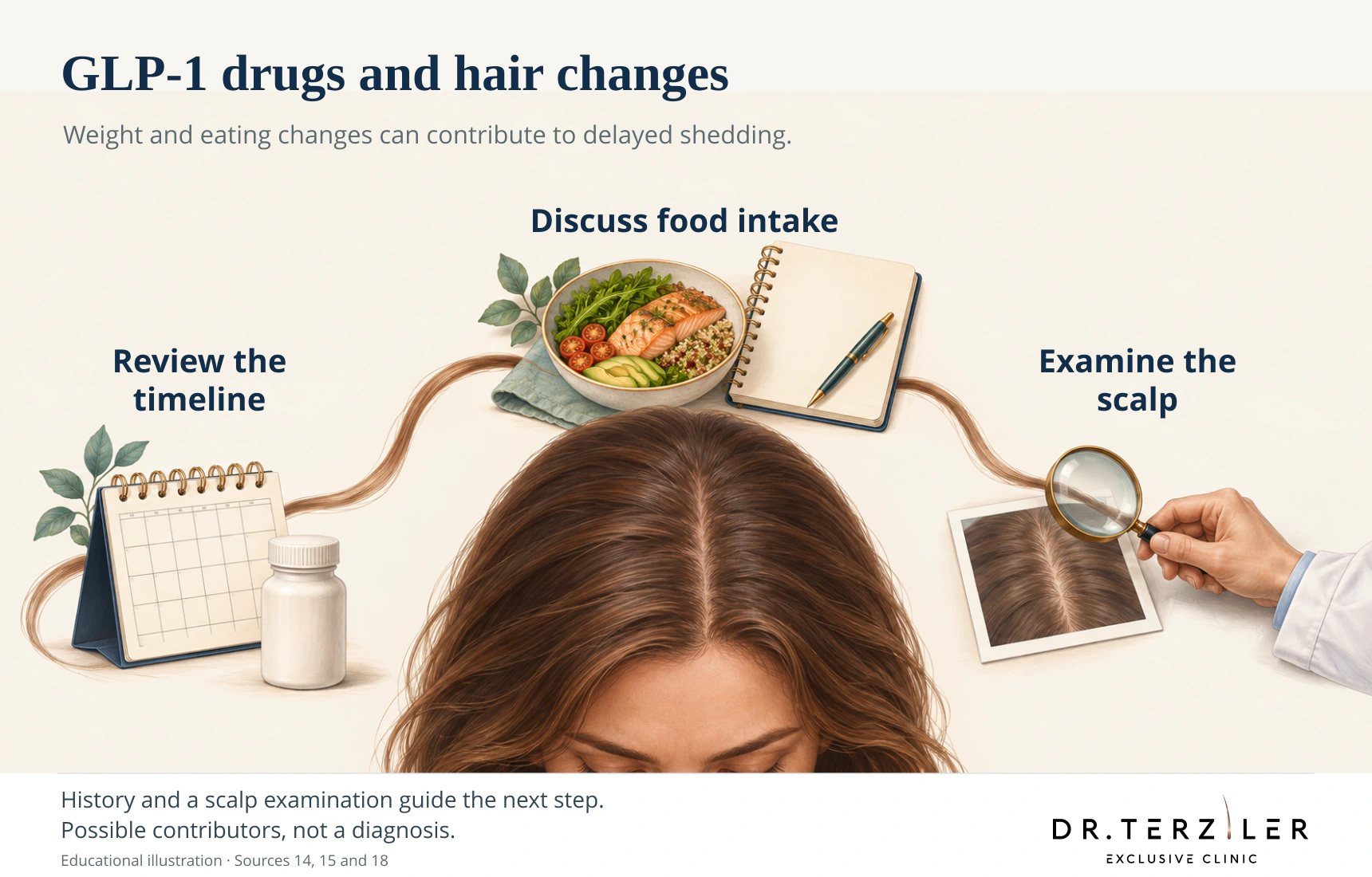
Your next step depends partly on what has changed:
| What you notice | What it helps to discuss | A useful next step |
|---|---|---|
| More shedding across the scalp after weight or appetite changes | A possible hair-cycle disturbance, including telogen effluvium | Review the timeline, food intake and other possible triggers |
| A gradually wider part, thinner crown or receding hairline | Pattern hair loss, which can coexist with extra shedding | Have the distribution and hair shafts examined |
| Short snapped strands after heat, bleach or tight styling | Breakage or traction as well as possible shedding | Review hair care and examine the scalp and shafts |
| New distinct patches, redness, scaling, pain or loss of eyebrows | Other scalp conditions that need a separate assessment | Seek medical advice promptly rather than waiting for a weight-loss milestone |
On a narrow screen, swipe the table to see all columns.
These are descriptions to take to a clinician, not results from a diagnostic test. In a hair-loss assessment, the distribution and course of the change matter alongside the medication history. New scalp symptoms deserve attention even when weight loss seems a plausible explanation. [22][25]
If you would like help describing the change, ask the Dr. Terziler team about a scalp assessment. Your prescribing clinician should remain involved in decisions about your GLP-1 treatment.
Does Ozempic cause hair loss?
Hair loss is listed as alopecia in the current U.S. Ozempic prescribing information under postmarketing experience. That means reports have been received after the medicine entered routine use. It does not supply a reliable percentage of Ozempic users who will develop hair loss or establish the cause of an individual report. [3]
Ozempic contains semaglutide, but an Ozempic prescription is not interchangeable with every semaglutide trial. The product, formulation, dose, indication and study population matter. In particular, a Wegovy weight-management trial percentage should not be relabelled as an “Ozempic hair loss rate.”
If shedding begins while you use Ozempic, a clinician should consider the amount and pace of weight change, changes in eating, illness, other medicines and the scalp findings. Someone can have a metabolic treatment that is helping their health and a hair problem that still deserves attention.
Does Wegovy cause hair loss too?
Yes. The current U.S. Wegovy injection label reports hair loss in its weight-reduction studies. In the pooled adult studies described in the hair-loss subsection, the figure was 3.3% with the 2.4 mg injection and 1% with placebo. The main adverse-event table rounds that treatment figure to 3%. [1]
The label also includes a separate 7.2 mg injection trial context, with 5.8% reporting hair loss compared with 1.0% on placebo. These figures describe the named study groups. They are not dosing advice, a personal prediction or a percentage to transfer to Wegovy tablets.
The existence of several figures is a reason to check the exact label section, rather than repeat a single “semaglutide hair loss percentage” across all products.
Does Mounjaro cause hair loss?
Hair loss can occur during tirzepatide treatment. Mounjaro contains tirzepatide, a medicine that acts on both GIP and GLP-1 receptors. In the current U.S. Mounjaro label, alopecia appears under postmarketing experience without an incidence that can be calculated reliably from those reports. [4]
Mounjaro's U.K. product information also describes weight-management studies. In pooled SURMOUNT-1, -2 and -3 studies, hair loss was reported in 4.9% of tirzepatide-treated patients and 1.0% of placebo-treated patients. Most events were mild, and most affected patients recovered while continuing treatment. [6]
Country matters here. Mounjaro's U.K. indications include weight management as well as type 2 diabetes. U.S. weight-management information is also published under the Zepbound brand. “Mounjaro hair loss” therefore needs a country and clinical context before a percentage becomes useful.
Does Zepbound cause hair loss, particularly in women?
Yes. Hair loss is a reported adverse reaction in Zepbound's U.S. weight-reduction trials, and the label describes an association with weight reduction. In pooled Studies 1 and 2, women reported hair loss more often than men: 7.1% versus 0.5% in the Zepbound groups, compared with 1.3% versus 0% in the placebo groups. [2]
The 7.1% figure concerns women in those pooled trials. It does not mean that 7.1% of every GLP-1 user will shed, that all affected women had the same diagnosis, or that the same proportion will have permanent thinning. The studies recorded an adverse event; they did not perform the same detailed hair assessment that every concerned patient might need.
How common is GLP-1 hair loss, and why do the numbers differ?
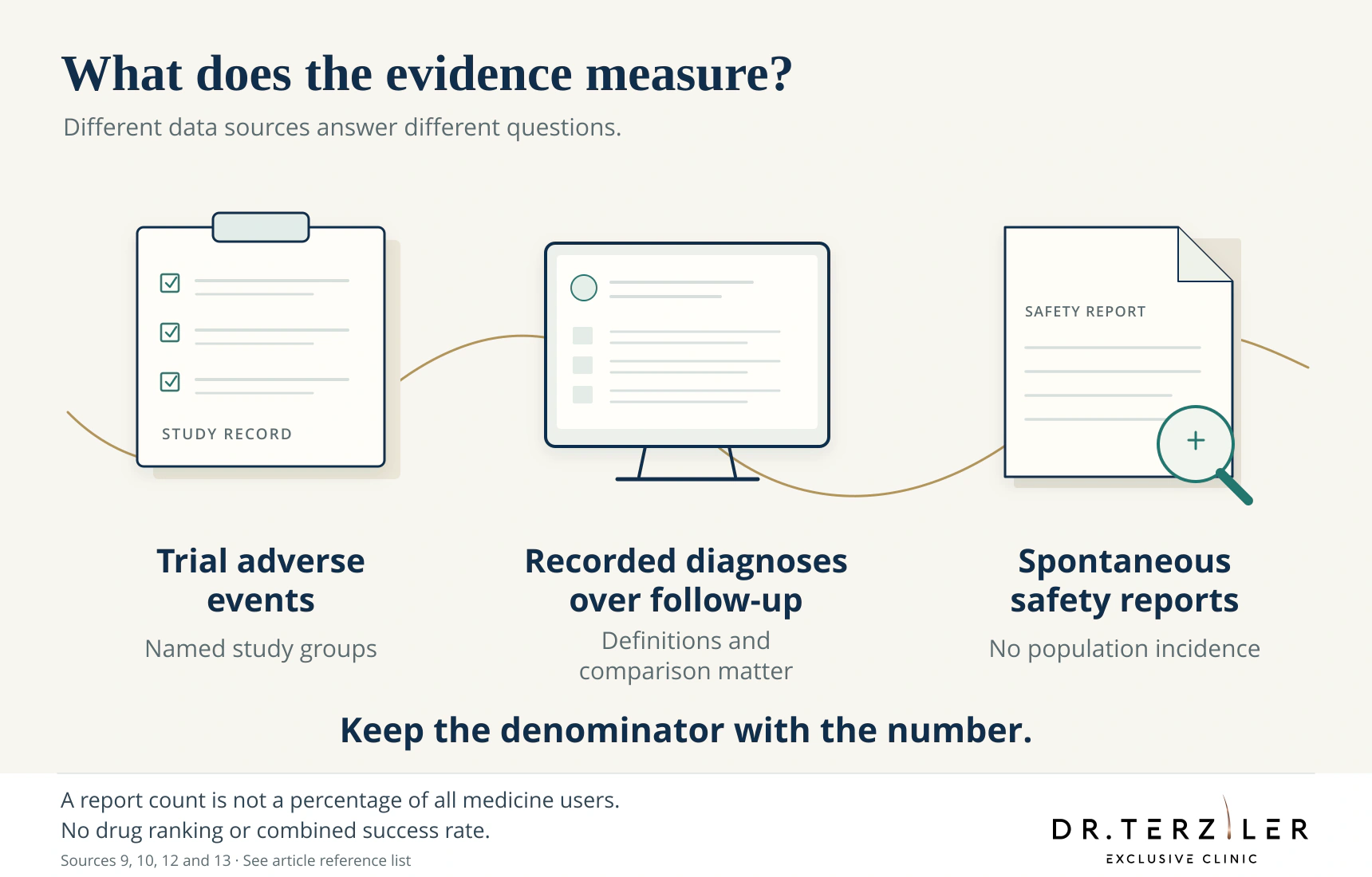
There is no single hair-loss percentage for the entire GLP-1 drug class. Trial percentages, medical-record diagnoses and spontaneous safety reports use different populations and methods. A number needs its medicine, comparison group and measurement method beside it.
| Product and source | What the source reports | What the figure cannot tell you |
|---|---|---|
| U.S. Ozempic label | Postmarketing alopecia reports; no reliably calculable frequency | The percentage of Ozempic users affected |
| U.S. Wegovy injection label, pooled adult 2.4 mg studies | 3.3% with Wegovy versus 1% with placebo in the hair-loss subsection | The rate for all semaglutide products or oral formulations |
| U.S. Zepbound label, pooled Studies 1 and 2 | 7.1% of women versus 1.3% of women on placebo | A class-wide female risk or a permanent-hair-loss rate |
| U.K. Mounjaro SmPC, pooled weight-management studies | 4.9% with tirzepatide versus 1.0% with placebo | A head-to-head comparison with Wegovy |
On a narrow screen, swipe the table to see all columns.
Sources: current product information checked 6 November 2026. [1][2][3][4][6] Dose descriptions identify the evidence; they are not instructions for changing treatment.
U.K. Wegovy information reports 2.5% with semaglutide 2.4 mg versus 1.0% with placebo in its described trial context. This differs from the U.S. pooled figure above. Read each figure in its own source rather than treating regional summaries as one identical dataset. Canadian readers should also check the current Canadian product monograph for their own product. [5][27]
What does the label for my medication actually say?
Match the country, product and study context. This lookup explains evidence; it does not calculate your risk or choose a treatment.
The comparison table and linked sources above remain available. Check the exact product information with your prescribing team; a missing percentage does not mean zero risk.
Ask about a scalp assessmentThe dose descriptions identify research, not a recommendation to change your prescription.
What do the newer studies add beyond the labels?
Newer observational studies strengthen the evidence for an association, but they do not establish exactly how the medicine, weight change and other factors contribute.
A 2026 BMJ study compared adults with type 2 diabetes starting GLP-1 drugs with adults starting other diabetes medicines. After adjustment, recorded alopecia occurred at 6.91 versus 5.04 events per 1,000 person-years compared with SGLT-2 inhibitors, with a hazard ratio of 1.37. The absolute difference was 1.87 events per 1,000 person-years in that analysis. These are rates of recorded diagnoses over follow-up, not a prediction that 37% of users lose hair. [9]
A separate 2026 JAAD International cohort found higher adjusted odds of telogen effluvium, androgenetic alopecia and overall nonscarring hair loss at 12 months. The overall adjusted odds ratio was 1.40. That does not mean 40% of treated people developed hair loss. Diagnostic coding, the choice of control group and differences in medical attention can influence findings in these studies. [10]
A later matched TriNetX analysis also linked semaglutide and tirzepatide to nonscarring hair-loss diagnoses. Follow-up BMI was lower among treated patients with hair loss than among those without it, supporting weight change as a possible contributor. This observation still cannot settle the mechanism for one patient. [11]
Why do some reports sound more certain than the evidence?
Different research designs answer different questions. Systematic reviews from 2025 and 2026 bring together trials, medical-record studies and safety reports, but the underlying methods and hair-loss definitions vary. Some analyses find associations that others do not. [7][8]
Safety databases are particularly easy to misread. A pharmacovigilance study identified disproportionate alopecia reporting for semaglutide and tirzepatide. A reporting signal is a reason to investigate; it is not a measured incidence among everyone taking the medicine. [12]
The FDA explains that spontaneous reports can contain duplicates, incomplete histories and events with uncertain causation. They cannot establish how often an event occurs in the population or reliably rank one medicine's safety against another. [13]
Why can hair shed after GLP-1 treatment or weight loss?
Rapid weight change, a substantial reduction in food intake and other physical stresses can disturb the hair cycle. One possible result is telogen effluvium: more hairs than usual enter the resting phase and later shed across the scalp. The follicle remains present, so this process differs from a disorder that destroys follicles. [15]
Three questions help make the explanation more specific:
- Did the amount or pace of weight loss change before shedding began?
- Did nausea, vomiting, food aversions or a very small appetite make adequate eating difficult?
- Could another event, such as illness, surgery, childbirth or a change in another medicine, fit the same timeline?
More than one answer can be relevant. A person may also have pattern hair loss that was present before treatment and becomes easier to see when overall volume falls. The American Academy of Dermatology identifies sudden weight loss and reduced nutrient intake as plausible contributors while noting that researchers still need to clarify possible direct drug effects. [14]
How much weight loss is enough to cause shedding?
There is no validated weight-loss percentage that predicts whether your hair will shed. Statements such as “it only happens after losing 20% of your weight” turn a research observation into a personal threshold.
A retrospective study of 140 people already diagnosed with weight-loss-associated telogen effluvium reported an average weight loss of 15.21%. Because the researchers selected people who had the condition, that average cannot tell us the risk among all people losing weight. It also cannot define a guaranteed safe pace or prove that smaller changes cannot matter. [17]
Your prescriber can assess your weight trajectory alongside your medical needs, symptoms and nutritional intake. A hair article cannot set the right weight-loss target for an individual.
When does GLP-1 hair loss start?
Telogen effluvium often becomes noticeable about two to four months after a trigger because the hair cycle creates a delay. The date you first see shedding may therefore be different from the date your eating or weight changed. It should not automatically be timed from your first injection. [26]
For example, you might start treatment, tolerate it well for a while, then eat much less during a later period. The later period could be more relevant to the hair history than the original prescription date. This is an illustration of how to build a history, not proof that a particular dose change caused shedding.
Which four dates should I bring to an appointment?
Record four parts of the timeline, using approximate dates if needed:
| Part of the history | What to record |
|---|---|
| Medication history | Product, formulation, reason for treatment, starting date and relevant changes |
| Weight and eating history | When weight changed more quickly, meals became smaller or symptoms affected eating |
| Hair history | When extra shedding, a wider part, patches or breakage first became noticeable |
| Current course | Whether shedding, eating, weight and scalp symptoms are now changing or stable |
On a narrow screen, swipe the table to see all columns.
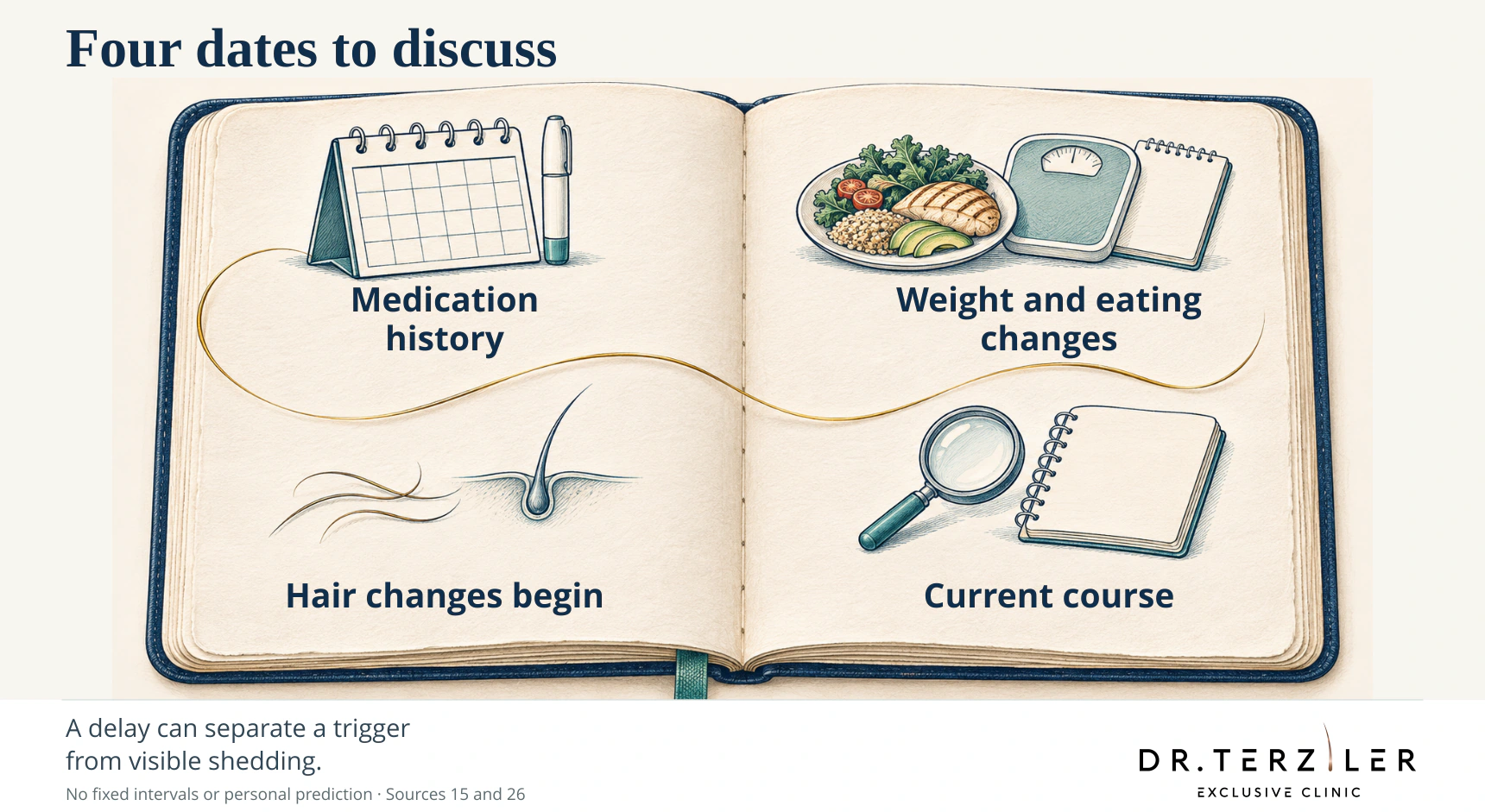
Dates help a clinician test an explanation against the hair cycle and examine competing causes. They do not produce a diagnosis by themselves. Bring any blood results you already have rather than buying a broad test panel before someone has taken your history.
You can ask which records to bring for a hair-loss consultation before deciding on a treatment. Keep medication changes with your prescribing team.
What should I record before discussing hair changes?
Build an editable history and a suggested discussion focus. Approximate dates and “not sure” are useful too. This is an educational organizer, not a medical test.
Bring the product name, medication history, weight and eating changes, hair-change dates and any scalp symptoms. You can arrange an assessment without knowing every date or having earlier photographs.
Ask about a scalp assessmentWhat should I take to an assessment?
A new version is ready. Your edited summary has been preserved.
Without your selection, this is a general appointment inquiry. WhatsApp opens a draft; you decide whether to send it.
Your answers stay in this page’s memory unless you choose to copy, download or include them in a WhatsApp draft. Do not change a prescription because of this organizer.
Is GLP-1 hair loss reversible or permanent?
Shedding caused by telogen effluvium is usually reversible because the follicles remain intact. Hair can recover as the relevant trigger resolves, but a diagnosis matters: ongoing triggers, pattern hair loss or a separate scalp disorder can change the course. “Hair loss on a GLP-1” is too broad a label to promise everyone the same recovery. [15][26]
Less hair in the shower and a fuller ponytail are also different outcomes. Shedding may settle before the new growth is long enough to restore the volume you notice when styling. A few short hairs can be encouraging, but short strands can also reflect breakage; a photograph alone cannot determine which process is present.
Does Ozempic hair loss grow back without stopping the medicine?
It can, depending on the diagnosis and the continuing trigger. The U.K. Wegovy and Mounjaro product information reports that most affected patients in the described studies recovered while continuing treatment. That is useful evidence that stopping is not always necessary, but it is not a promise about every Ozempic user or every type of alopecia. [5][6]
Your prescriber should weigh hair symptoms alongside the reason for treatment, its benefits, nutrition and other adverse effects. A scalp clinician can help establish what is being treated. Neither a generic supplement recommendation nor a switch between brands answers that diagnostic question.
How long does Ozempic or GLP-1 hair loss last?
There is no reliable drug-specific countdown for regrowth after starting or stopping treatment. In general telogen effluvium, shedding and recovery unfold over months; continued or repeated triggers can extend the course. The AAD describes hair fullness often recovering within six to nine months as the body readjusts, but this is general shedding guidance, not a validated GLP-1 recovery deadline. [16]
Seek assessment if the loss continues, coverage is worsening or the explanation remains uncertain. You do not need to wait six months to ask for help, particularly if symptoms or patches are developing.
Why might GLP-1 hair loss be more noticeable in women?
Some product trials recorded hair loss more frequently in women, including the Zepbound trials described above. That observation does not establish one female-specific mechanism or show that every woman using a GLP-1 has a high risk. [2]
The assessment should also consider contributors that can overlap: heavy menstrual bleeding, recent childbirth, changes around menopause, restrictive eating and an existing widening part. Fatigue, menstrual changes or a previous iron problem are useful history, rather than proof of a deficiency.
Our guide to hair loss in women explains how diffuse shedding, female pattern thinning and inflammatory conditions can look different. A widening part should be examined even when there is a plausible weight-loss trigger. A scalp examination and selected investigations can help distinguish those possibilities. [21][22]
Is GLP-1 hair loss caused by DHT?
A proven class-wide increase in DHT has not been established as the explanation for GLP-1-associated shedding. Androgenetic alopecia and telogen effluvium are different diagnoses and can coexist. Research linking these medicines with pattern-loss diagnoses does not demonstrate that every user's DHT has risen or that a DHT blocker is the right response. [7][10]
Do not choose finasteride, spironolactone or another hormone-related treatment solely because shedding followed a GLP-1 prescription. The distribution of loss, reproductive considerations and medical history affect those decisions.
How can I tell shedding from thinning or breakage?
Shedding describes hairs being released; thinning describes reduced coverage; breakage describes damaged shafts. One person can have all three. Separating the observations makes the consultation more useful than simply saying that your medicine “made you bald.” [19][22]
| Observation | What it describes | What it does not prove |
|---|---|---|
| More full-length strands after washing | Increased noticed shedding | The cause, permanence or a specific deficiency |
| A part or crown that looks progressively less covered | A possible change in coverage | Whether the change is telogen effluvium, pattern loss or another condition |
| Short pieces at different lengths | Possible shaft breakage | That every short hair represents follicle miniaturization |
| More scalp in one bright or wet-hair photograph | Appearance under those conditions | A measured change in hair density |
On a narrow screen, swipe the table to see all columns.
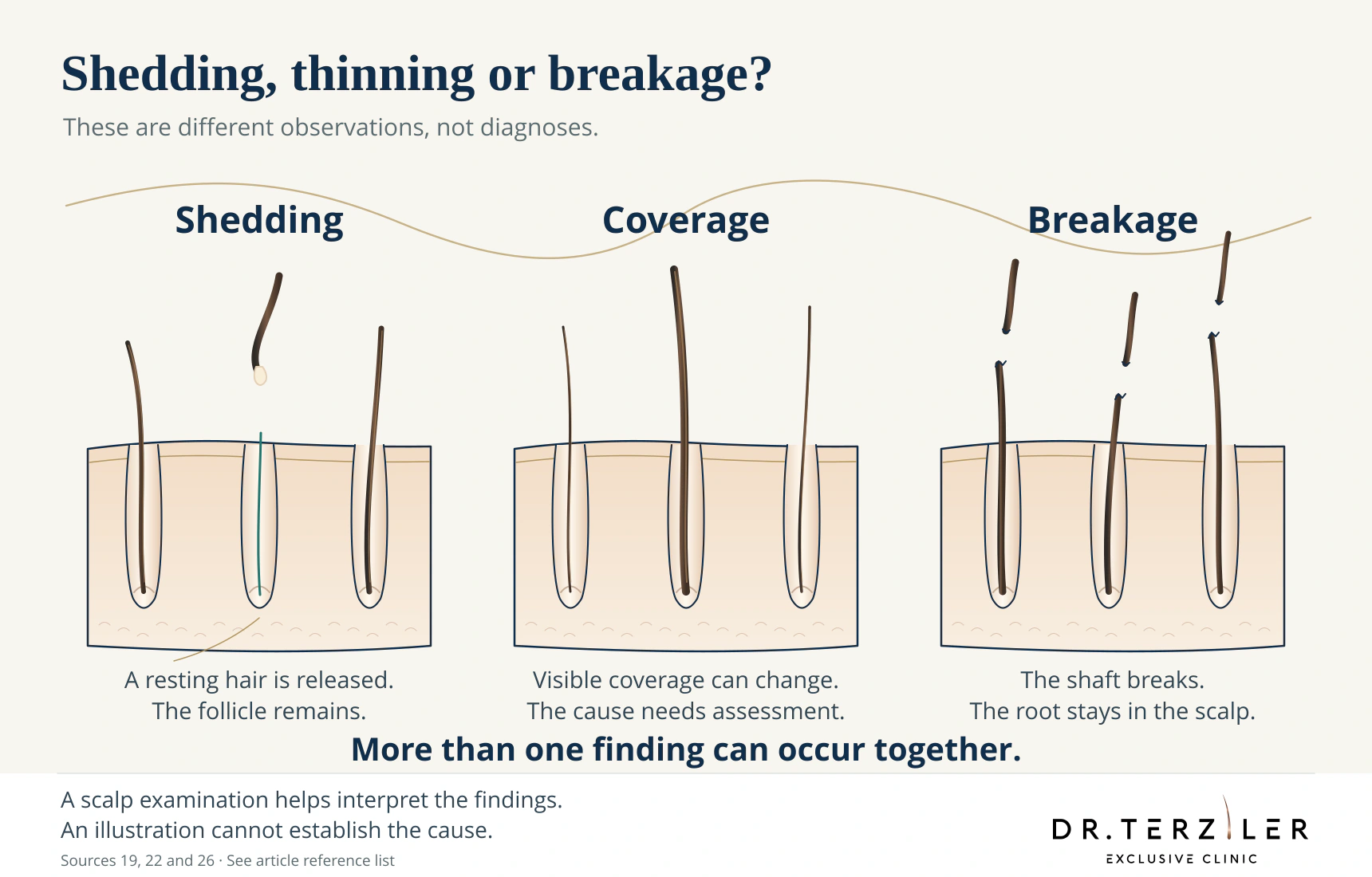
Use a planned set of photographs with similar lighting, distance, head position, parting and hair condition. Label the dates. Avoid repeatedly checking only the angle that worries you most; changing the comparison conditions makes interpretation harder.
If you are unsure whether coverage has changed, the observation questions in our hairline and crown self-check can help you describe it. They support a conversation and do not replace an examination.
What can I fairly compare at my next review?
Choose the outcomes you want to discuss and record the photo conditions. This tool uses your observations; it does not upload or analyze photographs.
Compare the same scalp areas under similar lighting, distance, head position, parting, hair length and dry/wet conditions. Record changes in products or other treatments, and discuss new symptoms promptly.
Ask about a scalp assessmentWhat can this comparison show?
New symptoms or rapid changes should not wait for a photographic comparison.
What will I compare at my review?
Your selections changed. Your edited checklist is preserved; compare again or rebuild it when ready.
A new checklist is ready. Choose whether to replace your edited text.
Adding a checklist to your note does not send it anywhere. You can review the note and choose separately whether to include it in a WhatsApp draft.
Which tests might help with hair loss during weight loss?
Testing should answer a question raised by your history and scalp examination. A clinician may consider iron deficiency, thyroid disease or selected nutritional problems, but not everyone needs the same blood tests. A normal blood panel cannot exclude every scalp disorder. [22]
| Question to discuss | Possible assessment |
|---|---|
| Is the loss diffuse, patterned, patchy or associated with inflammation? | Scalp examination, often with magnification of the scalp and hair shafts |
| Could blood loss or low iron intake contribute? | A clinician may select a blood count and ferritin or other iron studies |
| Do symptoms or history suggest thyroid disease? | Thyroid testing when indicated |
| Has intake become restricted, or is there another reason to suspect deficiency? | Diet review and selected nutrient tests rather than a universal vitamin panel |
| Is the diagnosis unclear or scarring suspected? | Dermatology assessment; occasionally a scalp biopsy |
On a narrow screen, swipe the table to see all columns.
Blood results are part of the interpretation. One low nutrient value does not necessarily explain the entire change, and a laboratory reference range is not automatically a hair-regrowth target. Bring existing results with their dates, units and reference ranges so the clinician can consider them in context.
If you already have results, ask which records would be useful for an assessment. An initial message can help organize the appointment; it should not become a diagnosis from one laboratory number.
How can I reduce hair shedding while taking a GLP-1?
The most useful approach is to address a possible trigger, protect the remaining hair and confirm the diagnosis. There is no proven routine that guarantees prevention of GLP-1-associated hair loss.
How should I discuss food intake and protein?
Tell your prescribing team if a reduced appetite, food aversions or gastrointestinal symptoms make regular eating difficult. The joint GLP-1 nutrition advisory from four professional organizations recommends attention to nutrient adequacy and individualized dietary support. A registered dietitian can help adapt meals to your symptoms, preferences and health needs. [18]
Protein-rich foods can be easier to distribute across smaller meals than to fit into one large meal. Depending on your diet, options include eggs, yogurt, fish, poultry, tofu, beans or lentils. Adequate energy and a varied diet matter alongside protein; a protein drink does not automatically correct a restricted diet.
Ask for a personal target rather than copying a fixed grams-per-kilogram “hair protocol.” Body composition, kidney health and the method used to calculate requirements can change the advice. Better nutrition supports health during treatment; it has not been shown to prevent every case of shedding.
Which hair-care changes can protect the hair I have?
Use gentle washing and conditioning, reduce damaging heat and chemical processing, and avoid styles that pull tightly on the scalp. These measures can reduce additional shaft damage or traction. They do not reverse a medication effect or establish why follicles are shedding. [19]
Washing can release hairs that were already ready to fall. Cutting down on washing to avoid seeing them does not diagnose or resolve the underlying problem. Consider comfort and scalp care rather than using the drain as a daily test of whether treatment is working.
If symptoms are interfering with food or fluid intake, contact the prescribing team promptly. Addressing tolerability is a medical review issue, not a reason to make an unsupervised dose change.
Which supplements help with GLP-1 hair loss?
No supplement has been established as a universal treatment for GLP-1-associated hair loss. Correcting a confirmed deficiency is different from taking a large “hair growth” combination when the cause is unknown.
A standard multivitamin may be worth discussing when intake is limited; some dermatologists recommend one during GLP-1 treatment. That is not equivalent to recommending high-dose biotin, iron, zinc or several overlapping products for everyone. The choice should reflect what you eat, your results and your other medicines. [14][18]
Excess amounts of some nutrients, including vitamin A and selenium, can contribute to hair loss. “More” therefore does not necessarily mean better. Bring photographs of supplement labels to your appointment, including powders and gummies, so the total intake can be reviewed. [19]
Biotin can also interfere with some laboratory tests and produce misleading results. Tell the clinician and laboratory if you take it; follow their instructions for the particular tests rather than inventing your own stopping interval. [20]
Can minoxidil help hair loss caused by GLP-1 medication?
Minoxidil may be appropriate when an examination identifies pattern hair loss or another indication, but it is not an automatic treatment for everyone who sheds during GLP-1 therapy. Evidence for treating hereditary thinning should not be presented as proof of a GLP-1-specific regrowth treatment.
Topical minoxidil has an established role in female pattern hair loss. It takes time to assess, may cause irritation or an initial increase in shedding, and generally needs continued use to maintain its benefit in that condition. It is usually avoided during pregnancy and breastfeeding. [21]
Ask what diagnosis the medicine would treat, which outcome you should monitor and when to review it. Oral minoxidil is a prescription decision with different risks from a scalp product; it should not become an online add-on simply because your hair changed after an injection.
What about PRP, laser treatment or a “big three” hair routine?
There is no standard “big three” protocol proven to treat GLP-1-associated hair loss. Treatments should match the scalp diagnosis. A routine used for hereditary male pattern loss does not automatically apply to a woman with a recent episode of diffuse shedding.
If pattern thinning is also present, a clinician may discuss additional options. Research on PRP hair treatment should be assessed by diagnosis, preparation and outcome, rather than offered as proof that it stops weight-loss-related shedding. [28]
The same distinction applies to low-level light therapy for hair loss: evidence for a particular device and pattern-loss population does not establish a treatment for every GLP-1 user. [29]
Before agreeing to a course, ask which finding it targets, what improvement would count, how progress will be recorded and what the review and continuation costs are. A proposed procedure should answer those questions as clearly as a proposed medicine.
You can discuss a treatment plan based on your scalp findings before choosing a package. Bring your prescriber's details and an up-to-date medication list so the advice can take your ongoing care into account.
Should I stop or switch my GLP-1 because of hair loss?
Do not change treatment without speaking with the clinician who prescribes it. Hair symptoms, the reason for treatment, benefits, nutrition and other adverse effects all belong in that decision. The Cleveland Clinic's discussion of GLP-1-associated shedding also emphasizes reviewing the change with your health care team. [23]
There is no good basis for promising that a switch will protect everyone's hair. Fewer reports for another product may reflect different use, weight effects or less available evidence. Choosing a medication from a hair-loss percentage alone ignores why it was prescribed.
Which GLP-1 does not cause hair loss?
No GLP-1 medicine can be guaranteed to cause no hair loss. Some agents have fewer published reports or weaker signals, but absence of a strong signal is not proof of zero risk. Cross-trial percentages also cannot establish a reliable “best GLP-1 for hair” ranking. [7][13]
If you have hair loss before starting treatment, ask for a baseline assessment and a plan for reviewing any change. This is more useful than waiting until a photograph looks different and then trying to reconstruct the history.
Can GLP-1 drugs help hair growth instead?
Early reports of improvement in particular hair disorders do not make GLP-1 medicines established hair-growth treatments. A publication on central centrifugal cicatricial alopecia explored outcomes in a specific scarring condition. Those observations cannot be applied to ordinary pattern thinning or used to promise regrowth from Ozempic. [24]
A medicine can have different observed effects in different diseases. Changes in metabolism, inflammation and concurrent treatment complicate interpretation. Neither reports of shedding nor reports of improvement justify prescribing or stopping a GLP-1 solely on the basis of a general hair claim.
Can a hair transplant treat thinning after weight loss?
A hair transplant may help selected people with stable pattern hair loss and a suitable donor area. It moves existing follicles; it does not correct an active shedding trigger or a nutritional problem. Persistent symptoms, uncertain diagnosis or diffuse donor thinning need assessment before surgery is considered. [28]
For women, a female hair transplant assessment should examine the donor region as carefully as the area that looks thin. When hair remains in the proposed recipient area, the limitations of transplanting into thinning hair also need discussion.
Tell any procedural team which GLP-1 you take and about relevant symptoms. Medication and procedure planning should be coordinated with your prescribing clinician. A generic instruction to stop a medicine for a fixed period is not a substitute for that discussion.
When should I seek medical advice rather than keep monitoring?
Arrange assessment for new patches, a changing hairline or part, ongoing loss, or scalp pain, burning, redness, scaling or sores. Eyebrow or eyelash changes also deserve attention. These findings should not automatically be assigned to a temporary weight-loss reaction. [25]
You can also ask for help because the shedding is distressing, even without an obvious patch. Bring your medication list, the four-date history, relevant prior results and a small set of comparable photographs. A clinician can then decide whether the next step is a nutrition review, selected tests, observation or treatment for a specific scalp diagnosis.
Arrange a hair-loss assessment if you would like to discuss the scalp findings with Dr. Terziler Exclusive Clinic. You can also ask the team on WhatsApp how to prepare for a consultation. A message or photo discussion can help organize an appointment; it cannot establish the cause of hair loss on its own.
What else do people ask about GLP-1 drugs and hair loss?
Can I lose hair on a GLP-1 even if I have not lost much weight?
Yes, hair changes still deserve assessment. Weight loss is one possible contributor, and the timing of another trigger, an existing scalp condition or a separate medicine may matter. Current evidence does not support dismissing the change simply because your weight loss was modest. [11][17]
Can GLP-1 hair loss start immediately after the first dose?
Shedding caused by a new telogen-effluvium trigger usually has a delay. An immediate change should prompt a review of earlier events, existing hair loss and what you are actually observing. Timing alone cannot prove or exclude a medication contribution. [15][26]
How do I thicken my hair after weight loss?
First establish whether the problem is continuing shedding, pattern thinning, breakage or a combination. Correcting an ongoing trigger and treating an identified condition offer a clearer plan than choosing a thickening product by its marketing. Cosmetic volume products may change appearance, but that is different from measured regrowth.
Does a GLP-1 hair-loss story on Reddit predict what will happen to me?
No. A personal account can raise useful questions, but it rarely controls for dose, weight trajectory, diet, other treatment or a confirmed hair diagnosis. Even formal safety-report databases cannot use uncontrolled reports to calculate individual risk. [13]
What should my follow-up appointment compare?
Agree on a specific outcome: less shedding, stable coverage, improved scalp symptoms or visible regrowth in the same area. Record which treatments or dietary changes occurred between reviews. Comparable photographs can support the review, but a visual estimate of scalp visibility is not a measured hair count.
Which sources support this article?
Sources checked 6 November 2026. Product information can change. Numbers above remain attached to their named study groups and countries.
- Novo Nordisk. Wegovy U.S. prescribing information. See section 6.1, including the Hair Loss subsection and formulation-specific trial tables. ↩
- Eli Lilly. Zepbound U.S. prescribing information. See section 6.1, Hair Loss, pooled Studies 1 and 2. ↩
- Novo Nordisk. Ozempic U.S. prescribing information. See section 6.2, Postmarketing Experience. ↩
- Eli Lilly. Mounjaro U.S. prescribing information. See section 6.2, Postmarketing Experience. ↩
- Novo Nordisk. Wegovy U.K. Summary of Product Characteristics. See section 4.8, Hair loss. ↩
- Eli Lilly. Mounjaro U.K. Summary of Product Characteristics. See section 4.8, Hair loss. ↩
- Gupta AK, Teasell EM, Economopoulos V, Mirmirani P. GLP-1 therapies and hair loss: A systematic review of current evidence and implications for counseling. Science Progress. 2026. DOI: 10.1177/00368504261444578. ↩
- Alsuwailem, et al. Hair Loss Associated With Glucagon-Like Peptide-1 (GLP-1) Receptor Agonist Use: A Systematic Review. Cureus. 2025. DOI: 10.7759/cureus.92454. ↩
- Tang H, et al. Risk of hair loss associated with glucagon-like peptide-1 receptor agonists in adults with type 2 diabetes: target trial emulation. BMJ. 2026. DOI: 10.1136/bmj-2026-100077. ↩
- Vidal SI, et al. Increased risk of hair loss with GLP-1 receptor agonists: A real-world multicenter TriNetX cohort study. JAAD International. 2026;25:133–135. DOI: 10.1016/j.jdin.2026.01.014. ↩
- Katragadda R, et al. Nonscarring Alopecia in Adults Treated With GLP-1s: A Propensity Score Matched TriNetX Cohort Study. 2026. PMID: 42647098. ↩
- Godfrey H, et al. Alopecia associated with the use of semaglutide and tirzepatide: A disproportionality analysis using FAERS from 2022 to 2023. Journal of the European Academy of Dermatology and Venereology. 2025;39:e153–e154. DOI: 10.1111/jdv.20197. ↩
- U.S. Food and Drug Administration. Understanding CDER's Postmarket Safety Surveillance Programs and Public Data. ↩
- American Academy of Dermatology. How can GLP-1 drugs affect my skin, hair, and nails?. ↩
- British Association of Dermatologists. Telogen effluvium patient information. October 2025. ↩
- American Academy of Dermatology. Do you have hair loss or hair shedding?. ↩
- Kang DH, Kwon SH, Sim WY, Lew BL. Telogen Effluvium Associated With Weight Loss: A Single Center Retrospective Study. Annals of Dermatology. 2024. PMID: 39623615. ↩
- American College of Lifestyle Medicine, American Society for Nutrition, Obesity Medicine Association and The Obesity Society. Nutritional priorities to support GLP-1 therapy for obesity: A joint advisory. 2025. ↩
- American Academy of Dermatology. Hair loss: Tips for managing. ↩
- U.S. Food and Drug Administration. Biotin interference with laboratory tests. ↩
- American Academy of Dermatology. Thinning hair and hair loss: Could it be female pattern hair loss?. ↩
- NYU Langone Health. Diagnosing hair loss. ↩
- Cleveland Clinic. Can GLP-1 medications cause hair loss?. Health Essentials podcast. ↩
- Desir N, et al. GLP-1 agonists may modulate treatment efficacy in central centrifugal cicatricial alopecia. Journal of the American Academy of Dermatology. 2025;93:771–773. DOI: 10.1016/j.jaad.2025.04.058. ↩
- American Academy of Dermatology. Hair loss: Signs and symptoms. ↩
- DermNet. Telogen effluvium. ↩
- Health Canada. Wegovy entry in the Drug Product Database. Use the current Canadian product monograph for local prescribing information. ↩
- American Academy of Dermatology. Hair loss: Diagnosis and treatment. ↩
- Perez SM, Vattigunta M, Kelly C, Eber A. Low-Level Laser and LED Therapy in Alopecia: A Systematic Review and Meta-Analysis. 2024. DOI: 10.1097/DSS.0000000000004442. Evidence concerns the studied devices and alopecia populations, rather than a dedicated GLP-1-associated shedding trial. ↩