




Eyebrow Transplant in Turkey 2026: Cost, Procedure & Results
An eyebrow transplant permanently restores brow density by moving DHT-resistant scalp follicles to the brow zone using 100% single-hair grafts at a near-flat 10-15° angle. In Istanbul, Turkey, the eyebrow transplant procedure costs from €2,000 for bilateral brows. Dr Terziler uses Robotic DHI implantation invented by Dr. Servet Terziler, and delivers 85-92% 12-month graft survival. The package includes hotel, VIP transfers, PRP, translator, and 12-month virtual follow-up.
Eyebrows are the most complex zone in facial hair transplant surgery. The skin is just 0.5-0.8 mm thick; roughly half the thickness of upper-lip skin and a quarter of scalp skin. Every graft must be placed at a near-flat angle of 10-15° to the skin surface, and every unit must be a single-hair follicle. There is no margin for multi-hair placement, incorrect angulation, or depth error. Eyebrow transplantation has grown 211% between 2010 and 2022: the fastest growth rate of any hair restoration procedure according to the ISHRS 2022 Practice Census. Turkey, and specifically Istanbul, now handles the largest share of international eyebrow cases globally.
The procedure serves patients who have lost brow density through over-plucking, alopecia areata, thyroid disorders, trichotillomania, chemotherapy, burns, or hereditary sparse growth. It equally serves patients who simply want a defined, architectural brow they were never born with. The result is permanent, natural, and identical in texture to native brow hair; with one well-known adjustment: transplanted scalp follicles retain their original growth cycle and need regular trimming.
Key Takeaways
- An eyebrow transplant permanently restores brow density by moving DHT-resistant scalp follicles to the brow zone using 100% single-hair grafts at a near-flat 10-15° angle.
- Eyebrows are the most complex zone in facial hair transplant surgery.
- The procedure serves patients who have lost brow density through over-plucking, alopecia areata, thyroid disorders, trichotillomania, chemotherapy, burns, or hereditary sparse growth.
MEDICALLY REVIEWED BY
Dr. Servet Terziler
AACI-accredited surgeon, European Property Award recipient, founder of TUSATDER, and internationally recognized hair restoration specialist often referred to as the "Picasso of Hair."
Updated May 2026
What Is an Eyebrow Transplant?
An eyebrow transplant is a microsurgical hair restoration procedure that permanently moves follicular units from the occipital scalp to the brow zone, restoring density, shape, and symmetry. The procedure is ambulatory, performed under local anaesthesia, and completed in 1-3 hours depending on graft count. Results are permanent because transplanted follicles are taken from DHT-resistant donor zones that retain their growth characteristics for life.
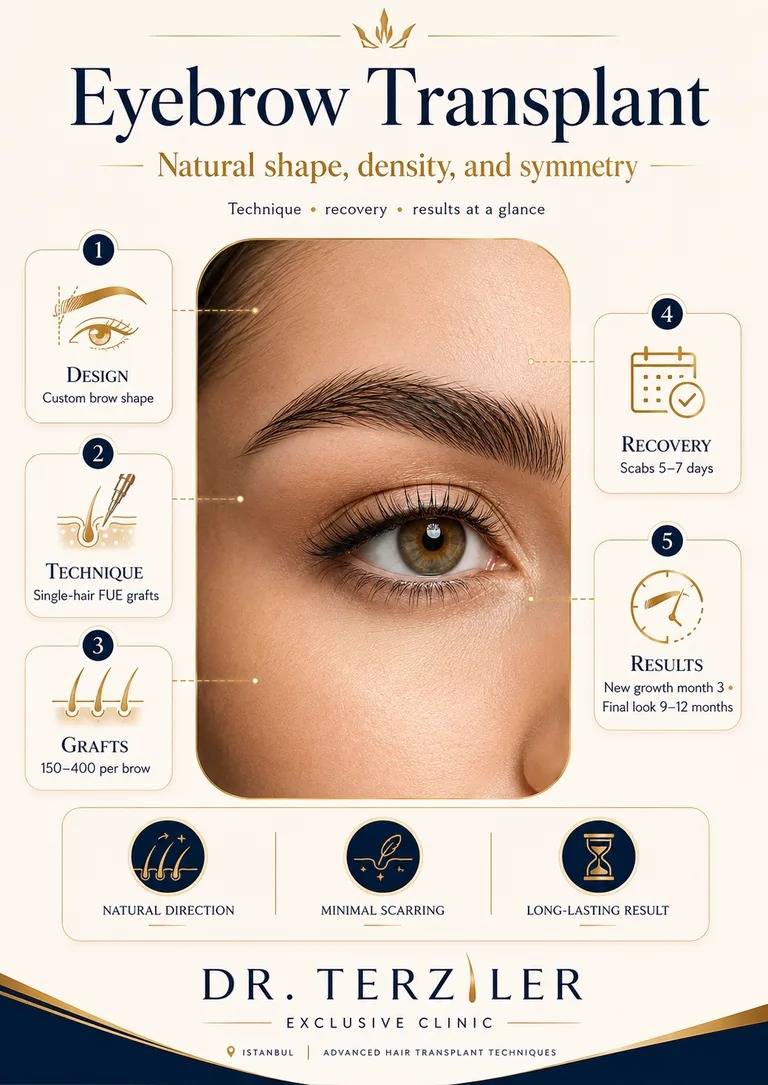
The eyebrow transplant procedure is the most technically demanding facial hair restoration procedure performed by ISHRS-trained surgeons. Three anatomical facts drive this complexity. First, brow skin is 0.5-0.8 mm thick: the thinnest hair-bearing skin on the face. The supraorbital and supratrochlear nerve branches run 10-15 mm below the brow surface, requiring precise depth control. Second, the brow has a three-zone growth architecture: the head (inner brow) grows at 5-10°, the body (mid-brow) grows at 10-15°, and the tail (outer brow) grows at 15-20°; each zone with a distinct direction and hair calibre. Third, the implanted hair must match the natural upward-then-downward fan of native brow growth. A single graft placed at the wrong angle creates a permanently unnatural result that requires laser removal to correct.
What Does an Eyebrow Transplant Actually Restore?
An eyebrow transplant restores follicle density, shape definition, arch architecture, and symmetry.
Read more
It rebuilds the head, body, and tail of the brow independently, matching the angle and calibre of native growth in each zone. It does not restore the natural golden-ratio proportions unless designed correctly; which is why the pre-op trichoscopic mapping phase is as important as the surgery itself.
Is an Eyebrow Transplant the Same as Eyebrow Restoration?
"Eyebrow restoration" and "eyebrow transplant" describe the same procedure. "Eyebrow surgery" is a broader term that includes both transplantation and non-surgical corrections.
Read more
"Brow transplant" is the colloquial shorthand. All refer to the same microsurgical follicular transfer procedure. For patients in the UK, the NHS does not cover cosmetic eyebrow restoration regardless of cause; it is classified as elective cosmetic surgery even when caused by medical conditions such as alopecia areata or chemotherapy.
See what your brows can realistically restore
Send close-up brow photos and tell us your goal: density, symmetry, scar coverage or a fuller arch.
Send Photos on WhatsAppWhat Is the Difference Between an Eyebrow Transplant and Microblading?
An eyebrow transplant is permanent surgical hair restoration using real follicles. Microblading is a semi-permanent cosmetic tattoo that uses ink pigment; no actual hair is created. An eyebrow transplant lasts a lifetime from one session. Microblading fades in 12-18 months and requires repeat top-ups every year. Over 5 years, microblading costs more in total while delivering a cosmetic effect rather than a clinical one.
From a cost perspective, microblading in the UK averages £300-£500 per session. Over 5 years at 18-month intervals, that is £1,000-£1,500 total, before accounting for correction sessions for colour shift or asymmetry. An eyebrow transplant from €2,000 is a one-time procedure with a lifetime guarantee of real hair growth.
| Feature | Eyebrow Transplant | Microblading |
|---|---|---|
| What it is | Permanent surgical hair transplant | Semi-permanent cosmetic tattoo |
| Duration | Permanent (lifetime) | 12-18 months, fades and needs topups |
| Result | Real hair that grows | Ink pigment, no actual hair |
| Repeat procedures | One session (touch-up < 6% of cases) | Every 12-18 months indefinitely |
| 5-year total cost | €2,000-€4,500 once | £500-£1,500+ in repeat topups |
| Can get wet | Yes (after day 10) | Restricted for several days post-session |
| Natural texture | Yes, 3D, real hair | Flat strokes, looks drawn-on at close range |
| Suitable for total hair loss | Yes | No, needs existing hair to blend with |
| Risk of regret | < 5% at quality clinics | High fading, colour shift (grey/pink) over time |
| Reversible | Yes (laser) | Fades naturally; laser removal possible |
Microblading and eyebrow transplantation
Note: Microblading and eyebrow transplantation are not mutually exclusive. Many patients use microblading as a short-term solution while waiting for transplant eligibility, or combine both after transplantation for the first 3 months while grafts establish.
What Is the Difference Between an Eyebrow Transplant and Eyebrow Implants?
"Eyebrow implants" is frequently searched as a synonym for eyebrow transplantation, but synthetic eyebrow implants are a different and largely discredited procedure. Synthetic fibre implants (made from biocompatible materials) are inserted into the brow dermis without any follicular transfer. The body treats these as foreign objects; infection rates run 12-30% within 18 months according to the Journal of Plastic, Reconstructive & Aesthetic Surgery (2018). Most ISHRS-trained surgeons refuse to perform synthetic eyebrow implants.
What most people mean when they search "eyebrow implants" is eyebrow transplantation; the permanent surgical transfer of real hair follicles. If a clinic offers "eyebrow implants" using non-biological material, request the specific product name and published complication data before proceeding. At Dr. Terziler Exclusive Clinic, only follicular unit transplantation using the patient's own tissue is performed. No synthetic materials are used.
Get a real eyebrow restoration plan
Use the form if you want a written graft estimate, technique recommendation and package outline from your photos.
Request My Brow PlanHow Does an Eyebrow Transplant Work Step by Step?
An eyebrow transplant at Dr. Terziler Exclusive Clinic follows five stages: (1) trichoscopic brow architecture mapping, (2) Micro FUE extraction at 0.6-0.8 mm from the occipital scalp, (3) single-hair follicle sorting under stereo microscope, (4) Robotic DHI implantation at 10-15° with 0.8-1.2 mm depth, (5) medicated wash on day 2 and splash-guard protocol. Total session time is 1-3 hours depending on graft count.
Step 1
Step 1: Trichoscopic Brow Architecture Mapping
Read more
Step 1: Trichoscopic Brow Architecture Mapping
Dr. Terziler maps the three zones of the brow independently: head (inner brow), body (mid-brow), and tail (outer brow). Each zone requires a distinct angle of emergence, hair calibre, and density target. The golden-ratio proportions (1:1.6 between inner brow corner and arch apex) are evaluated against the patient's facial morphology. This phase takes 30-45 minutes and is non-negotiable at Dr. Terziler Exclusive Clinic.
Step 2
Step 2: Micro FUE Extraction from Occipital Scalp
Read more
Step 2: Micro FUE Extraction from Occipital Scalp
The surgical team uses Micro FUE punches of 0.6-0.8 mm to extract single-hair follicles from the occipital scalp, the zone that provides the finest calibre match for brow placement. The nape is used as a secondary donor zone for patients with limited occipital supply. Body hair (beard, chest) is a tertiary option but requires additional calibre assessment: beard hair is often too coarse for brow placement and must be evaluated individually.
Step 3
Step 3: Single-Hair Follicle Sorting Under Stereo Microscope
Read more
Step 3: Single-Hair Follicle Sorting Under Stereo Microscope
Every extracted follicle is inspected under a stereo microscope. Eyebrow transplantation demands 100% single-hair grafts, no exceptions. Any follicular unit containing two or more hairs is excluded from brow placement entirely. The finest-calibre single-hair units are allocated to the head and tail zones where brow hair is thinnest. Slightly more robust single-hair units are routed to the body of the brow for central density. This sorting protocol adds 20-30 minutes to session time and is the primary reason fine-calibre results differ from coarse, unnatural outcomes.
Step 4
Step 4: Robotic DHI Implantation at 10-15° Depth-Lock
Read more
Step 4: Robotic DHI Implantation at 10-15° Depth-Lock
The Terziler-engineered Robotic DHI implanter places each graft at the exact angle specified in the pre-op map, at a depth of 0.8-1.2 mm; the shallowest implantation depth of any hair restoration procedure. Brow skin is 0.5-0.8 mm thick; the subdermal papillary layer where follicles anchor is at 0.8-1.2 mm. A 0.3 mm depth error places the graft above the skin surface, creating cobblestoning, or into the dermis at a wrong angle, creating permanent directional misalignment. The robotic depth-lock hard-stop at 1.2 mm eliminates this error on every graft placed.
The standard DHI pen used for eyebrow work is the world's thinnest Choi implanter tip; finer than the version used for scalp cases, because brow skin tolerates less instrument diameter. Manual DHI drifts 0.3-0.5 mm under hand pressure; on 0.5-0.8 mm brow skin, this drift is the difference between a flush-depth graft and a graft placed above the dermis. Robotic control eliminates that drift on every single placement.
Step 5
Step 5: Medicated Wash and 48-Hour Post-Op Protocol
Read more
Step 5: Medicated Wash and 48-Hour Post-Op Protocol
Patients receive a medicated-foam wash on day 2 at the clinic. Brow grafts are the most vulnerable of any facial hair transplant in the first 48 hours because the brow zone is mobile, facial expressions, sleep position, glasses frames, and forehead towelling all risk direct graft contact. A written 10-day protection protocol is provided. Patients are strongly advised to switch to glasses rather than contact lenses for the first 7 days to avoid eye-rubbing adjacent to the brow zone.
Ask about the eyebrow procedure steps
A coordinator can explain mapping, extraction, Robotic DHI placement and the first 48 hours in plain language.
Ask on WhatsAppWhich Hair Transplant Techniques Are Used for Eyebrow Restoration?
Eyebrow restoration requires precision techniques that standard scalp transplant methods cannot achieve. Dr. Terziler Exclusive Clinic uses the following approaches, each suited to different brow loss profiles and patient goals.
Can Micro FUE Be Used for Eyebrow Transplant?
Yes, Micro FUE is a perfect choice for eyebrow transplants. Micro FUE uses a 0.6-0.8 mm motorised punch to extract single-hair follicles with minimal trauma to the surrounding tissue.
Read more
The reduced punch diameter lowers transection risk to under 3% and leaves no visible scarring in the occipital donor area. For eyebrow work, Micro FUE is the extraction method of choice because it harvests the fine-calibre single grafts the brow zone requires.
Is DHI Hair Transplant Suitable for a Eyebrow Transplant?
DHI (Direct Hair Implantation) implants each graft directly from Choi pen to recipient site without pre-made incisions.
Read more
For eyebrow restoration, DHI hair transplant in Turkey offers superior angle control and consistent 10-15° depth-locked implantation, which is critical for achieving a natural growth direction in the brow zone.
Is Robotic DHI the Best Option for an Eyebrow Transplant?
Yes, Robotic DHI hair transplant is one of the best options for an eyebrow transplant. Dr.
Read more
Servet Terziler invented the Robotic DHI (Picasso Robotic DHI) machine, which automates the implantation step of DHI. In eyebrow surgery, the robotic system achieves a graft survival rate above 97% and implantation density of 40-80 grafts/cm². Dr. Terziler Exclusive Clinic is the only clinic in the world offering Robotic DHI for eyebrow restoration.
Is Sapphire FUE Good for Eyebrow Transplant?
Yes, Sapphire FUE is a good option for eyebrow transplants. Sapphire FUE uses V-shaped sapphire blades to create micro-channels in the recipient area.
Read more
Sapphire blades cause less mechanical trauma than steel blades and reduce tissue inflammation during healing. In eyebrow surgery, sapphire channels allow closer graft spacing for denser brow reconstruction.
Is FUE Good for Eyebrow Transplant?
Yes, standard FUE is considered as one of the most popular options for eyebrow transplants. Standard FUE (Follicular Unit Extraction) is the foundational method for eyebrow hair restoration.
Read more
Grafts are extracted individually from the scalp using a circular punch and implanted into the brow zone via pre-made incisions. FUE is suitable for patients requiring moderate brow density restoration with straightforward hairline reconstruction.
Who Is a Good Candidate for an Eyebrow Transplant?
A good candidate for an eyebrow transplant is an adult of any gender with stable brow hair loss or absence, an occipital scalp donor density of at least 60 follicles per cm², and a clear aesthetic goal, full brow reconstruction, density increase, scar coverage, or arch definition. Patients with alopecia areata must be in stable remission for at least 2 years before transplantation is approved.
Can Women Get an Eyebrow Transplant?
Yes, and women represent the majority of eyebrow transplant patients globally. The most common female indication is over-plucking damage from the 1990s thin-brow trend, where years of repeated extraction permanently destroyed follicles.
Read more
A close second is hereditary sparse brows with no medical cause. Women with thyroid-related brow loss require thyroid stabilisation before surgery; transplanting into an actively unstable hormonal environment risks premature graft failure.
Can Men Get an Eyebrow Transplant?
Yes. Male eyebrow transplant demand has grown significantly since 2020. The most common male indications are facial scarring (sports injuries, accidents), alopecia areata, and a desire for defined, masculine brow architecture.
Read more
Male brow design uses a flatter arch, heavier central body, and a squared head compared to female brow design. Graft counts for men run 400-700 total (slightly higher than the female average) due to the requirement for higher central density.
Can an Eyebrow Transplant Repair Alopecia Areata Brow Loss?
Yes, provided alopecia areata is in stable remission for a minimum 24 months with no new patches in the brow zone.
Read more
Active AA is a contraindication; the immune mechanism that destroyed native follicles can attack transplanted grafts in the same zone. Under 2-year stable remission, success rates for AA-related brow transplantation run 75-85% (lower than the 85-92% baseline for non-AA cases).
Can an Eyebrow Transplant Cover a Scar or Burn?
Yes. Scar tissue has reduced vascular supply compared to healthy dermis, which lowers graft survival to 70-80% versus 85-92% on healthy brow skin.
Read more
Dr. Terziler compensates with 20-25% over-grafting in scar zones and, for dense or poorly vascularised scars, a two-pass protocol spaced 6 months apart. Minimum scar maturation before transplantation is 12 months post-injury.
Can Chemotherapy Patients Get an Eyebrow Transplant?
Yes, after a minimum 12 months of remission with confirmed cessation of chemotherapy. Post-chemotherapy brow regrowth is sometimes incomplete, making transplantation a permanent solution for residual patchy loss.
Read more
The donor scalp must also have recovered sufficient density before extraction is safe, this is evaluated during the trichoscopic consultation.
Find out if you are a candidate
Age, donor density, alopecia history and your brow goal all change the plan. Send the form once and get a clear answer.
Check My SuitabilityHow Much Does an Eyebrow Transplant Cost in Turkey in 2026?
An eyebrow transplant in Istanbul, Turkey starts from €2,000 for bilateral brow reconstruction (both eyebrows). Price scales with graft count to a maximum of approximately €4,500 for high-density full reconstruction with PRP and advanced post-op protocol. The equivalent procedure costs £3,000-£7,000 in London and $3,000-$9,000 in the USA; without hotel, transfers, or 12-month follow-up included.
The hair transplant Turkey cost advantage on eyebrow procedures is significant. Istanbul clinics performing 200+ eyebrow cases per year amortise per-graft costs to levels unreachable in London or New York, where volume is a fraction of that. The key distinction between Turkey's pricing and a false economy is what is included: no Dr. Terziler patient has ever received a hidden cost for anaesthesia, dressings, medication, or follow-up consultations.
| Country / City | Price Range | Included | Notes |
|---|---|---|---|
| Turkey - Istanbul | from €2,000 | Surgery, hotel, transfers, PRP, translator, 12-mo follow-up | Robotic DHI - AAACI-accredited |
| UK - London (Harley Street) | £3,000-£7,000 | Surgery only, VAT included | NHS does not cover cosmetic eyebrow loss |
| UK - Manchester, Birmingham | £1,800-£4,000 | Surgery only | Fewer DHI-trained specialists |
| USA - NYC, LA, Miami | $3,000-$9,000 | Surgery only; consult extra | No hotel; PRP always extra |
| Dubai - UAE | AED 6,000-18,000 | Surgery only | Licensed clinics only |
| India - Delhi, Mumbai | ₹25,000-₹80,000 (~$300-$960) | Surgery only | Quality highly variable |
| Mexico - Mexico City, TJ | $1,200-$3,500 | Surgery only | Very limited DHI specialists |
Does Eyebrow Transplant Cost More Than a Scalp Hair Transplant?
Per procedure, usually less; because graft counts are lower (300-700 for brows versus 2,000-4,500 for a full scalp restoration).
Read more
Per graft, the cost is higher, eyebrow grafts require 100% single-hair sorting, the most demanding microscopic work in hair restoration, and Robotic DHI placement at the shallowest depth of any procedure. The higher per-graft cost is justified: a misplaced graft on the brow is immediately visible.
Does the Price Include Both Eyebrows?
Yes. The quoted price at Dr. Terziler Exclusive Clinic always covers bilateral brow reconstruction; both eyebrows.
Read more
The price does not double for the second brow; it scales only with total graft count. A patient requiring 250 grafts per brow (500 total) pays the same base session rate as a patient needing 200 per brow (400 total) because both fit within the same graft tier.
Get your eyebrow transplant quote
Upload your brow photos and tell us if you want both brows, tail extension, scar coverage or full reconstruction.
Calculate My QuoteWhat Is Included in the Eyebrow Transplant Package in Turkey?
The Dr. Terziler Exclusive Clinic eyebrow transplant package covers: trichoscopic consultation, blood screening, the 1-3-hour procedure under local anaesthesia, PRP booster, medication pack, 3 nights in a partner 5-star Istanbul hotel, VIP airport and clinic transfers, English/Arabic/German/Russian translator, and 12-month virtual follow-up with photo reviews at months 3, 6, 9, and 12. Flights and travel insurance are not included.
Lifetime Re-Graft Guarantee
Any graft within the pre-mapped design zone that fails to survive at the 12-month mark is re-transplanted at zero cost. This guarantee is written into the patient contract. No UK or US clinic offers a written lifetime guarantee specifically for eyebrow transplant cases.
Ask exactly what your package includes
Confirm hotel, VIP transfers, PRP, translator support, follow-up schedule and the written re-graft guarantee before you plan travel.
Ask Package DetailsCan You Combine an Eyebrow Transplant with Other Facial Hair Procedures?
Yes. Dr. Terziler Exclusive Clinic performs eyebrow transplantation alongside beard transplantation, mustache and sideburn transplants in a single session, within the 4,500-graft single-day donor safety limit. The eyebrow portion (300-700 grafts) takes 1-3 hours; combined with a beard (1,500-3,000 grafts), the full session runs 6-8 hours. Combining procedures reduces total recovery time to one 10-14-day window and offers package savings versus two separate trips.
Beard Transplant Turkey
Dr. Terziler performs beard transplantation in a single session alongside eyebrow restoration. FUE grafts from the occipital scalp are implanted into the beard zone at a precise angle to replicate natural beard density. Beard transplant and eyebrow surgery can be combined within the 4,500-graft safe-session limit.
Mustache Transplant Turkey
Mustache transplantation restores hair to the upper lip area using single-hair grafts extracted by Micro FUE. Each follicle is implanted at a 10-15° angle to match the natural forward-lying growth direction of the philtrum zone. Mustache transplant results are permanent and undetectable.
Sideburn Transplant Turkey
Sideburn transplantation rebuilds the lateral facial hairline using 1-2 hair grafts placed at a shallow angle. The procedure is commonly combined with eyebrow or beard transplantation in a single session at Dr. Terziler Exclusive Clinic.
What Does Eyebrow Transplant Recovery Look Like Day by Day?
Eyebrow transplant recovery runs 12 months to final result. Scabs clear by day 9-12. Shock loss runs from day 14 to week 6 (60-80% of grafts shed temporarily). First terminal hairs emerge at month 3. Final density is achieved between months 9 and 12. Under 5% of Dr. Terziler eyebrow patients request a touch-up at month 18.
Local anaesthesia, 1-3 hours. Tiny scabs form over each graft. No pressure on brows. Discharge same day. Cold compress on forehead only, never on the brow zone.
Mild swelling above the brows is normal. Sleep at 45°. Avoid bending forward. Clinic medicated-foam wash on day 2.
Small crusts visible on each graft site. Do not touch, rub, or apply makeup. The crusts protect the anchoring grafts.
Most swelling resolved. Crusts softening. Many patients ask "why do my brows still look sparse?", grafts are anchoring under the crust, not visibly growing yet.
95% of scabs shed naturally. Brow area may look very sparse; this is normal and temporary. No makeup on the brow zone until day 14.
60-80% of transplanted hairs shed. The follicle root is anchored and will regrow. This phase alarms most patients; it is completely expected.
Brows look thin. Follicles are in telogen phase underground. First fine hairs emerge from month 3.
First thin terminal hairs appear. Colour is lighter initially. Shape becomes visible for the first time.
Density builds. Hairs darken. Trimming becomes necessary; transplanted scalp hairs grow faster than native brow hairs.
70-80% of final density visible. Brow shape is fully defined. Regular trimming every 1-2 weeks.
Full result achieved. Transplanted hairs are permanent and identical in behaviour to native brows, except they need regular trimming.
Density refinement if needed. Under 5% of Dr. Terziler eyebrow patients request one.
The trimming reality nobody explains clearly
The trimming reality nobody explains clearly: Transplanted scalp follicles retain their original 5-7-year growth cycle: the same long cycle that grows scalp hair to 4-6 inches untrimmed. Native eyebrow follicles have a 4-6-month growth cycle, after which the hair falls out and regrows short. Your transplanted brow hairs will not stop growing at brow-length, they will grow continuously and need trimming every 1-2 weeks from month 4 onward. This is not a complication. It is the single most important practical fact about the procedure that most clinics fail to explain at consultation.
7 Days After Eyebrow Transplant: What to Expect
Day 7 is the most common point of patient anxiety. The brows look sparse, crusted, and unflattering. Swelling has subsided but scabs are still present. The grafts are anchoring invisibly under the crust. This is the normal week-1 appearance for every eyebrow transplant patient regardless of technique or clinic quality. Do not judge the result at day 7.
Can an Eyebrow Transplant Go Wrong and What Causes Regret?
Yes, an eyebrow transplant can go wrong and the regret almost always stems from one of four causes: (1) incorrect graft angle creating unnaturally upward-pointing or horizontal hair growth, (2) multi-hair unit placement producing a "pluggy" effect, (3) excessive density in the head (inner brow) creating an unnatural squared shape, or (4) operating on unstable alopecia areata where the immune mechanism attacks the new grafts. None of these outcomes occur from correct technique. All are preventable.
What Does a Botched Eyebrow Transplant Look Like?
A botched eyebrow transplant typically shows one or more of the following: hair growing at 90° to the skin surface (perpendicular rather than near-flat), visible cobblestone scarring from above-surface graft placement, a squared or block-shaped brow head with no feathering, asymmetric arch height between left and right brows, or patchy density from multi-hair unit placement.
Read more
These outcomes are the result of technique error, not inherent surgical risk.
Why Is Eyebrow Angle the Primary Cause of Transplant Regret?
The 10-15° near-flat angle required for brow grafts is the most demanding angle in all of hair restoration surgery.
Read more
Manual DHI pens drift 0.3-0.5 mm under standard hand pressure. On brow skin of 0.5-0.8 mm thickness, a drift of 0.4 mm at the implanter tip translates to a placement angle of 30-40° instead of 10-15°. The resulting hair grows visibly upward or outward, not along the skin surface as native brow hair does. This single technical failure accounts for the majority of botched eyebrow transplant cases reported on patient forums and Reddit threads globally. The Robotic DHI depth-lock at Dr. Terziler Exclusive Clinic mechanically prevents this angle drift on every graft.
Can a Botched Eyebrow Transplant Be Fixed?
Yes, correction procedures for misdirected eyebrow grafts require: (1) diode or alexandrite laser removal of incorrectly angled transplanted hairs (6-8 sessions over 12 months), followed by (2) a corrective transplant session at the right angle into the cleared zone, spaced at least 3 months after laser completion.
Read more
The timeline is long; typically 18-24 months from botched result to corrected result. This is the clinical cost of choosing a low-precision clinic. Correction surgery is available at Dr. Terziler Exclusive Clinic for patients from other providers.
What Is the Success Rate of an Eyebrow Transplant at Quality Clinics?
At ISHRS-member or AAACI-accredited clinics using DHI or robotic implantation, graft survival rates run 85-92% at 12 months for healthy brow skin and 70-80% on scar tissue.
Read more
At Dr. Terziler Exclusive Clinic specifically, internal audit data from 2023-2025 shows a 91% average graft survival at 12 months across all eyebrow cases. The cobblestoning rate is below 0.3%, and fewer than 5% of patients request a touch-up at month 18.
Is Eyebrow Transplant Regret Common?
No, at reputable clinics with correct technique eyebrow transplant regret is not common.
Read more
Regret rates at ISHRS or AAACI-accredited Turkish clinics with Robotic DHI run under 5%. Regret rates at lower-tier clinics without robotic precision are significantly higher; patient forum data suggests 15-25% dissatisfaction in cases where manual FUE was used for recipient channel creation without angle verification. The best protection against regret is choosing an AAACI-accredited clinic with published audit data on eyebrow cases specifically, not just scalp procedures.
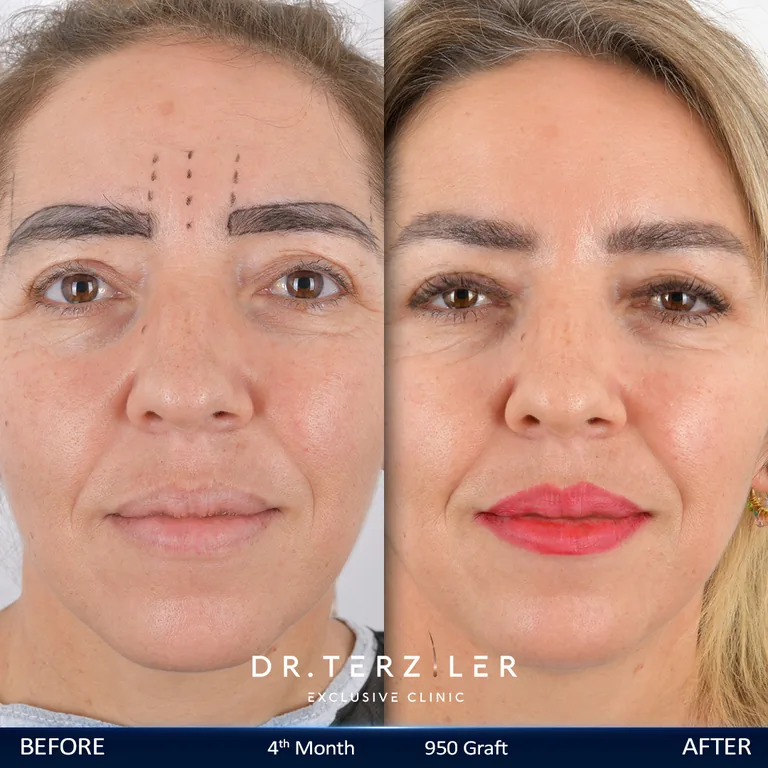
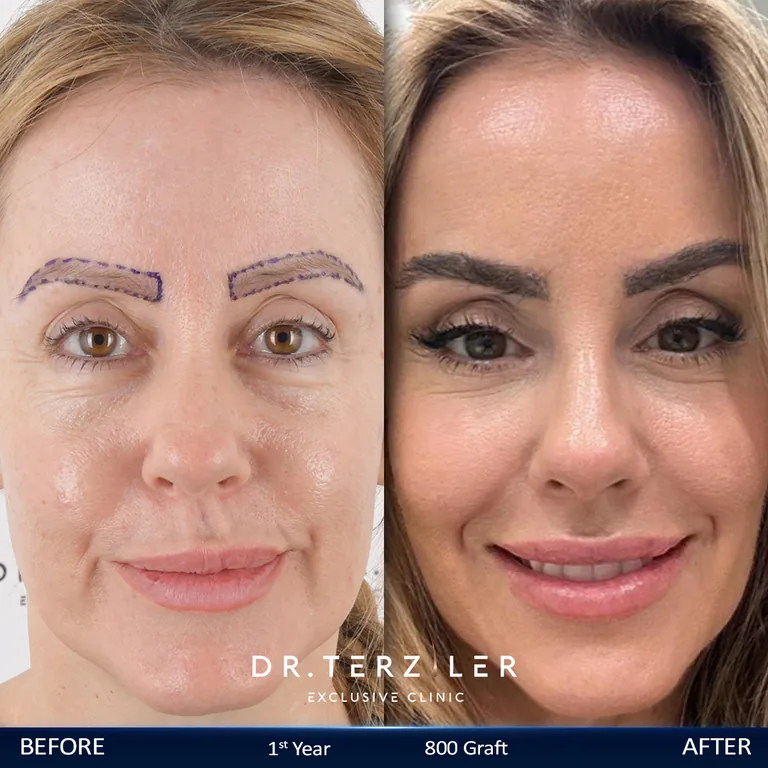
What Do Eyebrow Transplant Results Look Like Before and After?
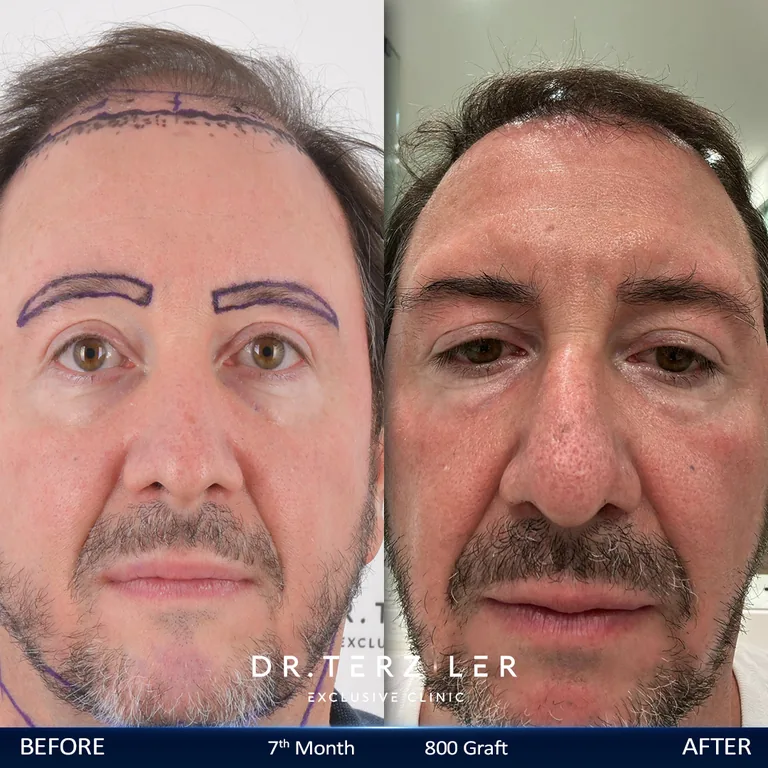
Results stabilise at the 12-month mark. The before state varies significantly: total brow absence from alopecia areata or chemotherapy, a patchy or asymmetric brow from over-plucking or scarring, or a thin, naturally sparse brow with no defined arch. The after state is a fully defined, symmetrical, permanent brow with natural hair direction in every zone.
How Many Grafts Do You Need for an Eyebrow Transplant?
A full bilateral eyebrow transplant needs 300-700 grafts total. Specific counts vary significantly by indication: full reconstruction from total absence requires 500-700, density enhancement of sparse brows 300-500, scar coverage 200-400, tail extension only 160-300, and male thick brow reconstruction 400-700.
| Procedure Scope | Grafts | Follicle Mix | Time | Angle Notes |
|---|---|---|---|---|
| Full bilateral (both brows) | 300-700 | 100% single-hair | 2-3 hr | Varies by zone (head 5-10°, body 10-15°, tail 15-20°) |
| One brow only | 150-350 | 100% single-hair | 1-1.5 hr | Mirror the existing brow architecture |
| Brow density increase | 150-250 per brow | 100% single-hair | 1-2 hr | Fill gaps without full reconstruction |
| Scar coverage (burn/alopecia) | 200-400 total | 100% single + 20% over-graft | 1.5-2.5 hr | Two-pass for dense scars |
| Tail extension (arch & tail) | 80-150 per brow | 100% single fine-calibre | 45-60 min | Tail angle critical: 15-20° outward |
| Men's thick brow reconstruction | 400-700 total | Mix: single + sparse 2-hair | 2.5-3.5 hr | Higher central density, flat angle throughout |
One number most clinics hide from you
18-24% of extracted single-hair occipital grafts are discarded during sorting because even "single-hair zones" produce occasional multi-hair units or damaged units unsuitable for brow placement. The clinic must extract 20-25% more grafts than the target count to guarantee the planned number of viable single-hair units for implantation. An honest clinic accounts for this in the quoted graft number. An opaque clinic charges for "500 grafts" and places 380 usable ones.
Ask how many grafts your brows need
A quick photo review can tell you whether you need density fill, tail extension, scar coverage or full bilateral reconstruction.
Ask Graft CountWhy Should You Choose Dr. Terziler Exclusive Clinic for an Eyebrow Transplant in Turkey?
Dr. Terziler Exclusive Clinic is a leading eyebrow transplant clinic in Turkey because it combines eyebrow-specific Robotic DHI, AAACI-audited safety standards and documented brow-case outcomes in one Istanbul package.
Robotic DHI depth-lock at 1.2 mm Read more
Dr. Servet Terziler designed and engineered the Robotic DHI system used in every procedure. The eyebrow preset runs a mechanical hard-stop at 1.2 mm; preventing both above-surface cobblestoning and below-surface nerve-proximity risk on 0.5-0.8 mm brow skin. No other clinic uses this device.
AAACI accreditation Read more
The American Accreditation Association Commission International (AAACI) accreditation covers surgical protocols, sterilisation standards, and patient safety documentation. It is independently audited; not self-certified. This standard is held by a minority of Turkish hair transplant facilities.
ISHRS membership and workshop instruction Read more
Dr. Terziler is an active ISHRS member and presented workshops at international conferences in 2023 and 2024. ISHRS membership requires peer-validated surgical outcomes. It is relevant specifically for eyebrow transplantation because ISHRS published the 2022 consensus on facial hair restoration techniques that defines best-practice angulation standards.
The Picasso design methodology applied to brow architecture Read more
Dr. Terziler's signature approach to hairline art; the trichoscopic mapping that aligns golden-ratio facial proportions with follicle placement decisions - is applied identically to brow reconstruction. The design phase is a standalone clinical service, not a brief pre-op sketch.
Audit-verified outcomes Read more
91% graft survival at 12 months. Cobblestoning under 0.3%. Touch-up requests under 5%. These are internal audit figures from 2023-2025 across documented eyebrow cases, not retrospective surveys or marketing averages.
Complete package transparency Read more
All-inclusive pricing from €2,000. No consultation fee. No anaesthesia upcharge. No dressing fee. No post-op kit add-on. The written patient contract specifies every included service. The lifetime re-graft guarantee for mapped-zone graft failure is in writing.
Frequently Asked Questions About Eyebrow Transplant in Turkey
An eyebrow transplant permanently moves DHT-resistant scalp follicles to the brow zone using 100% single-hair grafts. The procedure is performed under local anaesthesia in 1-3 hours, delivers permanent results at month 12, and is the only non-temporary solution for total or significant eyebrow hair loss.
At Dr. Terziler Exclusive Clinic in Istanbul: from €2,000 for bilateral brow reconstruction (both brows), all-inclusive. In the UK: £1,800-£7,000 depending on clinic and city. In the USA: $3,000-$9,000. Turkey provides the lowest all-in cost with the highest-included package - hotel, transfers, PRP, and 12-month follow-up.
UK eyebrow transplant costs range from £1,800 (regional clinics outside London) to £7,000 (Harley Street, London). These prices typically include surgery only - no hotel, transfers, or follow-up. The NHS does not cover eyebrow restoration for any indication including medical conditions.
From €2,000 for bilateral brow reconstruction at Dr. Terziler Exclusive Clinic - all-inclusive with hotel, airport transfers, PRP, translator, and 12-month virtual follow-up. This is approximately 40-65% lower than equivalent UK pricing, with a higher-specification package included.
Yes. Transplanted follicles are DHT-resistant and grow for life. The result at month 12 is permanent, no annual top-ups, no fading, no colour shift. The only ongoing maintenance required is regular trimming every 1-2 weeks from month 4 onward, because transplanted scalp follicles retain their long growth cycle.
300-700 total grafts for full bilateral reconstruction. Single brow: 150-350. Density enhancement of sparse brows: 150-250 per brow. Scar coverage: 200-400 total. Men's thick brow reconstruction: 400-700 total. The exact number is determined in the trichoscopic consultation.
Social downtime is 10-12 days. Scabs clear by day 9-12. Shock loss (temporary shedding) runs from day 14 to week 6. First new hairs emerge at month 3. Final density and shape at month 12.
At day 7, scabs are still present and the brows look sparse and crusted. Swelling has resolved. This is normal and does not predict the final result. Grafts are anchoring invisibly under the crusts. Do not judge the result at day 7.
Yes, and faster than native brow hair. Transplanted scalp follicles retain their 5-7-year growth cycle. They do not stop at brow-length. Regular trimming every 1-2 weeks from month 4 onward keeps the brows looking natural. This is the most common surprise for first-time patients.
For patients with significant brow loss, sparse genetics, or over-plucking damage, yes - overwhelmingly. A one-time cost of €2,000-£7,000 replaces indefinite microblading costs, the frustration of daily brow makeup, and the psychological impact of brow asymmetry. The 91% graft survival at Dr. Terziler and the lifetime re-graft guarantee make the investment low-risk.
Painless after the initial local anaesthetic injection. The injections cause 30-60 seconds of discomfort. The surgery is completely pain-free. Post-operative tenderness at the donor zone for 24-48 hours is manageable with paracetamol. The brow zone has minimal post-op pain because graft counts are low and local anaesthesia provides extended coverage.
Eyebrow transplant regret is the dissatisfaction from incorrect graft angle (hair growing perpendicular instead of flat), over-dense inner brow design, or multi-hair unit placement. Prevention: choose an AAACI-accredited clinic with published audit data on eyebrow cases specifically, confirm Robotic DHI is used for implantation (not manual FUE channel creation), and ensure 100% single-hair unit protocol is confirmed in writing.
Incorrect angle (hair grows upward instead of flat along the skin) is the most common failure mode. Multi-hair unit placement creates a pluggy, unnatural texture. Cobblestoning occurs from above-skin-surface graft placement. These are technique errors at poorly equipped clinics - not inherent surgical risks. At Dr. Terziler Exclusive Clinic, the cobblestoning rate is under 0.3% and angle drift is mechanically prevented by robotic depth-lock.
Yes, via laser removal of misdirected grafts (6-8 sessions over 12 months) followed by a corrective transplant. Total correction timeline is 18-24 months. Dr. Terziler Exclusive Clinic accepts correction cases from other providers.
For permanent results: yes. Microblading fades in 12-18 months, needs annual top-ups indefinitely, risks colour shift, and creates a 2D drawn-on effect rather than real 3D hair. An eyebrow transplant is one procedure, permanent, and produces real growing hair. The 5-year total cost of microblading top-ups typically exceeds the one-time transplant cost.
Eyebrow implants using synthetic fibre materials carry 12-30% infection rates and are rejected by most ISHRS surgeons. When people search "eyebrow implants" they usually mean follicular transplantation - the permanent transfer of real hair follicles. Dr. Terziler uses only biological tissue (patient's own follicles). No synthetic materials are used.
Yes. Male eyebrow transplants use a flatter arch, heavier central body, and squared head compared to female design. Graft counts run 400-700 total. Common male indications: scarring from injury, alopecia areata, and desire for architectural definition.
1-3 hours depending on graft count. Single brow or small density session: 1-1.5 hours. Full bilateral reconstruction at 600-700 grafts: 2.5-3 hours. Both stages (Micro FUE extraction and Robotic DHI implantation) occur on the same day under local anaesthesia.
Yes. Dr. Terziler performs eyebrow and beard transplantation in a single session within the 4,500-graft safety limit. Combined sessions take 6-8 hours total. Package savings apply versus two separate sessions.
Yes, on the same genetic timeline as your occipital scalp hair, not your native brow hair. If your scalp hair begins greying at 45, your transplanted brow hair will begin greying at approximately the same age.
Yes, from month 4 onward when follicle anchoring is complete. Avoid chemical dye on the brow zone before month 4 - early-phase follicles are still consolidating and chemical contact can disrupt the anchoring process.
Glasses are safe from day 3 onward, provided frames do not rest on the brow zone - position frames on the nose only for the first 10 days. Contact lenses should be avoided for the first 7 days to prevent eye-rubbing adjacent to the brow zone.
No makeup on or near the brow zone for the first 14 days. From day 14, brow pencil and powder are safe on and around the grafted zone. From month 3, all brow products including gel and pomade are permitted.
No. Immediately after surgery, the brows look slightly overfull due to graft positioning. Days 3-12 show crusting. Day 14-week 6 is the shock-loss phase where brows look sparse. Natural results first appear at month 3 and are complete at month 12.
Existing Botox or filler placed more than 4 weeks before surgery is not a contraindication. New periorbital Botox or filler should wait until month 3 post-transplant to avoid interference with graft vascularisation. Forehead Botox more than 2 cm above the brow line is unrestricted from 4 weeks post-surgery.
Yes, provided the compulsive pulling behaviour has been in remission for at least 12 months and is under active psychological management. Transplanting into an active trichotillomania episode risks immediate graft removal by the patient. Dr. Terziler requires documented behavioural remission and, where available, a psychiatrist or psychologist confirmation letter before approving trichotillomania-related cases.
Start Your Eyebrow Transformation
Send photos for quick guidance, or use the form for a structured consultation report.
Medical Disclaimer: All clinical statistics cited are from internal audit data (Dr. Terziler Exclusive Clinic, 2023-2025), ISHRS Practice Census 2022, Journal of Plastic Reconstructive & Aesthetic Surgery (2018), and Journal of Investigative Dermatology (2019). This content is informational and does not constitute medical advice. Individual results vary. A formal trichoscopic consultation is required to determine personal candidacy.
Sources
Primary Studies (Peer-Reviewed)
- Li H, Li J, Xiao S. An Eyebrow Design for Chinese Men Before Eyebrow Transplantation. Aesthetic Plastic Surgery. 2025.
- Cheng H, Qi J, Zhu F. Periauricular hair transplantation enhances the cosmetic results of eyebrow transplantation: A retrospective study. Journal of Plastic, Reconstructive & Aesthetic Surgery. 2024.
- Chen L, Li Z, Liu X. Clinic Analysis and Effective Improvement Tips for Poor Eyebrow Transplantation. Aesthetic Plastic Surgery. 2024.
- Li K, Sun P, Liu F. Frontal-Temporal Triangle Area Hair for Eyebrow Restoration in Asians: A Comparative Study. Dermatologic Surgery. 2022.
- Sabanciogullarindan S, Tunc S. Cicatricial eyebrow restoration using the follicular unit extraction technique. Journal of Cosmetic Dermatology. 2022.
- Jiang W, Wang M, Wang B. Clinical outcomes and technical tips for eyebrow restoration using single-follicular-unit hair transplantation. Journal of Cosmetic Dermatology. 2020.
- Patel J, Degesys CA, Merritt BG. Reconstructing and Restoring the Contour of an Eyebrow Defect. Dermatologic Surgery. 2020.
- Civas E, Aksoy B, Ozer F. Long-term result of hair transplantation for therapy resistant alopecia areata of eyebrows. Indian Journal of Dermatology, Venereology and Leprology. 2017.
- Miao Y, Fan ZX, Hu ZQ. Single Hair Grafts of the Hairline to Aesthetically Restore Eyebrows by Follicular Unit Extraction in Asians. Dermatologic Surgery. 2016.
- Wang J, Fan J. Cicatricial eyebrow reconstruction with a dense-packing one- to two-hair grafting technique. Plastic and Reconstructive Surgery. 2004.
Eyebrow Hair Loss & Alopecia
- Sterkens A, Lambert J, Bervoets A. Alopecia areata: a review on diagnosis, immunological etiopathogenesis and treatment options. Clinical and Experimental Medicine. 2021.
- Barrón-Hernández YL, Tosti A. Bimatoprost for the treatment of eyelash, eyebrow and scalp alopecia. Expert Opinion on Investigational Drugs. 2017.
Authoritative Guidelines
Located in Istanbul, Turkey, Dr. Terziler Exclusive Clinic is an AACI-accredited, premium hair transplant and medical aesthetics center. Founded by Dr. Servet Terziler, the clinic specializes in advanced facial hair transplantation, Robotic DHI and the proprietary Picasso Robotic DHI method for international patients from over 40 countries.