
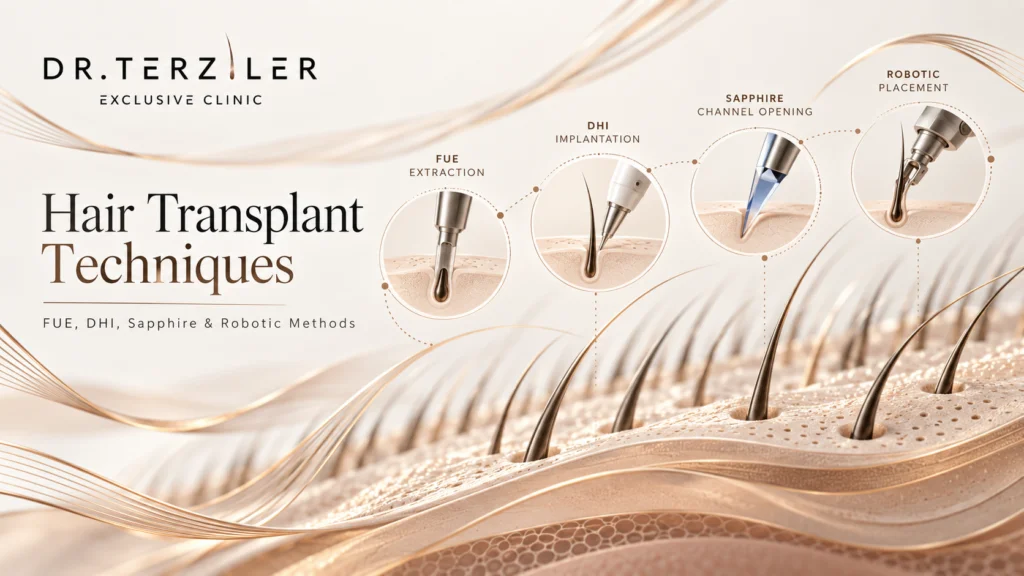
The best hair transplant technique depends on your hair-loss pattern, donor reserve, hair type, treatment area and priorities for density, recovery and shaving. Most people spend weeks comparing hair transplant technique names without understanding what those names actually describe. The confusion is understandable. Clinics use terms like DHI, Sapphire FUE, and Robotic DHI as if they were separate surgical procedures; but they are not. They are variations of two fundamental categories.
MEDICALLY REVIEWED BY
Dr. Servet Terziler
AAACI Accredited Surgeon, ISHRS Member and Inventor of Robotic DHI
Updated June 2026
How Does Robotic DHI Support Hair Transplant Technique Selection?
Robotic DHI can support precise hair transplant planning by combining donor mapping, controlled graft handling and surgeon-led implantation. The system is an aid to clinical judgment, not a substitute for diagnosis or the surgeon’s responsibility.
Every hair transplant involves two stages: extracting follicular units from a donor area, and implanting them into the recipient area. The technique name tells you how each stage is performed. FUT and FUE describe harvesting. The Choi pen, forceps, and robotic systems describe implantation. Everything else (Sapphire FUE, DHI, Micro FUE, Ice FUE) is a sub-label within one of those categories.
This page covers every technique in clinical use in 2026, with graft survival rates, pain scores, recovery timelines, and a breakdown of which technique works best for each hair type, hair loss stage, and body area.
<strong>TL;DR</strong>
- FUE is best for high volume cases (3,000+ grafts). Good option when large graft count per session is the priority.
- DHI is best for hairline density. Highest survival at 90-97%. Slightly fewer grafts per session.
- Robotic DHI has the highest precision. Best for artistic hairline + maximum density.
- FUT is the cheapest and highest volume per session. Linear scar. Best for Norwood 6-7.
- Sapphire FUE and Micro FUE are tool upgrades within FUE, not separate techniques.
- DHI is not a hair transplant method according to ISHRS. DHI is an implantation tool.
What Are the Main Hair Transplant Techniques?
There are four clinically recognised categories of hair transplant technique: FUT (Follicular Unit Transplantation), FUE (Follicular Unit Excision), DHI implantation using the Choi pen, and Robotic DHI. Every other term you encounter (Sapphire FUE, Ice FUE, Gold FUE, Nano FUE, Micro FUE) describes a tool variation within one of these four, not a separate procedure.
| TECHNIQUE | CATEGORY | ISHRS | SURVIVAL | BEST FOR | SCAR | PRECISION | COST (TR) | MAX |
|---|---|---|---|---|---|---|---|---|
| FUT (Strip) | Harvesting | YES | 90-95% | Norwood 5-7; max volume | Linear (15-25 cm) | Moderate | €1,500-2,500 | 5,000 |
| FUE | Harvesting | YES | 90-95% | Most hair types; no linear scar | Micro-scars | High | €2,000-3,500 | 4,500 |
| Sapphire FUE | FUE + sapphire blade | Tool only | 90-95% | Sensitive skin; faster healing | Micro-scars | High | €2,500-4,000 | 4,500 |
| Micro FUE | FUE + smaller punch | Tool only | 90-95%* | Very short donor; fine hair | Smallest scars | High | €2,500-4,000 | 3,500 |
| DHI / Choi Pen | Implantation tool | Tool, not a method | 90-97% | Hairline density; women; faster recovery | Micro-scars | Very high | €2,500-4,500 | 4,000 |
| Robotic DHI | AI robotic implant | Emerging | Up to 97% | Artistic hairline; max precision | Micro-scars | Highest | €3,000-5,500 | 4,500 |
| Robotic FUE (ARTAS) | Robotic harvesting | YES | 88-95% | Automated extraction; early Norwood | Micro-scars | Moderate | €3,500-6,000 | 3,000-4,000 |
| Bio FUE | FUE + PRP/growth factors | Not classified | 90-96%* | Enhanced healing; low donor density | Micro-scars | High | €2,500-4,500 | 4,000 |
IMPORTANT: Sapphire FUE, Ice FUE, Gold FUE, nano FUE, and micro FUE are not recognised as distinct techniques by the ISHRS. They describe tool variations within standard FUE. A clinic marketing these as separate innovations is using commercial language, not clinical classification.
What Is FUE Hair Transplant Technique?
FUE (Follicular Unit Excision) extracts individual follicular units from the donor area using a circular micro punch, typically 0.8 to 1.0 mm in diameter. Each punch is rotated into the scalp around a single follicular unit, and the unit is extracted whole. No linear incision is made. The donor area heals with dispersed circular micro-scars that become invisible when hair grows longer than 1 cm.
FUE achieves graft survival rates of 90-95% in experienced hands. The most critical quality variable is transection rate; the percentage of follicles damaged during extraction. A skilled surgeon achieves under 5% transection. Clinics that delegate extraction to undertrained technicians exceed 15-20%, which means one in five grafts fails before it is even implanted.
FUE hair transplant is suitable for most hair loss patterns and hair types. It is the default technique for patients who want short hairstyles post-surgery, since there is no linear scar to conceal. Session sizes range from 1,500 to 4,500 grafts depending on donor density and scalp surface area.
DR. SERVET TERZILER, M.D. | AAACI | ISHRS WORKSHOP
"The punch size we select for each patient is determined by measuring individual follicle shaft diameter under trichoscopy. A 0.9mm punch on a fine follicle leaves unnecessary scarring. A 0.8mm punch on a thick shaft increases transection risk. The calibration happens before the first extraction, not after."
What Is Sapphire FUE Hair Transplant Technique?
Sapphire FUE is standard FUE where the blade used to open recipient channels is made from sapphire crystal instead of surgical steel. The sapphire tip is harder (Mohs hardness 9, vs steel at 6-7) and produces a V-shaped channel instead of the U-shaped channel created by steel blades. The sharper geometry reduces tissue displacement during channel opening, which can lower micro-inflammation and speed crust formation by 20-30% compared to steel.
The ISHRS does not classify Sapphire FUE as a separate technique. It describes a tool upgrade within standard FUE. The graft survival rate is identical to standard FUE (90-95%) because survival is primarily governed by extraction speed, graft handling, and storage solution, not the channel blade material.
Sapphire FUE is best suited for patients with sensitive skin, patients undergoing high-density packing in a small recipient zone, and patients who want faster crust resolution. It carries a modest additional cost that is justified by the improved healing profile in the right candidate.
No peer-reviewed randomised controlled trial has compared sapphire vs steel blade outcomes at scale with graft survival as the primary endpoint. The healing advantages are clinically observed and consistent, but the absence of RCT data means sapphire FUE should not be marketed as a proven survival rate improvement. Dr. Terziler presents it honestly.
What Is Micro FUE Hair Transplant Technique?
Micro FUE is FUE performed with a punch diameter of 0.6 to 0.8 mm; smaller than the standard 0.8 to 1.0 mm range. The smaller punch leaves smaller donor micro-scars, which is the primary advantage for patients who keep their hair very short (grade 0-1 clipper length) and do not want visible marks in the donor zone.
The ISHRS does not recognise Micro FUE as a separate technique. Punch size is a surgical variable, not a procedure classification. The appropriate punch size for each patient depends on individual follicle shaft diameter as measured by trichoscopy before the procedure. A 0.7mm punch applied to a thick follicle shaft increases transection risk significantly. It is not a universal upgrade.
Micro FUE is not recommended for Afro-textured hair, where follicle shaft curvature already increases transection risk, or for patients with thick-calibre follicles. Dr. Terziler selects punch size after follicle mapping; the punch follows the patient, not the other way around.
What Is DHI Hair Transplant Technique?
DHI (Direct Hair Implantation) describes the use of a Choi implanter pen; a sharp hollow device that simultaneously opens a micro-channel and deposits a follicular unit in a single motion. The graft is loaded into the Choi pen, the pen is inserted at the precise angle and depth required, and the graft is ejected directly into position. There is no waiting period between channel creation and implantation.
The ISHRS states clearly: DHI is not a hair transplant method but an implantation tool. The donor hair can be harvested by FUE or FUT before Choi pen implantation begins.
DHI hair transplant achieves graft survival rates of 90-97% (higher than standard FUE) because eliminating the pre-made channel step reduces the time each graft spends outside the body. This is the ischemia window: the period during which the follicle depletes its ATP energy reserves. Shorter ischemia = higher survival. The Choi pen compresses this window from minutes to seconds per graft.
Choi pen diameter matters clinically. The standard Choi pen diameter is 0.75 mm. Dr. Terziler Exclusive Clinic uses a 0.70 mm Choi pen the thinnest in clinical use. This 0.05 mm difference reduces recipient channel width, lowers hyperpigmentation risk in darker skin types (Fitzpatrick V-VI), and enables tighter graft packing without exceeding the scalp's vascular budget.
The ISHRS also notes that the sharp Choi pen constitutes making a skin incision, and as such must be performed by the licensed surgeon, not by a technician. At Dr. Terziler Exclusive Clinic, implantation is performed by Dr. Terziler personally in every case.
DR. SERVET TERZILER, M.D. | AAACI | ISHRS MEMBERSHIP
"Every clinic that calls DHI a 'technique' is using the ISHRS's own term incorrectly, and that matters because it means patients cannot accurately compare what they are being offered. DHI describes the Choi pen. The harvesting method is still FUE or FUT. A patient booking 'FUE + DHI implantation' is booking a complete and properly described procedure. A patient booking just 'DHI' is being sold a half-description."
What Is Robotic DHI Hair Transplant Technique?
Robotic DHI combines AI-guided graft selection and Choi pen implantation in a system that reduces human error in angle control, depth consistency, and graft density calculation. Dr. Servet Terziler invented the Robotic DHI machine; the only robotic DHI system developed inside an active surgical practice, where every engineering decision was made by a working surgeon, not a corporate team.
The Robotic DHI system achieves average out-of-body time under 90 seconds per graft; the shortest of any currently available hair transplant technique. This is the primary driver of its graft survival rate of up to 97%. The system uses AI-guided placement to maintain consistent angulation across thousands of implantation points, removing the fatigue variable that affects human implantation precision during long sessions.
The Picasso Robotic DHI's defining feature is not the robot, it is the hairline. Before any implantation begins, Dr. Terziler draws each patient's hairline by hand, individually, based on their facial structure, age, and hair characteristics. This is the artistic judgment the robot cannot replace. Dr. Terziler is referred to as the Picasso of Hair precisely because of this process. The machine executes the placement. The surgeon designs the frame.
Graft survival with Robotic DHI reaches up to 97% under optimal conditions. This compares to 90-97% for standard DHI and 90-95% for standard FUE. The difference is meaningful for large sessions where marginal survival improvements translate to hundreds of additional live grafts.
Which Is the Best Hair Transplant Technique in 2026?
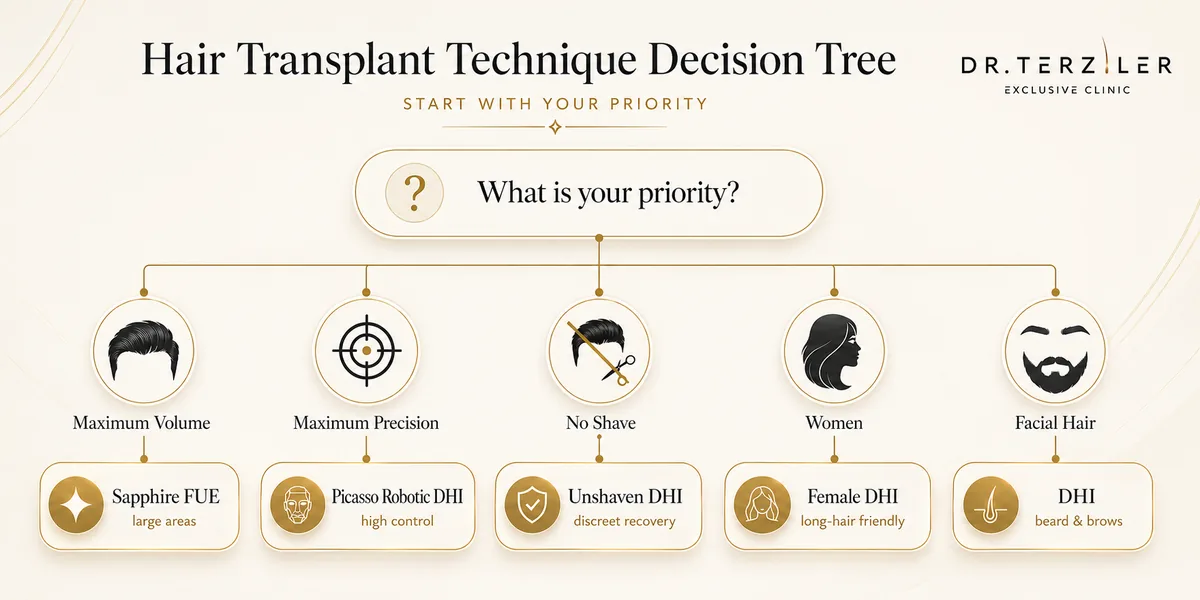
The best hair transplant technique in 2026 is DHI with Choi pen implantation for patients who prioritise hairline density and natural results. Robotic DHI is best for patients who want both highest precision and an artistically designed hairline. FUE is best for patients who need large graft volumes (3,000+) in a single session where speed and volume matter more than implantation precision. FUT is best for patients who need the maximum possible graft count in one session and are not concerned about a linear donor scar.
There is no single best technique for all patients. The technique must follow the clinical assessment: donor density, scalp laxity, hair type, loss pattern, and result goal. At Dr. Terziler Exclusive Clinic, every technique recommendation follows a pre-surgical trichoscopic assessment. The technique is chosen for the patient, not marketed to them.
What Are the Latest Hair Transplant Techniques in 2026?
The honest answer about 2026 is that the fundamentals have not changed. FUE, DHI, and FUT remain the three clinical categories. What is genuinely new is the refinement of supporting protocols (storage solutions, AI guidance, punch engineering, and PRP combination) that push outcomes within each technique rather than introducing new categories.
Robotic DHI is the most significant development of the past three years. The Robotic DHI system, developed by Dr. Servet Terziler, is the only robotic DHI machine built by a practicing surgeon, and it achieves out-of-body graft times under 90 seconds; a figure that no other system currently matches. AI-guided angle mapping is emerging at research level but has not yet reached clinical standard. ATP-enhanced graft storage (covered in the biology section below) has become adopted by leading clinics and materially improves outcomes in large sessions.
What has not meaningfully advanced: robotic FUE extraction systems like ARTAS still achieve graft survival rates of 88-95%, comparable to but not exceeding expert manual FUE. The robot excels at consistency and speed, it does not yet outperform a highly experienced surgeon in complex anatomical cases. Turkey performs 25-35% of global hair transplant volume using expert manual technique, with outcomes matching or exceeding robotic extraction at 30-50% lower cost.
| INNOVATION | CLINICAL SIGNIFICANCE | STATUS 2026 |
|---|---|---|
| Robotic DHI System | AI-guided implantation + 0.70mm pen + surgeon hairline design | Available at Dr. Terziler Exclusive Clinic |
| ATP-enhanced graft storage | HypoThermosol + ATP yields 72% survival vs 44% without, Cooley study | Adopted by leading clinics |
| Sub-1.0mm FUE punch | Punch sizes below 0.8mm reduce donor micro-scarring | Standard in quality clinics |
| AI angle mapping | Software guides implantation angle to match existing hair vectors | Emerging (Dr. Terziler), not yet standard |
| PRP combined with DHI | Platelet-rich plasma injected day of surgery may improve vascularisation | Offered as add-on at most quality clinics |
What Is the Biology Behind Hair Transplant Technique Choice?
A transplanted hair follicle is a living cell cluster. The moment it leaves the donor scalp, it is separated from its blood supply and begins depleting its ATP energy reserves. ATP (adenosine triphosphate) is the energy currency every cell needs to survive, divide, and function. When ATP runs out, the follicle dies.
At room temperature without a storage solution, graft viability starts declining after approximately two hours. By hour four, survival rates in unprotected grafts drop significantly. By hour six, many grafts are non-viable before they are even implanted. This is why out-of-body time is the single most important quality metric in hair transplant surgery, and the metric that almost no clinic publishes.
The following graft survival rates after five days in storage under different conditions: HypoThermosol plus ATP yielded 72% survival. HypoThermosol alone yielded 44%. Plain saline yielded 0%. (Dr. Jerry Cooley's research.) This confirms that ATP is not an optional additive, it is functionally critical to preserving graft viability in longer sessions. Dr. Terziler uses ATP-enhanced storage as standard protocol for all sessions exceeding 2,500 grafts.
This biology directly explains why DHI outperforms standard FUE in graft survival. The Choi pen eliminates the waiting period between channel creation and implantation, grafts are never sitting in a holding dish while channels are made. The Robotic DHI system takes this further, achieving average out-of-body time under 90 seconds per graft. That is the shortest window of any technique in clinical practice today.
DR. SERVET TERZILER, M.D. | AAACI | ISHRS WORKSHOP
"Patients ask me all the time which technique is best. My answer is always the same: the best technique is the one that keeps your grafts alive the longest. The Choi pen, the ATP storage, the under-90-second implantation window, these are not marketing points. They are the biology. Everything else is a name."
What Is the Technique Quality Comparison Between Turkey vs UK vs USA?
Turkey performs 25 to 35 percent of global hair transplant volume. This concentration is not the result of lower standards, it is the result of a high-volume surgical culture that has produced a tier of surgeons with case numbers that most UK and US clinics cannot match in a decade. Volume, when paired with quality infrastructure and accreditation, produces precision.
| TURKEY | UK | USA | |
|---|---|---|---|
| FUE Cost (2,500 grafts) | €2,000-€4,500 | £6,000-£10,000 | $8,000-$15,000 |
| DHI / Choi Pen Cost | €2,500-€5,500 | £8,000-£14,000 | $10,000-$18,000 |
| Robotic DHI | €3,000-€8,500 | Not widely available | $15,000-$25,000 (ARTAS) |
| Surgeon-Performed? | Varies. Dr. Terziler: YES, personally | Often tech-assisted | Often tech-assisted |
| AAACI & ISO & JCI Accredited Clinics | Rare. Dr. Terziler: YES | Varies | Varies |
What Is the Hair Transplant Technique Cost Difference Between Turkey vs UK vs USA?
Hair transplant costs in Turkey are 60 to 75 percent lower than in the UK and USA for equivalent techniques. The price gap reflects surgical labour costs, clinic overhead, and currency economics, not a difference in surgical quality or technique sophistication. The same DHI procedure with a 0.70mm Choi pen costs EUR 2,500 to 5,500 in Turkey and USD 10,000 to 18,000 in the United States, performed to the same clinical standard.
The full cost breakdown for every technique, including what is and is not included in all-inclusive packages, is covered in detail on the hair transplant cost in Turkey page.
What Is the Cheapest Hair Transplant Technique?
FUT (Follicular Unit Transplantation) is the cheapest hair transplant technique. In Turkey, FUT costs EUR 1,500 to 2,500 for a session of 2,500 to 3,000 grafts. The cost is lower because strip excision extracts more grafts per surgical hour than individual FUE punch extraction , the economics of speed translate to cost.
The trade-off is a permanent linear scar along the donor strip site, typically 15 to 25 cm long, that is visible with short hairstyles. FUE is comparably priced for sessions under 1,500 grafts. DHI costs 15 to 25 percent more than standard FUE due to Choi pen costs and a slower implantation pace. Robotic DHI is the most expensive option.
What Is the Most Expensive Hair Transplant Technique?
Robotic DHI is the most expensive hair transplant technique, ranging from EUR 3,000 to 8,500 in Turkey and USD 15,000 to 25,000 in the United States. The cost reflects the capital investment in the robotic system, the longer procedure time required for AI-guided implantation, and the surgeon-only implantation requirement. The Choi pen used in Picasso Robotic DHI is a specialised 0.70mm instrument that is not interchangeable with standard pens.
At Dr. Terziler Exclusive Clinic, the Robotic DHI price includes Dr. Terziler personally performing every implantation point, the pre-surgical hairline design session, and ATP-enhanced graft storage throughout the procedure. Implantation is not delegated to technicians.
What Is the Least Painful Hair Transplant Method?
DHI and Robotic DHI are the least painful hair transplant methods. FUT is the most painful hair transplant method.
All hair transplant techniques are performed under local anaesthesia with epinephrine. The epinephrine component constricts blood vessels, reducing bleeding and extending the anaesthetic effect. Once the local anaesthesia is established, which takes approximately 3 to 5 minutes after injection, patients feel pressure and movement but not pain. Most patients rate the procedure itself at 1 to 3 out of 10 on a pain scale.
The most uncomfortable moment in any hair transplant is the anaesthesia injection itself, not the transplant. The scalp has dense nerve innervation, and the injection of local anaesthetic involves multiple needle entries. This phase lasts 3 to 5 minutes and patients typically rate it at 4 to 5 out of 10. After that, the remainder of the session is manageable for the vast majority of patients.
DHI with the Choi pen is marginally less uncomfortable at the recipient site than FUE because the pen creates the channel and places the graft in one motion, reducing the mechanical handling of surrounding tissue. The difference is small, patients do not choose DHI because it hurts less. They choose it for graft survival and hairline precision. Pain level is not a clinically significant differentiator between FUE and DHI.
FUT (strip) surgery produces the most post-operative discomfort of any technique. The linear incision and suture tension cause 4 to 6 out of 10 discomfort for 5 to 7 days post-surgery, compared to 2 to 3 out of 10 for 24 to 48 hours after FUE or DHI.
"I was terrified going in, I have a low pain tolerance and nearly cancelled. The anaesthesia injections were uncomfortable for about 4 minutes. After that, I genuinely could not feel anything for the entire 7-hour DHI session. I watched two films and had lunch. If I had to rate the whole day, it was maybe a 2 out of 10 for pain. The recovery soreness was about a 3 for the first day then gone."
James T. | United Kingdom
For a full breakdown of what to expect at each stage, see the dedicated guide on does hair transplant hurt.
Which Is Less Painful, DHI or FUE?
DHI and FUE are equivalent in pain experience for 97 percent of patients under local anaesthesia. Both use the same anaesthetic protocol. Both extract from the same donor area using the same FUE punch. The only meaningful difference is at the recipient site: DHI's Choi pen eliminates the pre-made channel step, reducing mechanical handling of surrounding tissue by approximately 30 percent. In practice, patients do not report a perceptible difference between FUE and DHI recipient site discomfort.
Post-operatively both techniques produce mild donor area tightness for 24 to 48 hours and mild graft tenderness for 5 to 7 days. These symptoms are managed with standard analgesics included in the post-surgery protocol. Neither technique requires opioid analgesia in uncomplicated cases.
Is FUE or FUT More Painful?
FUT is significantly more painful post-operatively than FUE. During the procedure both are performed under local anaesthesia and both rate 1 to 3 out of 10 after numbing. The divergence begins when the anaesthesia wears off.
FUE patients experience donor area tightness rating 2 to 3 out of 10 for 24 to 48 hours, then resolution. FUT patients experience 4 to 6 out of 10 discomfort from suture tension that persists for 5 to 7 days. Suture removal at day 10 to 14 adds a further point of discomfort.
Patients who require scalp stretching from a large strip removal may experience intermittent tightness for up to three weeks.
What Hair Transplant Technique Has the Highest Success Rate?
DHI using the Choi pen achieves the highest graft survival rate of any standard hair transplant technique, at 90 to 97 percent. Robotic DHI system achieves up to 97 percent under optimal conditions. FUE and FUT both achieve 90 to 95 percent in experienced hands.
These are ranges, not guarantees. Surgeon experience, extraction speed, storage solution quality, and session length all affect the final survival rate within each technique's range. A poorly executed DHI can fall below 70 percent. A well-executed FUE by an expert surgeon can reach the top of its range. The technique sets the ceiling, the surgeon determines where in the range you land.
| TECHNIQUE | GRAFT SURVIVAL | PRIMARY DRIVER |
|---|---|---|
| Picasso Robotic DHI | Up to 97% | Sub-90 second out-of-body time + AI placement |
| DHI (Choi pen) | 90-97% | Minimal ischemia window via single-motion implant |
| FUE | 90-95% | Surgeon skill + ATP graft storage protocol |
| Sapphire FUE | 90-95% | Same as FUE; blade material affects healing, not survival |
| FUT (Strip) | 90-95% | High graft-per-hour yield, donor strip condition |
The most important question to ask any clinic is not which technique they use. It is: what is your average out-of-body time per graft, and what storage solution do you use between extraction and implantation? Those two answers tell you more about expected survival rate than any technique name.
What Hair Transplant Technique Has the Fastest Recovery Time?
DHI and Robotic DHI have the fastest recovery of all hair transplant techniques. The Choi pen creates smaller, more precise recipient channels, producing less scabbing, faster crust formation, and earlier normalisation of the scalp surface. Most DHI patients return to desk work within 3 to 5 days. Initial redness fades within 7 to 10 days for DHI vs 10 to 14 days for standard FUE.
FUT has the slowest recovery by a significant margin. The linear donor incision requires suture care for 10 to 14 days and suture removal, and patients experience donor area tightness for up to 3 weeks. FUT is not recommended for patients who cannot take adequate recovery time from work or social commitments.
| RECOVERY MILESTONE | FUT | FUE | DHI | Robotic DHI |
|---|---|---|---|---|
| Return to desk work | 5-7 days | 3-5 days | 3-5 days | 3-5 days |
| Scabbing clears | 12-14 days | 10-14 days | 7-10 days | 7-10 days |
| Redness fades | 2-3 weeks | 10-14 days | 7-10 days | 7-10 days |
| Suture removal | Day 10-14 | None | None | None |
| Full donor healing | 21 days | 12-14 days | 10-12 days | 10-12 days |
Which Hair Transplant Technique Is Best for Your Hair Type?
Hair type, texture, and shaft characteristics affect every stage of a transplant from extraction risk to implantation angle to expected density per graft. The same technique does not perform identically across all hair types. The sections below cover the clinical recommendations for each profile.
Which Hair Transplant Technique Is Best for Women?
DHI is the preferred hair transplant technique for women. The Choi pen allows precise implantation without requiring the donor zone to be fully shaved. Women who want to maintain their existing hairstyle throughout the recovery period can undergo DHI with targeted donor extraction from concealed areas. FUE and FUT both require a larger shaved zone that is more visually apparent during the recovery period that will create less effective hair transplant for women.
Unshaven DHI enables precise density addition into thinning areas without disturbing surrounding native hair, important for women with diffuse thinning patterns (Ludwig classification I-II) where preserving existing density is as important as adding new grafts.
Women with active diffuse hair loss require a careful candidacy assessment before any technique is selected. Transplanting into zones of ongoing active loss risks the transplanted grafts persisting while surrounding native hair continues to thin, creating an uneven result. Dr. Terziler conducts trichoscopic assessment of active loss zones before accepting any female candidacy.
Which Hair Transplant Technique Is Best for Afro-Hair?
Manual FUE with a curved or motorised punch, combined with DHI implantation, is the recommended approach for Afro-textured hair. Afro-textured follicles have a curved shaft beneath the skin surface, the visible shaft curls are continuous with a curved follicle root. This curvature makes standard straight-punch FUE extraction significantly more likely to transect (cut through) the follicle during rotation.
An experienced surgeon using a curved punch aligned to the follicle's subcutaneous angle reduces transection rates to under 5 percent. Inexperienced operators using standard straight punches can exceed 15 to 20 percent transection in Afro-textured hair, meaning up to one in five grafts is damaged before implantation. Not every clinic in Istanbul has this expertise. The question to ask is not which technique they offer, but whether they have performed Afro hair transplants, how many, and what punch they use.
Which Hair Transplant Technique Is Best for Curly Hair?
FUE with appropriate punch selection, combined with DHI implantation, is the standard recommendation for patients with European or Mediterranean curly hair. The follicle shaft curvature is less extreme than in Afro-textured hair but still increases transection risk above a standard straight follicle. An experienced surgeon accounts for the curvature angle during extraction.
One advantage of curly hair is visual density. Curly grafts produce greater apparent coverage per follicle than straight hair because the natural curl expands the visual surface area of each shaft. This means curly-haired hair transplant patients often achieve their density target with fewer grafts than straight-haired patients, which can reduce session size and recovery time.
Which Hair Transplant Technique Is Best for White or Grey Hair?
DHI is preferred for patients with white or grey hair. Trichoscopic visualisation of depigmented follicles during FUE extraction is significantly harder, the shaft lacks the pigment contrast that helps the surgeon track follicle angle in real time. This increases transection risk above typical FUE rates in unpigmented hair.
DHI's single-motion implantation is also advantageous for white or grey hair patients, who often have age-related skin laxity changes that affect recipient site precision. The Choi pen's direct angle and depth control reduces the effect of skin softness on placement accuracy.
White or grey hair presents a hairline design challenge: the result in unpigmented hair requires extremely precise single-hair-unit frontal edge placement to avoid a visible implanted appearance. Dr. Terziler's hand-drawn hairline design is particularly important for these patients.
Which Hair Transplant Technique Is Best for Totally Bald People?
Total baldness (Norwood Class 6-7) typically requires 5,000 or more grafts. This usually means two separate sessions, as the vascular budget of the recipient scalp limits single-session graft survival above approximately 4,500 grafts per session. FUT maximises first-session yield at up to 5,000 grafts and is often recommended for Stage 6-7 patients who need maximum volume and are not concerned about a linear scar.
FUE across two sessions is the alternative for patients who want to avoid a linear scar. Session intervals of 8 to 12 months allow donor area recovery and follicle cycling before the second harvest.
The most important consideration for totally bald hair transplant patients is donor assessment. A depleted donor zone (low density at the back and sides, common in advanced Norwood patterns) may yield insufficient grafts for full coverage regardless of technique. Realistic density expectations, set before any technique is chosen, protect patients from disappointment after full investment. Dr. Terziler will not accept a case where the donor cannot support the patient's coverage expectation.
Which Hair Transplant Technique Is Best for Older People?
Age alone is not a contraindication for hair transplant surgery. Patients in their 60s and 70s have successfully undergone FUE and DHI with comparable graft survival to younger patients, provided the relevant pre-surgical assessments are completed. Medical clearance (including ECG, full blood panel, and cardiovascular assessment) is required at Dr. Terziler Exclusive Clinic for patients above 60.
DHI is often preferred for older patients because its smaller anaesthesia volume (no large tumescent injection required) and shorter implantation time reduce physiological load. Donor density naturally decreases with age, and older patients may require a scaled-down session plan that accounts for available yield over multiple possible sessions rather than one maximum extraction.
Minoxidil and finasteride continuation are especially important for older patients, as androgenetic progression continues post-transplant. The transplanted grafts are permanent, the native hair around them is not.
Which Hair Transplant Technique Is Best for Trans People?
DHI is the most versatile technique for gender-affirming hair procedures. For trans women (MTF), DHI enables hairline feminisation, lowering the hairline, rounding the temples, and creating the softer frontal arc that characterises a female hairline. This procedure requires the Choi pen's single-hair-unit precision and surgeon-designed hairline mapping more than any other application in hair restoration.
The visual outcome of MTF hairline surgery depends almost entirely on the quality of the hairline design, not the volume of grafts transplanted. A technically correct transplant into a poorly designed hairline produces an incorrect result that requires repair. Dr. Terziler personally designs every MTF hairline based on facial geometry, forehead height, temporal recession pattern, and the patient's specific aesthetic goal.
For trans men (FTM), FUE donor extraction from scalp hair can be used to add beard density, sideburn coverage, and structural facial hair where testosterone therapy has produced incomplete results. DHI is preferred for the beard border and cheek definition zones where precision matters most.
Which Hair Transplant Technique Is Best for Facial and Body Hair?
Facial hair transplants require different technique specifications than scalp transplants. Angulation, Choi pen depth, graft unit composition, and expected results differ significantly by anatomy. DHI with the 0.70mm Choi pen is the preferred technique for all facial hair areas. The single-unit precision and angle control it provides are not achievable with forceps implantation.
What Hair Transplant Technique Is Best for Eyebrow Transplant?
DHI with the 0.70mm Choi pen is the only technique that consistently achieves the implantation angles required for natural eyebrow transplant results. Natural eyebrow hair grows at angles of 10 to 15 degrees relative to the skin surface, far shallower than scalp hair (35 to 45 degrees). At these angles, the Choi pen's single-motion implantation allows precise depth and angle control that forceps-based FUE implantation cannot match.
Typical graft count is 200 to 350 follicular units per eyebrow. Eyebrow hair grows in a layered directional pattern: superior row hairs angle upward, inferior row hairs angle downward. Replicating this requires individual graft-by-graft directional judgment. This is why eyebrow transplant results differ so dramatically between surgeons, the technique is identical, but the execution requires anatomical knowledge and artistic judgment.
One important note for patients: scalp donor hair used for eyebrows grows at the scalp's growth rate, significantly faster than native eyebrow hair. Transplanted eyebrows require regular trimming. Results take 8 to 12 months to fully mature. Temporary shock loss of existing eyebrow hair is possible in the months following surgery.
What Hair Transplant Technique Is Best for Moustache Transplant?
DHI is the preferred technique for moustache transplants. Moustache hair grows downward and slightly outward from the philtrum at angles of 20 to 30 degrees. Single-hair-unit placement at these angles requires the Choi pen's directional precision. Typical graft count is 200 to 500 follicular units depending on the coverage required.
Donor hair for moustache transplants is typically scalp hair from the occipital zone. Beard hair from the cheeks can also serve as donor and produces naturally thicker shafts that more closely match native moustache texture. Dr. Terziler selects donor source based on desired moustache calibre and available beard density. Results are visible at 6 to 9 months.
What Hair Transplant Technique Is Best for Beard Transplant?
DHI is preferred for beard transplants in precision zones: cheek fill, clean beard border, and patchy coverage areas where natural-looking density requires individual graft placement. FUE followed by forceps implantation is also used for larger coverage zones where maximum volume matters more than per-unit precision. Typical graft count ranges from 500 to 2,000 follicular units depending on coverage goal.
Beard hair can serve dual purpose. In patients whose scalp donor density is insufficient for full scalp repair, beard-to-scalp donor extraction provides supplementary grafts, the coarser beard shaft blends into scalp density areas without appearing different when trimmed to standard lengths.
Dr. Terziler adjusts Choi pen depth settings for beard anatomy. The facial skin (particularly on the cheeks) is softer and more mobile than scalp skin, which affects implantation depth calculation. Beard transplant results mature at 9 to 12 months. Initial growth appears patchy before full density emerges.
What Hair Transplant Technique Is Best for Sideburn Transplant?
DHI with single-hair units is the only technique suitable for sideburn transplants at the temporal border. The sideburn-to-temple transition requires a density gradient that progresses from single isolated hairs at the edge to full coverage toward the scalp. Any block implantation or uneven border at this zone is immediately visible and difficult to correct.
Typical graft count is 100 to 250 follicular units per sideburn. The implantation angles at the sideburn edge are 5 to 15 degrees (as shallow as eyebrow transplant angles) and require the same level of directional control. FUE with forceps implantation is not recommended for the sideburn border zone for this reason. Sideburn transplant results emerge at 8 to 12 months.
Is Aftercare the Same for All Types of Hair Transplant Techniques?
The first 72 hours are identical across all hair transplant techniques. No touching the grafts. Sleep at 45 degrees with the head elevated. Apply saline spray every 30 minutes to the graft zone. No direct sunlight. No alcohol. No exercise. This protocol is universal and non-negotiable regardless of whether the patient received FUE, DHI, or FUT.
From day 3, the protocols diverge slightly. FUT patients must clean the linear donor scar daily, avoid any neck stretching or scalp tension, and return for suture removal at day 10 to 14. FUE and DHI patients begin gentle washing with pH-neutral baby shampoo from day 3 to 4, using the specific technique provided by the clinic to avoid dislodging grafts.
Long-term aftercare (month 1 through month 12) is identical across all techniques: no hats or tight headwear for 2 weeks, sun protection on the scalp for 3 months, and continuation of any prescribed medical therapy (finasteride, minoxidil, or dutasteride) for patients with androgenetic alopecia. The transplanted grafts are permanent. The native hair around them is not, and requires ongoing medical management.
| PHASE | FUE / DHI / ROBOTIC DHI | FUT (STRIP) |
|---|---|---|
| Hours 0-72 | No touch. Saline spray. Elevated sleep. | Same + avoid neck extension, no scalp tension |
| Days 3-14 | Gentle washing from day 3-4 | Same + daily linear scar cleaning |
| Day 10-14 | No action required | Suture removal appointment required |
| Months 1-12 | Identical for all: sun protection, no hats 2 weeks, medical therapy if prescribed | Same |
What Are the Alternatives to Hair Transplant Surgery?
Hair transplant surgery is the only intervention that permanently restores hair in a depleted area. The alternatives below address hair loss through different mechanisms; slowing loss, improving density in remaining follicles, or providing cosmetic coverage. None of them replace transplant surgery for patients with established hair loss zones.
Finasteride is an FDA-approved DHT blocker that slows or stops androgenetic hair loss in 80 to 90 percent of male users, based on a New England Journal of Medicine study. It does not regrow hair in bald areas. It works by reducing DHT levels systemically, which protects susceptible follicles from miniaturisation. It requires continuous use, stopping finasteride typically results in resumed loss within 6 to 12 months. It is not approved for use in women of childbearing potential.
Minoxidil is an FDA-approved topical vasodilator available without prescription. It extends the anagen (growth) phase of the hair follicle cycle. It works in 40 to 60 percent of users at clinically measurable levels. It is most effective for early-stage diffuse thinning and produces modest improvement in vertex density. Like finasteride, discontinuation reverses the benefit.
Low-Level Laser Therapy (LLLT) is FDA-cleared for hair loss. A 2014 meta-analysis in Lasers in Surgery and Medicine found improved hair density in 51 percent of treated patients. LLLT is best used as an adjunct therapy alongside finasteride, minoxidil, or post-transplant recovery, not as a standalone treatment for moderate to severe loss.
Scalp Micropigmentation (SMP) is a cosmetic tattoo technique that replicates the appearance of a shaved-head or stubble look. It provides no actual hair growth and is not a transplant. SMP is a genuinely viable option for Norwood 6-7 patients whose donor supply cannot support meaningful transplant coverage, and for patients who prefer the maintenance-free shaved aesthetic.
PRP (Platelet-Rich Plasma) therapy uses autologous growth factors derived from the patient's own blood to stimulate follicle activity. The strongest evidence supports PRP as an adjunct to hair transplant surgery, applied on the day of the procedure or in the months following. As a standalone treatment for significant loss, PRP evidence is limited.
Exosome therapy is an emerging regenerative treatment that uses extracellular vesicles derived from mesenchymal stem cells. Exosomes carry growth factors, mRNA, and signalling proteins that stimulate follicle activity and reduce scalp inflammation. Clinical evidence is building but no large-scale RCTs have yet confirmed efficacy as a standalone treatment. Exosomes show the strongest results when combined with microneedling or applied intraoperatively during hair transplant sessions. At Dr. Terziler Exclusive Clinic, exosome therapy is offered as a post-transplant recovery protocol to support graft survival and reduce shock loss duration.
Growth Factor Treatment applies a prepared solution of EGF (epidermal growth factor), FGF (fibroblast growth factor), IGF (insulin-like growth factor), and VEGF (vascular endothelial growth factor) directly to the scalp via mesotherapy microinjections or topical application. Growth factors extend the anagen phase and improve scalp microcirculation. Results are measurable in early-to-mid diffuse thinning. Growth factor treatment does not reverse established androgenetic loss in fully miniaturised follicles.
Hair Nail Cocktail Treatment is a combined IV and topical micronutrient protocol targeting deficiency-driven hair loss. It delivers biotin, zinc, iron, selenium, vitamin D3, and amino acid complexes directly into circulation, bypassing absorption variability from oral supplementation. It is not effective for androgenetic alopecia. It produces measurable density improvement in patients whose hair loss is driven by nutritional deficiency which is more common than widely recognised, particularly in women.
Hair Elixir is a topical serum formulation combining peptides (such as copper peptides and biomimetic peptides), plant stem cell extracts, and growth factor analogues. Applied daily to the scalp, it functions as a supportive adjunct to medical therapy or post-transplant care. Hair elixir does not address the hormonal mechanisms driving androgenetic alopecia. It is best positioned as a maintenance protocol alongside finasteride or minoxidil, not as a standalone solution.
Tricho Test is a trichogenomic diagnostic tool, not a treatment. It analyses genetic markers associated with DHT sensitivity, androgenetic alopecia progression risk, and individual response to finasteride vs dutasteride. The result produces a personalised treatment pathway recommendation. At Dr. Terziler Exclusive Clinic, the Tricho Test is used as a pre-treatment assessment for patients where the appropriate medical protocol is unclear, it removes guesswork from the finasteride vs dutasteride decision and identifies patients who are unlikely to respond to standard DHT-blocking therapy.
| ALTERNATIVE | EFFECTIVENESS | COST (TURKEY) | BEST FOR |
|---|---|---|---|
| Finasteride | 80-90% stop further loss (NEJM) | EUR 200-600/yr | Early-mid androgenetic loss, men |
| Minoxidil | 40-60% density improvement | EUR 180-480/yr | Diffuse early thinning, men and women |
| LLLT | 51% improved density (2014 meta-analysis) | EUR 360-1,200/yr | Adjunct to finasteride/minoxidil or post-transplant |
| Scalp Micropigmentation | Cosmetic, no hair growth | EUR 1,500-4,000 (once) | Norwood 6-7 with insufficient donor supply |
| PRP | Best evidence as intraoperative/post-transplant adjunct | EUR 900-1,800/yr | Post-transplant recovery; early diffuse thinning |
| Exosome Therapy | Emerging; building RCT evidence; strongest intraoperative | EUR 600-1,500/session | Post-transplant recovery protocol; adjunct to PRP |
| Growth Factor Treatment | Measurable in early-mid diffuse thinning; not effective in fully miniaturised follicles | EUR 400-900/session | Early thinning; scalp microcirculation improvement |
| Hair Nail Cocktail | Effective for deficiency-driven loss; not for androgenetic alopecia | EUR 200-600/course | Women with nutritional deficiency hair loss |
| Hair Elixir | Supportive adjunct only; does not address DHT mechanism | EUR 150-400/course | Maintenance protocol alongside finasteride or minoxidil |
| Tricho Test | Diagnostic; guides treatment selection, not a treatment itself | EUR 300-600 (once) | Patients where finasteride vs dutasteride decision is unclear; pre-transplant protocol planning |
What Do Dr. Terziler Exclusive Clinic Patients Say About Hair Transplant Techniques?
The following reviews are from verified patients. Each patient selected their technique based on their individual candidacy assessment and was treated by Dr. Servet Terziler personally.
"I spent three months comparing FUE vs DHI hair transplant techniques before my consultation. What sold me was that Dr. Terziler explained the ISHRS position on DHI, he was the only surgeon in four consultations who treated me as someone who had actually done their research. DHI technique with 2,800 grafts, 14 months later my hairline looks completely natural. The 0.70mm Choi pen spec meant nothing to me before the procedure. It means everything now when I look in the mirror."
Michael R. | United Kingdom
"I had been quoted 18,000 dollars for ARTAS robotic FUE in New York. Dr. Terziler's Picasso Robotic DHI technique was not only a fraction of the price; he drew my hairline himself before a single graft was placed. That artistic hairline design is what you actually notice when the result grows in at month 9. The most advanced hair transplant technique I found anywhere, and the most honest conversation I had about what I actually needed."
David L. | United States
"As a woman, I was afraid of having my head shaved. Dr. Terziler performed the DHI hair transplant technique with targeted extraction, nobody at work noticed I had anything done. The density at my temples is exactly what I wanted at 9 months. The aftercare instructions were clear and the team checked in at every stage. I wish I had done this sooner."
Anna M. | Canada
"I have Afro-textured hair and had been told by two clinics in Germany that the FUE technique would have a high transection risk for my hair type. Dr. Terziler used a curved punch protocol that he explained in detail before I booked. 2,200 grafts with DHI implantation, 11 months later and the growth is exactly as predicted. He understood Afro hair at a clinical level that the clinics closer to home simply did not have."
Thomas K. | Germany
Why Dr. Terziler Exclusive Clinic?
Every clinic lists techniques. What separates clinical outcomes is what happens inside those techniques; the punch selection, the Choi pen diameter, the graft storage protocol, the hairline design, and who performs the implantation. These are the variables that determine your result.
| DIFFERENTIATOR | WHY IT MATTERS CLINICALLY |
|---|---|
| Robotic DHI; invented by Dr. Terziler | The system is the only robotic DHI machine developed inside an active surgical practice. Every design decision was made by a surgeon solving real problems in real surgeries, not by an engineering team designing to a specification. This produces a machine that handles clinical edge cases that generic robots do not account for. |
| AAACI Accreditation | American Association of Accreditation of Ambulatory Surgery Facilities. One of fewer than a handful of Turkish clinics to hold this accreditation. Requires audit of safety protocols, sterilisation, staff qualifications, and surgical environment standards. |
| ISHRS Membership + Workshop Attendance | Dr. Terziler is an active ISHRS member. The ISHRS publishes the clinical standards cited throughout this page. Membership means his technique knowledge is continuously updated by the same body that defines the evidence base. |
| 0.70mm Choi Pen | The thinnest Choi pen in clinical use. The standard is 0.75mm. This 0.05mm difference reduces channel width, lowers hyperpigmentation risk in darker skin types, and enables tighter graft packing without exceeding the scalp's vascular supply capacity. |
| Surgeon-drawn hairline: every patient | Dr. Terziler draws every hairline personally. No template, no technician, no algorithm. The hairline session is a conversation between surgeon and patient; it establishes the frame the result will live in. This is why he is called the Picasso of Hair. |
| Surgeon-performed implantation | All implantation is performed by Dr. Terziler. The ISHRS states that the sharp Choi pen constitutes a skin incision and must be performed by the licensed surgeon. Dr. Terziler complies fully. Many clinics do not; this is the difference between a surgical result and a technician result. |
What Are the Frequently Asked Questions About Hair Transplant Techniques?
DHI with Choi pen implantation is best for patients prioritising hairline density and natural results. Robotic DHI is best for patients who want maximum precision and an artistically designed hairline. FUE is best for large-volume cases of 3,000 or more grafts. No single technique is universally best, the right choice depends on your hair loss stage, donor density, hair type, and result goal.
DHI is an implantation tool, not a separate technique. The ISHRS states that DHI is not a hair transplant method and should not be marketed as such. DHI describes the Choi implanter pen, which simultaneously opens a micro-channel and deposits the graft. The donor hair is still harvested using FUE or FUT before DHI implantation begins.
All techniques are performed under local anaesthesia. Most patients rate procedure pain at 1 to 3 out of 10 after the anaesthesia is established. DHI is marginally less uncomfortable at the recipient site due to the Choi pen eliminating the pre-made channel step. Post-operatively, FUT causes the most pain (4-6/10 for 5-7 days from suture tension). FUE and DHI post-op pain resolves within 24 to 48 hours.
DHI achieves the highest graft survival rate at 90 to 97 percent. Robotic DHI achieves up to 97 percent. FUE and FUT achieve 90 to 95 percent. DHI's higher rate is caused by shorter ischemia time — the Choi pen implants the graft immediately after extraction without a waiting period for channel creation.
Sapphire FUE uses a sapphire crystal blade instead of surgical steel to open recipient channels. It produces a cleaner V-shaped channel, may reduce micro-inflammation, and can speed healing by 20 to 30 percent. It does not improve graft survival rate above standard FUE. The ISHRS does not classify it as a separate technique. Sapphire FUE is a justified tool upgrade for specific candidacies, not a universal improvement.
Micro FUE uses a smaller punch (0.6-0.8mm) to reduce donor micro-scars. It is best for patients keeping very short hairstyles. It is not suitable for thick or Afro-textured follicle shafts because the smaller punch increases transection risk. Punch size should be determined by trichoscopic follicle assessment, not patient preference alone.
DHI is best for women because it does not require full shaving of the donor area, allowing women to maintain their existing hairstyle during recovery. It also enables precise density addition without disturbing surrounding native hair. Women with active diffuse hair loss require candidacy assessment before any technique is selected.
FUT is the cheapest technique at EUR 1,500 to 2,500 in Turkey for 2,500 to 3,000 grafts, because strip extraction is faster per graft than individual FUE punch extraction. The cost saving comes with a permanent linear scar. DHI costs 15 to 25 percent more than standard FUE. Robotic DHI is the most expensive at EUR 3,000 to 5,500 in Turkey.
DHI and Robotic DHI have the fastest recovery. Most patients return to desk work within 3 to 5 days. FUE recovery is 7 to 10 days. FUT is the slowest at 14 to 21 days due to suture care requirements. DHI produces less scabbing than FUE because the Choi pen creates smaller, more precise channels.
The first 72 hours are identical for all techniques. From day 3, FUT patients add linear scar cleaning and avoid scalp tension, and attend suture removal at day 10 to 14. FUE and DHI patients begin gentle washing from day 3 to 4. Long-term aftercare (month 1 through 12) is identical across all techniques.
DHI with the 0.70mm Choi pen is the only technique that consistently achieves the 10 to 15 degree implantation angles required for natural eyebrow results. Typical graft count is 200 to 350 per eyebrow. Transplanted scalp hair grows faster than native eyebrow hair and requires annual trimming. Results take 8 to 12 months to fully mature.
DHI is preferred for precision beard zones (cheek area, clean border). FUE is suitable for larger coverage areas needing maximum volume. Typical graft count is 500 to 2,000. Beard hair can also serve as donor for scalp repair cases. Results mature at 9 to 12 months.
DHI and FUE are equivalent in pain experience for the vast majority of patients. Both use identical anaesthesia protocols. The only difference is at the recipient site, where DHI's Choi pen reduces tissue handling by approximately 30 percent. Patients do not typically report a perceptible pain difference between the two techniques.
Ask five questions: Who performs the implantation — surgeon or technician? What Choi pen diameter do you use? What is the average out-of-body time per graft? What does the graft storage solution contain — does it include ATP? Does the surgeon personally draw the hairline? These answers tell you more about expected outcomes than any technique name.
Dr. Servet Terziler is called the Picasso of Hair because he draws every patient's hairline by hand before every procedure — no template, no technician, no algorithm. The hairline is designed individually for each patient's facial structure. Dr. Terziler also invented the Picasso Robotic DHI machine — the only robotic DHI system designed by an active hair transplant surgeon. AAACI accreditation and ISHRS membership complete his clinical profile.
Hair plugs were 4mm grafts transplanted in the 1970s and 1980s, producing the visually obvious 'doll hair' appearance. Modern FUE transplants individual 1 to 4 hair follicular units at natural angles — the result is undetectable when performed correctly. Hair plugs are no longer practised anywhere. If you have existing plugs, repair is possible using FUE extraction of old plug grafts and DHI re-implantation.
Located in Istanbul, Turkey, Dr. Terziler Exclusive Clinic is an AAACI-accredited hair restoration, medical aesthetics, longevity, regenerative medicine and sexual health clinic. The clinic offers physician-led FUE, DHI, Robotic DHI and hair transplant repair pathways for international patients.