





Best Hair Transplant Method in 2026: FUE vs DHI vs Robotic DHI vs FUT
Robotic DHI is the best hair transplant method in 2026 for most patients. It protects your grafts at the three points where follicles die: extraction, time outside the body, and implantation. FUE and DHI still deliver excellent results in skilled hands. The gap between methods is graft trauma, not the brand name on the door.

MEDICALLY REVIEWED BY
Dr. Servet Terziler, M.D.
Founder, Dr. Terziler Exclusive Clinic
AAACI-accredited hair transplant surgeon, ISHRS workshop faculty and inventor of the Robotic DHI system
Updated July 2026
Every clinic calls its own method the best. That helps no one. So we did something the top results never do. We ranked the five main hair transplant in Turkey methods, FUE, DHI, Sapphire FUE, FUT and Robotic DHI, on one measurable thing: how many grafts survive. The answer decides your density, your final look, and whether you ever need a second surgery.
Robotic DHI
is best for most patients. It loses the fewest grafts.
DHI
is best for hairlines, women and unshaven cases.
Sapphire FUE
is best for large areas that need clean, dense channels.
Standard FUE
is best for big sessions that need speed.
FUT
is best only when donor density is very low and scarring is not a concern.
What Is the Best Hair Transplant Method?
Want to know which method protects the most grafts for you?
Send your hair type, donor status, and goal. The clinic will guide you toward the method that wastes the fewest follicles.
How Do We Rank Every Hair Transplant Method?
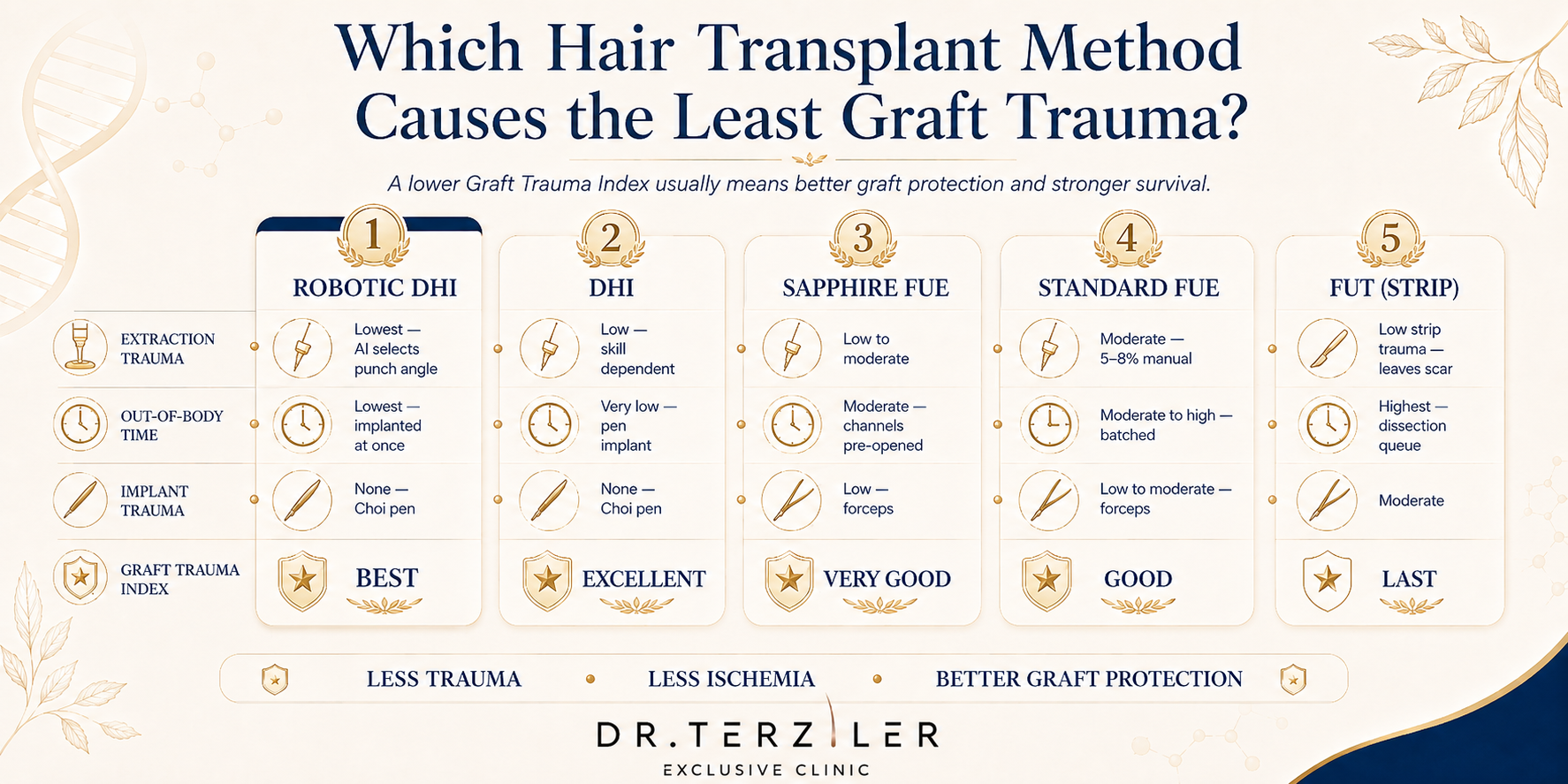
We rank each method with the Graft Trauma Index, a simple scorecard built on three axes drawn from peer-reviewed comparative studies. Each axis is a moment where grafts get damaged. Lower trauma means higher survival, and higher survival means denser, more natural hair.
Transection at extraction.
How many follicles get cut or crushed as they leave the donor zone.
Out-of-body time.
How long each graft sits outside the scalp, starved of blood, before it is replanted.
Implantation trauma.
How much the graft is squeezed or forced as it enters the recipient site.
Graft Trauma Index
The lower the combined trauma, the better the method protects your final density.
| Method | Transection at extraction | Out-of-body time | Implant trauma | Graft Trauma Index |
|---|---|---|---|---|
| Robotic DHI | Lowest. AI selects punch angle | Lowest. Implanted at once | None. Choi pen | Best |
| DHI | Low. Manual, skill dependent | Very low. Pen implant | None. Choi pen | Excellent |
| Sapphire FUE | Low to moderate | Moderate. Channels pre-opened | Low. Forceps | Very good |
| Standard FUE | Moderate, around 5 to 8% manual | Moderate to high. Batched | Low to moderate. Forceps | Good |
| FUT (strip) | Low strip, but leaves a scar | Highest. Dissection queue | Moderate | Last |
How Do the Methods Rank in 2026?
Here is the ranking, ordered by graft-trauma control rather than marketing.
Robotic DHI.
Lowest trauma across all three axes. Best for hairlines, precision and donor preservation.
DHI.
Immediate implantation with a Choi pen, no forceps, no pre-cut channel.
Sapphire FUE.
A sharper blade opens cleaner channels, useful for large areas.
Standard FUE.
Still excellent and fast in expert hands, the workhorse of modern surgery.
FUT.
Ranks last for most patients because it leaves a linear donor scar.
Need the definitions first?
For a full description of what each technique actually is, read our hair transplant techniques guide. This page is about which one wins and why.
Comparing FUE, DHI, Sapphire FUE, FUT, and Robotic DHI?
Ask the clinic to compare them for your donor area and hairline goal, not just by name.
Which Is Better, DHI or FUE?
Which Is Better, FUE or FUT?
Does the Robot Actually Help? Manual vs Robotic
How Does Robotic DHI Compare to FUE?
How Does Robotic DHI Compare to Robotic FUE?
What Is the Difference Between Sapphire FUE, DHI and Robotic DHI?
| Step | Sapphire FUE | DHI | Robotic DHI |
|---|---|---|---|
| Extraction | Manual punch | Manual punch | AI-guided punch angle |
| Channel opening | Sapphire blade | No separate channel | No separate channel |
| Implantation | Forceps into channel | Choi pen, direct | Choi pen, direct |
| Trauma axes improved | 1 of 3 | 2 of 3 | 3 of 3 |
What Is the Most Advanced Hair Transplant Method?
Picasso Robotic DHI is the most advanced hair transplant method available at Dr. Terziler Exclusive Clinic. It combines Dr. Servet Terziler's artistic hairline, robotic-assisted extraction, AI-guided angle mapping and Choi-pen implantation in one workflow. Dr. Servet Terziler engineered the robotic DHI device himself, which is why the system is tuned around graft survival rather than speed alone. You can see the method on our Picasso Robotic DHI page.
Want the newest method explained for your case?
Request a Robotic DHI suitability review with donor-area planning and hairline design guidance.
Which Hair Transplant Method Has the Highest Success Rate?
DHI and Robotic DHI report the highest graft survival, usually 90 to 97% in accredited clinics, because they cut ischemia time. DHI graft survival clusters at 90 to 96% in accredited series, as a 2020 Journal of Cosmetic Dermatology comparative study reported. FUE for male pattern hair loss exceeds 90% survival in experienced hands, as a 2024 BMC Surgery study on the FUE technique found.
Here is the number almost no clinic will show you. Graft survival is not a flat 95% forever. It is highest in the first year and settles over time.
| Time after surgery | Weighted graft survival | What it means |
|---|---|---|
| 7 to 12 months | 82.7% | Your visible year-one result |
| 13 to 24 months | 73.3% | Weaker grafts start to drop |
| 25 to 36 months | 58.4% | Long-term settling |
| 37 to 48 months | 55.4% | Rarely published anywhere |
| 49 to 72 months | 39.6% | The honest long-term picture |
Why Does Out-of-Body Time Decide the Winner?
Ask the question most clinics avoid: out-of-body time.
Message the clinic and ask how graft handling, waiting time, and implantation trauma are controlled.
How Long Do Hair Transplant Results Last by Method?
Transplanted grafts are permanent because they come from DHT-resistant donor zones. Those follicles keep their resistance after they move, so they do not fall out the way your original thinning hair did. Measured survival is highest in the first year and settles gradually over several years. Your method choice decides how many grafts clear that first year alive.
Which Method Is Least Painful and Has the Fastest Recovery?
DHI and Robotic DHI cause the least tissue disruption, so swelling and downtime are usually shorter. No-scalpel methods avoid the sutured strip wound of FUT completely. Most patients go back to desk work in 2 to 3 days after DHI. The procedure itself is done under local anaesthetic, so you can read exactly how much a hair transplant hurts before you book.
Which Hair Transplant Method Is Best for You?
The best method shifts with your hair type, your donor supply and your goal. Use this table to jump straight to your case, then read the deep-dive page linked in each row.
| Your situation | Best method | Why, in one line |
|---|---|---|
| Receding hairline | DHI | DHI controls angle and density at the frontal edge. |
| Crown or vertex balding | FUE or Robotic DHI | The crown whorl needs precise multi-angle placement. |
| Women | Unshaven DHI | DHI implants between existing hairs, so no shave is needed. |
| Afro or curly hair | Robotic or expert DHI, curved punch | Curved roots transect easily, so punch control decides survival. |
| White or grey hair | DHI | Hard-to-see grafts benefit from immediate implantation. |
| Totally bald or low donor | FUE plus body hair | It maximizes yield across beard and chest donor zones. |
| Trans hairline, MTF or FTM | DHI | It gives full control over a gendered hairline design. |
| Very large session, 4,000+ grafts | FUE for speed or hybrid | High graft counts favour extraction speed. |
| Scar repair or revision | FUE into scar tissue | FUE places grafts into low-vascularity scar tissue. |

Which Method Is Best for Women?
Which Method Is Best for Afro or Curly Hair?
Which Method Is Best for White or Grey Hair?
Which Method Is Best for Trans Patients?
Which Method Is Best for Totally Bald Patients?
Want the method chosen for your exact hair type?
Start with a donor-area and hair-type assessment before choosing FUE, DHI, or Robotic DHI.
Which Method Is Best for Beard, Moustache, Eyebrow and Sideburn?
DHI is best for every facial-hair transplant because single-hair grafts must sit at very shallow angles. Eyebrow and sideburn work needs 5 to 15 degree angle control that only pen implantation delivers reliably. Forceps cannot match that precision at the skin surface. Explore our beard, moustache, eyebrow and sideburn transplant pages for each one.
Is the Best Hair Transplant Method More Expensive?
Robotic DHI costs more per session than standard FUE because it uses more consumables and takes longer. In Turkey the premium is far smaller than the gap you would pay in the US or UK for the same technology. A denser, higher-survival first result is usually cheaper than a second corrective surgery. See the full breakdown on our hair transplant cost page.
Want a method recommendation with package guidance?
Ask for fixed-package planning instead of guessing per graft from US and UK prices.
How Do You Choose the Right Clinic and Method?
Ask any clinic these six questions. A clinic that answers all six with numbers is a safe clinic.
What is your own audited graft-survival rate, not the industry average?
The answer should be clinic-specific and measurable.
Will the surgeon perform my surgery, or a technician?
You need to know who handles extraction, design and implantation.
What is your transection protocol for my specific hair type?
Curly, white, grey, female and low-donor cases need different handling.
What is your average out-of-body time per graft?
This number directly affects graft survival.
What accreditation do you hold? Look for AAACI and ISHRS involvement.
Credentials matter most when surgery is marketed globally.
Can I see before-and-after photos of my Norwood stage? Check the hair transplant before and after gallery.
Similar cases are more useful than generic best-result photos.
What Do Patients Say About the Best Hair Transplant Method?
Patients pick Dr. Terziler for one reason: the results hold up. These reviews come from real hair transplant in Turkey patients across the US, UK and Canada.
★★★★★
"I spent weeks reading about the best hair transplant method before I booked. What convinced me was that Dr. Terziler ranked the options by graft survival. Robotic DHI, 2,900 grafts, and at month 12 my hairline looks like it was never gone."
James R., United States, Dr. Terziler Patient
★★★★★
"Three clinics told me FUE was the best hair transplant method. Dr. Terziler was the only one who explained why out-of-body time matters and why DHI kept more of my grafts alive. The density at my crown is exactly what he predicted."
Michael T., United Kingdom, Dr. Terziler Patient
★★★★★
"As a woman I did not want my head shaved. The unshaven DHI method meant nobody at work noticed. Best decision, and the most honest consultation I had anywhere."
Anna M., Canada, Dr. Terziler Patient
What Does Dr. Terziler Say About Choosing a Method?
Dr. Servet Terziler picks the method by graft survival, not by trend. He has performed thousands of cases across every hair type and built his own Robotic DHI system to protect the grafts at every step. Here is how he frames the choice for Dr. Terziler Exclusive Clinic patients.
"There is no single best hair transplant method for everyone. There is a best method for your hair type, your donor area and your goal. My job is to lose the fewest grafts getting you there."
"Patients ask me FUE or DHI. I tell them the real question is how long their grafts sit outside the body. That number decides survival, and it is why I built our robotic DHI workflow around immediate implantation."
"I designed the robotic DHI device myself because I wanted the punch angle decided by data, not by how tired the technician is at graft number three thousand."
Ready for Dr. Terziler to choose the method by graft survival?
Start with a method consultation based on your hairline, donor area, hair type, and density goal.
Frequently Asked Questions
Robotic DHI is the best hair transplant method in 2026 for most patients. It minimizes transection, out-of-body time and implantation trauma, the three points where grafts die. DHI and FUE remain excellent in expert hands. The difference is graft protection, not brand.
DHI is the best method for hairlines, unshaven procedures and facial hair because it implants each graft directly with no forceps and no pre-cut channel. For very large sessions FUE can be faster. Robotic DHI adds AI angle control on top of DHI.
DHI and Robotic DHI report the highest graft survival, around 90 to 97% in accredited clinics, as a 2020 Journal of Cosmetic Dermatology comparative study found. Success also depends on surgeon skill and your donor area, not the tool alone.
FUE and DHI extract grafts the same way and differ at implantation. FUE opens recipient channels first, then places grafts. DHI implants straight from a Choi pen in one step. DHI shortens the time grafts spend outside the scalp.
Robotic DHI improves two stages that standard FUE does not. It uses AI-guided extraction to lower transection and implants each graft immediately to cut out-of-body time. Standard FUE batches grafts and places them later, so more follicles wait outside the scalp.
FUE is better than FUT for nearly every modern patient. FUE leaves no linear scar and needs no stitches. FUT removes a strip of scalp and leaves a permanent line. FUT survives only as a very-high-volume option.
Picasso Robotic DHI is the most advanced method available. It combines robotic-assisted extraction, AI angle mapping and Choi-pen implantation. Dr. Servet Terziler engineered the robotic DHI device himself and holds AAACI accreditation.
DHI and FUE-based methods leave no linear scar because they remove individual follicular units, not a strip. Tiny dot scars fade and stay invisible at normal hair length. FUT is the only common method that leaves a visible line.
No. Unshaven DHI lets the surgeon implant between your existing hairs without shaving, which is why it is popular with women and professionals. Larger sessions may still need partial shaving for access.
All methods move permanent, DHT-resistant donor follicles, so transplanted hair is lifelong. Measured survival is highest in the first year and settles over several years. Lower-trauma methods keep more grafts alive across that timeline.
Elon Musk has never confirmed a specific method, and public discussion is speculation based on before-and-after photos. What his case does show is that a well-designed hairline plus dense packing looks natural, which is exactly what a precision method like DHI is built to deliver.
Robotic DHI is best with limited donor hair because it wastes the fewest follicles. When your donor supply is small, a lower transection rate directly means more grafts survive per graft harvested, so donor preservation becomes the whole game.
Still choosing between FUE, DHI, Robotic DHI, Sapphire FUE and FUT?
Get a surgeon-led method recommendation before you book flights, pay a deposit, or choose a package.
Medical Review and Sources
Medical reviewer: Dr. Servet Terziler, M.D., founder of Dr. Terziler Exclusive Clinic, AAACI-accredited surgeon and ISHRS workshop faculty.
Clinical claims on this page are organized around graft-survival logic: transection at extraction, out-of-body time, implantation trauma, scarring, recovery and donor preservation.
Source noted in content: 2014 Dermatologic Surgery robotic follicular unit extraction transection study.
Source noted in content: 2020 Journal of Cosmetic Dermatology comparative DHI graft-survival study.
Source noted in content: 2024 BMC Surgery study on FUE technique for male pattern hair loss.
Source noted in content: 2024 Dermatologic Surgery systematic review, A Systematic Review of Follicular Unit Graft Survival Rates.
Professional body: International Society of Hair Restoration Surgery (ISHRS).