
A hair transplant moves your own hair follicles from a donor area into areas of thinning or baldness. It can improve coverage in suitable patients, but it does not create new follicles or stop the hair-loss process affecting your remaining hair. The important decisions concern the diagnosis, the amount of usable donor hair, the design and the plan for future loss, not simply the number of grafts offered. [1, 2]
This guide explains candidacy, FUE and FUT, DHI placement, costs, recovery, long-term results and the questions worth taking to a consultation. It also separates what clinical studies measure from what a photograph or a clinic’s advertised success rate can tell you.
Prepared by Dr. Terziler Exclusive Clinic
Clinical team: Dr. Servet Terziler and Dr. Kürşat Yalvaç.
Evidence checked .
Before you choose surgery
Hair transplant at a glance
What does this hair transplant guide cover?
What is a hair transplant, and how does it work?
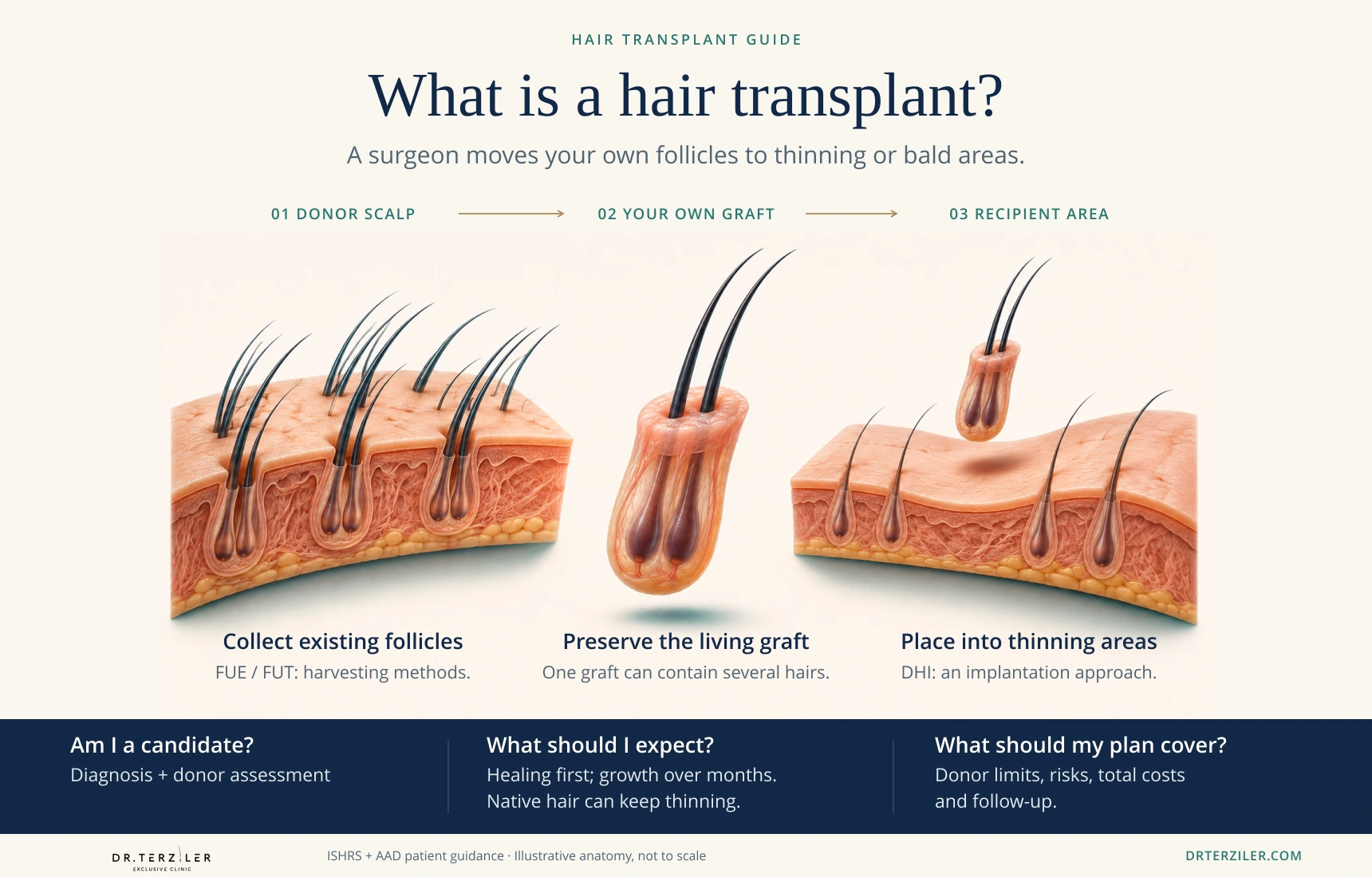
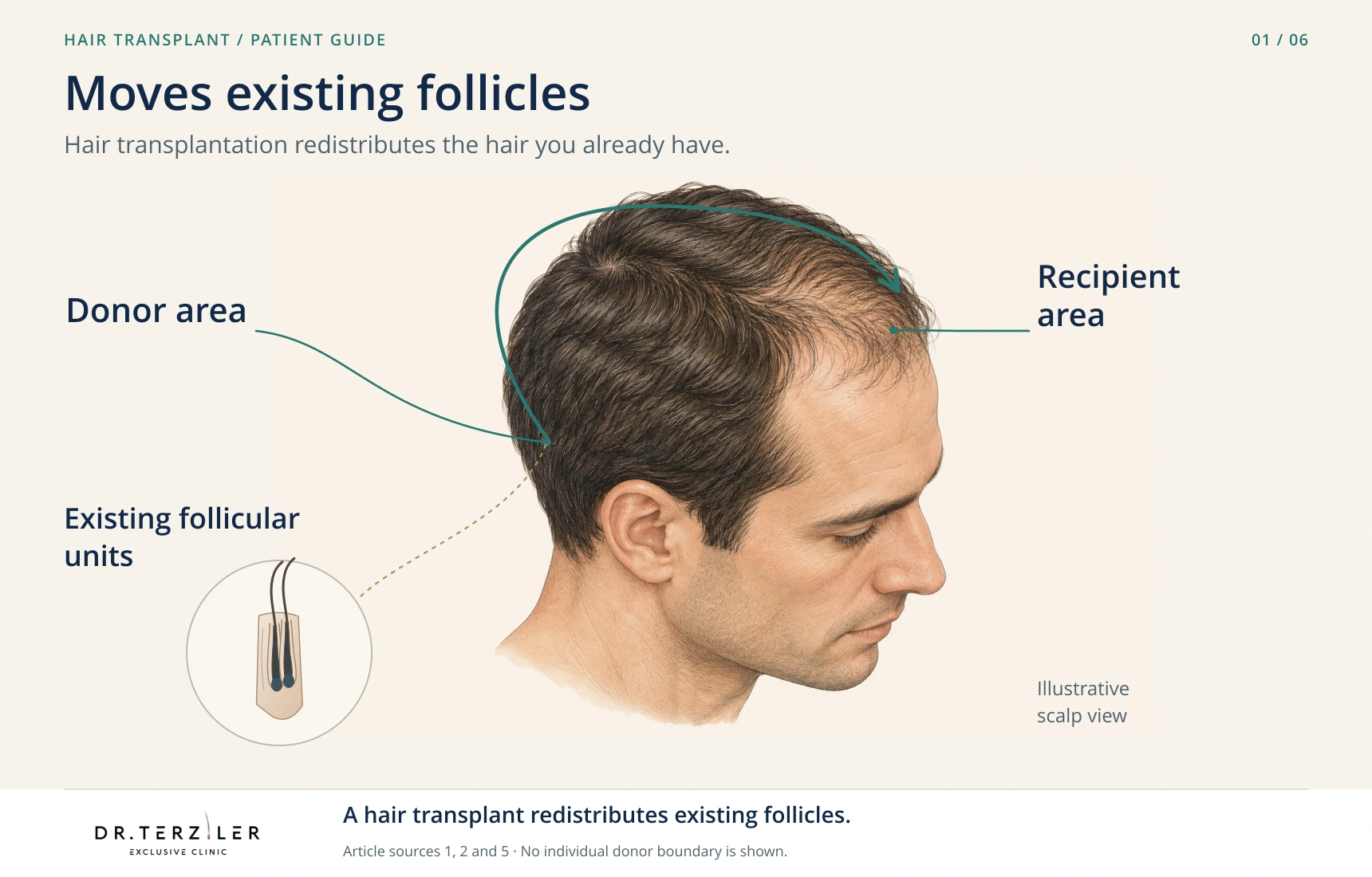
A hair transplant is a surgical redistribution of existing follicles. A surgeon removes hair-bearing tissue or individual follicular units from a donor region, usually at the back and sides of the scalp, and places grafts into prepared recipient sites. The follicles produce hair in their new locations after recovery. For patients comparing treatment in Istanbul, a hair transplant in Turkey requires the same assessment of diagnosis, donor supply, surgical responsibilities and follow-up as surgery elsewhere. [1, 2]
The operation changes where hair grows. It does not increase the total number of follicles available across the donor and recipient areas. This matters when a small donor region must provide coverage for a much larger area of loss: a plan that looks generous today can leave few options if thinning progresses.
What is actually moved: a hair, a follicle or a graft?
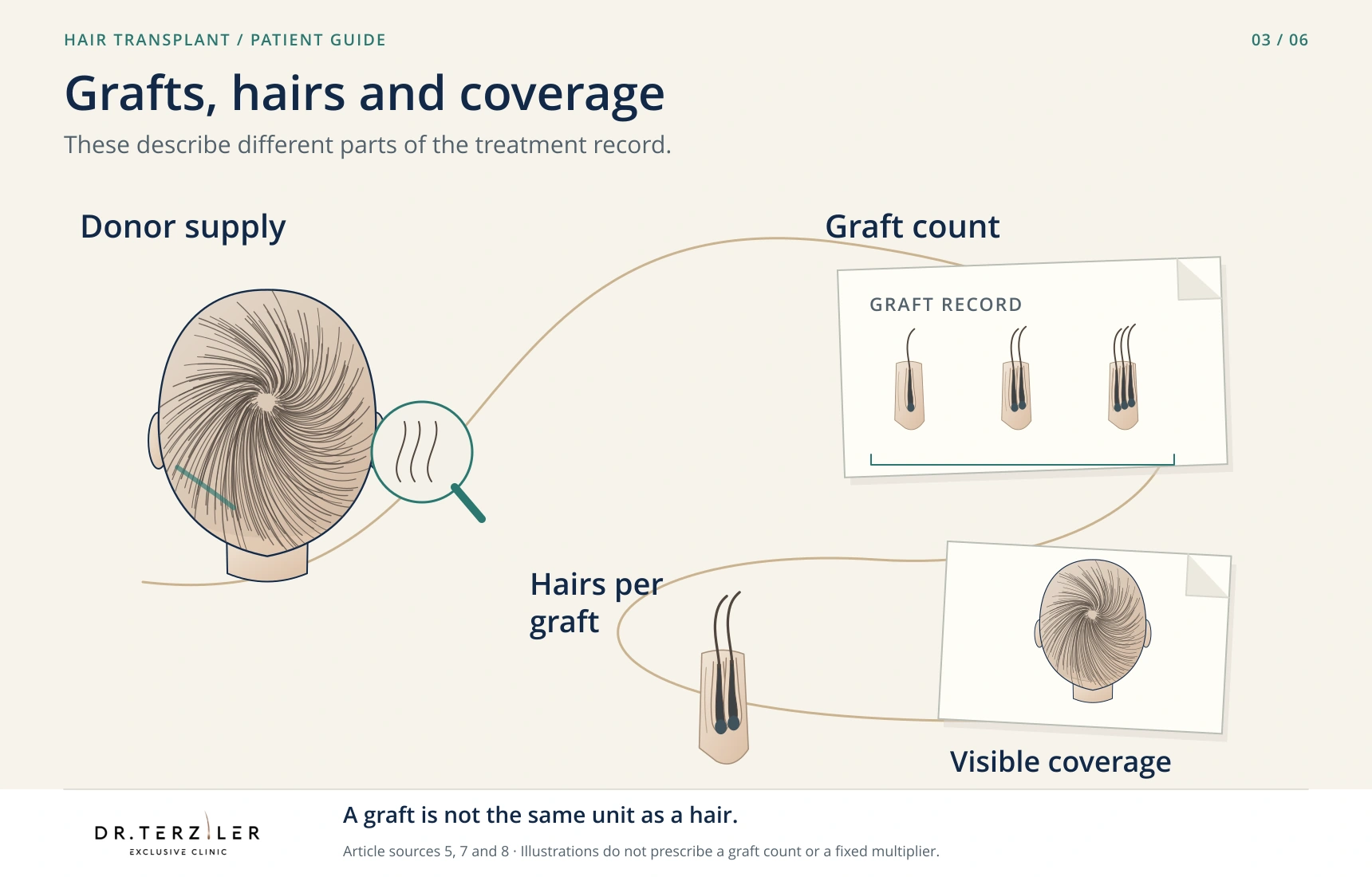
A hair shaft is the visible strand. The follicle is the living structure in the skin that produces it. A follicular unit is a naturally occurring group of follicles; a graft is the piece of tissue transferred during surgery. Modern follicular-unit grafts commonly contain one to four hairs. Therefore, 3,000 grafts and 3,000 hairs describe different quantities. [5]
The number printed on a quote needs a definition. Ask whether it describes planned extractions, grafts prepared for placement or grafts actually implanted, and whether the clinic records the distribution of single-hair and multi-hair units. None of these numbers alone measures how much hair ultimately grows.
Does transplanted hair behave like normal hair?
Successfully transplanted follicles continue their growth cycles, and the hair can usually be cut and styled after healing. Donor selection aims to use follicles less susceptible to androgen-driven miniaturization, which involves dihydrotestosterone (DHT). That resistance is relative, however: the long-term result also depends on the donor’s condition, the recipient scalp and changes in surrounding hair. [2, 5]
Hair restoration surgery may address a receding hairline, frontal or crown thinning, and selected reconstructive needs. A transplant is different from a hair system, scalp micropigmentation or a synthetic hair implant. Each changes appearance in a different way and has different maintenance and safety considerations.
Who is a good candidate for a hair transplant?
A good candidate has a diagnosis that surgery can reasonably address, an adequate donor area and expectations that fit the available hair. The assessment also considers progression, scalp health, medical conditions, previous procedures and the person’s ability to follow postoperative care. A photograph can start that discussion; it cannot complete it. [3, 6]
The first question is why hair is disappearing. Gradual pattern thinning, sudden diffuse shedding, broken shafts and inflammatory or scarring disease require different decisions. Transplanting hair does not correct an active shedding trigger, and placing grafts into an unhealthy scalp may produce a disappointing result. A scalp examination—and selected investigations when indicated—comes before surgical planning. [42]
Who should not have surgery yet?
Reasons to defer or reconsider surgery include unstable or rapidly progressing loss, active scalp inflammation, inadequate or diffusely thinning donor hair, uncontrolled medical problems, and expectations that cannot be met with the available supply. A clinician may also recommend further assessment when concern about appearance is severe or the expected emotional benefit is unrealistic. These are assessment questions, not a checklist that diagnoses suitability online. [6, 7, 29]
Scroll the table sideways to read every column.
| What you notice | Why it changes planning | What needs clarification |
|---|---|---|
| Sudden shedding throughout the scalp | Some losses can improve when a trigger is addressed | Timeline, illness, medicines, nutrition and examination |
| Gradual frontal or crown thinning | Future loss may change the appearance around grafts | Progression, donor stability and a longer-term plan |
| Pain, burning, scale or changing patches | An inflammatory or other scalp disorder may be present | Diagnosis and management before cosmetic planning |
| Thinning at the back or sides | The proposed donor may not be reliable | Distribution and miniaturization on examination |
| Previous surgery with visible donor depletion | Further harvesting may worsen coverage | Remaining supply, scars and realistic repair goals |
One useful distinction is whether a proposed treatment is intended to preserve existing hair, replace coverage in an established gap or treat a scalp disease. A plan can include more than one goal, but the goals should be named separately.
For male-pattern distribution, the Norwood scale can help describe where loss is visible. A stage is a description, however; it does not measure donor quality or prescribe a graft count.
What is the best age for a hair transplant, and is 25 too early?
There is no birthday that makes a hair transplant automatically appropriate. Younger adults may have an evolving pattern that is difficult to predict, so conservative design, observation or medical treatment may be preferable. FUE practice guidance calls for particular caution in patients younger than 25; it does not make age the sole decision. [7]
A 25-year-old with rapid progression and a weak donor may have fewer options than an older person with stable loss. Conversely, older age alone does not establish suitability. The relevant questions are the expected future pattern, donor quality, health and whether the proposed hairline will still make sense later. The discussion of the best age for a hair transplant should therefore lead to an individualized plan rather than a booking deadline.
Can women have a hair transplant?
Selected women can benefit from a hair transplant when the diagnosis, pattern of loss and donor quality support surgery. Diffuse thinning can also affect the donor region, so a widening part alone does not establish suitability. A female hair transplant assessment considers progression, donor miniaturization, existing hair and realistic coverage goals. Suspected scarring disease or active inflammation needs specialist evaluation before surgical planning. [15]
Can people with curly or Afro-textured hair have a hair transplant?
People with curly or Afro-textured hair can have a hair transplant, but follicle curvature requires individualized surgical planning. The follicle’s course beneath the skin can affect harvesting and the risk of cutting the follicle during extraction. Planning for Afro hair transplantation should consider scalp health, donor characteristics and the team’s experience with comparable hair textures. An ethnicity label does not determine a person’s graft requirement. [14]
Can transgender patients have a hair transplant?
Transgender patients can be candidates for hair transplantation when their scalp health, donor supply and restoration goals support surgery. Goals may include hairline shape, temple framing or facial hair. A transgender hair transplant requires a plan that considers the person’s hair-loss pattern, treatment history and donor limits. The consultation should explain achievable changes and how future hair loss could affect the result.
Can a hair transplant restore eyebrows or facial hair?
Selected patients seek transplantation for eyebrow or facial-hair restoration as well as scalp coverage. The recipient area changes the design and handling requirements, so a scalp graft plan should not simply be copied onto the face. The cause of missing hair and the health of the recipient skin still need assessment. [2, 38]
An eyebrow transplant needs discussion of hair direction, shape and the care required for the transplanted hair. The desired outline should be reviewed before surgery rather than inferred from a generic template.
Facial hair also varies in direction and appearance across different regions. A beard transplant should identify the areas to be filled and what texture or density differences may remain. These goals compete for the same donor resource used in scalp planning.
How are donor hair and graft numbers planned?
Donor planning matches a limited supply to the area and appearance a person wants to improve. A responsible estimate considers donor density, hair caliber, follicular-unit composition, miniaturization, scalp characteristics, previous scars and the size and priority of the recipient areas. A high graft count is useful only if it fits those constraints. [7, 8]
The graft-estimation process should explain the assumptions behind a number. An online photograph or calculator cannot reliably determine all of them, especially donor miniaturization and the condition of follicles under the skin.
Does hair grow back in the donor area?
A follicle removed during FUE does not regenerate in the extraction opening. With FUT, the donor wound is closed after the strip is removed, leaving a linear scar. Surrounding hair can help cover the donor region, but coverage is different from replacing the follicles that were removed. Both methods use a finite resource. [12, 41]
For that reason, the donor should be examined as carefully as the recipient. Ask to see how the extraction pattern, expected residual coverage and your preferred haircut have been considered. A short haircut may reveal donor changes that longer hair conceals. Repeat surgery requires a new examination of what remains, rather than simply repeating the original count.
How many hairs are in 3,000 grafts?
There is no single accurate conversion for every patient. The total depends on how many one-, two-, three- and four-hair units are actually present and used. A quote should not convert grafts to hairs with a fixed multiplier and present the result as a measured surgical record. [5]
The following distinctions help explain what to request; this is a record framework, not a formula for deciding how many grafts you need.
Scroll the table sideways to read every column.
| Record | What it describes | What it cannot establish alone |
|---|---|---|
| Donor assessment | Available hair and the condition of the donor region | A guaranteed lifetime supply |
| Planned graft count | The proposed surgical allocation | The final number implanted |
| Implanted graft count | Grafts recorded as placed | The number of hairs that later grow |
| Graft composition | Single- and multi-hair units used | Final visible coverage |
| Follow-up photographs or measurements | Change at a specified time and location | The cause of every change across the scalp |
A discussion of 3,000-graft hair transplantation is most useful when it identifies the treated area and donor limitations. The same count can produce very different appearances in a small frontal zone and a large area extending into the crown.
Should the hairline or the crown receive priority?
Priority depends on the person’s pattern, goals and donor reserve. The frontal frame and the crown have different visual demands, and the crown’s whorl can use a substantial allocation without reproducing youthful density. A plan should show the proposed zones and explain any compromise in coverage. [5, 7]
The direction, angle and selection of grafts also affect the result. A natural hairline design needs to suit facial proportions and anticipated future loss. A low, dense line can be a poor long-term choice if it consumes hair needed elsewhere.
Can existing thin hair, body hair or someone else’s hair be used?
Transplanting among existing hair requires attention to miniaturized follicles, placement and the possibility of postoperative shedding. The risks of transplanting into thinning hair belong in the consultation, especially when much of the apparent coverage comes from vulnerable native hair. Surgery and preservation may need separate plans. [6, 9]
Beard or body hair can supplement scalp donor hair in selected cases, but it may have different texture, length and growth characteristics. A published series of 122 selected patients provides clinical experience rather than proof that every body site can replace scalp hair. The limitations of body-hair transplantation should be explained before treating it as an unlimited reserve. Routine hair restoration uses your own follicles; hair from another person raises immune-rejection problems and is not a practical substitute. [13, 41]
How do FUE, FUT, DHI and robotic hair transplants differ?
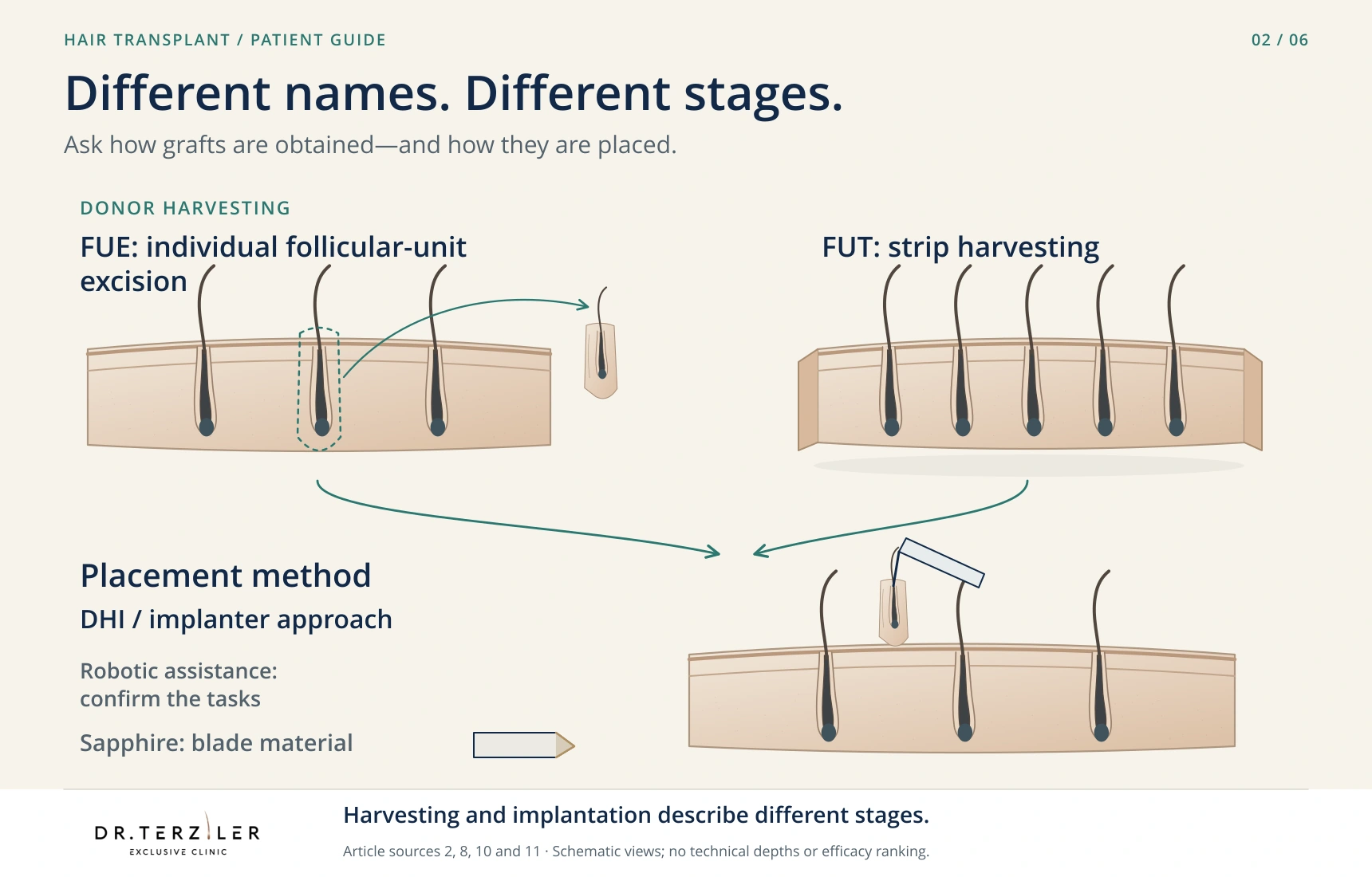
FUE (follicular unit excision, commonly called follicular unit extraction) and FUT (follicular unit transplantation, or strip harvesting) describe two principal ways of obtaining donor grafts. DHI generally describes an implantation approach, while robotic systems assist specified parts of the procedure. These terms can overlap in one operation, so they should not be presented as four mutually exclusive alternatives. [2, 8, 10, 11]
Separating harvesting from placement makes a clinic’s proposal easier to understand. First ask how grafts will be obtained. Then ask how recipient sites will be created and how grafts will be placed.
Scroll the table sideways to read every column.
| Term | What it mainly describes | What to clarify |
|---|---|---|
| FUE | Individual follicular-unit excision from the donor | Extraction pattern, punch selection, transection and residual coverage |
| FUT or strip harvesting | Removal and dissection of a strip of donor scalp | Scalp suitability, closure, linear scar and future donor strategy |
| DHI or implanter placement | A method of placing grafts, sometimes creating a site during insertion | The actual device, site creation and who performs each step |
| Sapphire FUE | FUE harvesting combined with a particular blade material for recipient work | The underlying surgical plan rather than the material alone |
| Robotic assistance | Device assistance with named surgical tasks | Which tasks are assisted and who controls and performs surgery |
| Unshaven or partially shaved surgery | A preparation and visibility approach | Areas shaved, practical limits and how graft handling is managed |
Is FUE better than FUT?
Neither harvesting method is best for every patient. FUE avoids the single linear donor scar associated with strip harvesting but leaves multiple small scars. FUT leaves a linear scar and may be appropriate within a particular donor strategy. Haircut preferences, scalp laxity, previous surgery, graft needs and the surgeon’s assessment influence the choice. [7, 8, 12]
The correct comparison includes the appearance of the donor after healing, not just the recipient result. A technique that suits one person’s future hair loss and hairstyle may be a poor fit for another. Ask the surgeon to explain the alternative they considered and why they rejected it in your case.
Is DHI a different way of harvesting follicles?
DHI does not by itself identify a separate donor-harvesting method. A clinic may combine FUE harvesting with implanter placement. Sharp implanters can create a recipient incision while placing a graft, whereas other instruments place grafts into sites made beforehand. The useful distinction is the actual sequence and instrument, not the abbreviation alone. [2, 11]
When comparing FUE and DHI terminology, ask for both stages to be written down. The label cannot establish graft survival, naturalness or a universal advantage for everyone.
Do sapphire blades, robots or unshaven surgery guarantee better results?
No instrument or preparation style guarantees a better result. Technology can assist selected tasks, but diagnosis, donor selection, design, tissue handling and surgical judgment still determine what the procedure can achieve. Robotic incisions remain surgical acts; the clinic should identify the responsible qualified professionals and their roles under local law. [11, 37]
The description of robotic DHI should state exactly what is assisted rather than imply that an autonomous machine replaces a surgical team. Comparable outcome records are more informative than a technology name.
Keeping hair long can help with discretion, although that does not remove healing signs or make every operation suitable for the same approach. An unshaven hair transplant needs a clear explanation of which areas remain long, which may be shaved and how the approach affects access and handling.
What happens before and during hair transplant surgery?
Before surgery, the team should confirm the diagnosis, review health and medication history, examine donor and recipient regions, discuss the design and obtain informed consent. The plan should identify the intended areas, expected limitations and who performs the surgical steps. International consensus supports individualized assessment and perioperative care; it is not a substitute for the operating clinician’s judgment. [9, 11]
Expert consensus
The 2023 international consensus involved 38 experts from 17 countries and reached agreement on 59 of 81 statements after two Delphi rounds. It brings together specialist judgment on selection and care. It does not establish that every proposed practice has been tested against an alternative in a clinical trial, or that one postoperative schedule applies to everyone. [9]
Tell the team about prescription medicines, supplements, allergies, bleeding problems, previous anesthesia reactions, smoking and previous scalp procedures. Do not stop prescribed treatment or start a supplement because a general internet checklist says to do so. The preoperative hair transplant guide should be used alongside your own team’s written instructions.
How long does a hair transplant take, including 3,000 grafts?
Many sessions take several hours; the American Academy of Dermatology describes four to eight hours as typical, with some patients needing another session. Duration varies with the operation’s extent, donor characteristics, technique and team workflow. A 3,000-graft count cannot establish a reliable finish time on its own. [3]
A surgical day includes more than extraction and placement. Design confirmation, local anesthesia, graft preparation, breaks and postoperative instructions also take time. Ask whether the proposed work is planned for one day, staged over more than one day or divided into separate procedures, and how the team protects grafts during that workflow.
Is a hair transplant painful, and what is the most painful part?
Local anesthetic is used to numb the operative areas. The injections can cause brief discomfort, and soreness, tightness or tenderness may occur afterward. Pain experiences differ, so a “painless” label should not replace an explanation of the anesthetic plan, monitoring and postoperative pain control. [1, 39]
Sedation may be offered in appropriate circumstances, but it is a separate decision with its own assessment and recovery requirements. Ask who administers it, how you are monitored and what you must arrange afterward. The discussion of sedation during hair transplantation should identify those practical details rather than promise that every patient feels nothing.
What should be confirmed before grafts are placed?
You should understand and agree to the intended hairline or recipient zones, the donor approach and the limits discussed during consent. Confirm whether the team expects to adjust the graft allocation if the operative findings differ from the initial estimate. The surgical record should make the final allocation understandable afterward. [9, 11]
A consent conversation is also the time to ask what cannot be promised: an exact density, a particular hairstyle, freedom from further loss or a fixed lifetime appearance. There should be room to reconsider before treatment begins.
How much does a hair transplant cost, and is it worth it?
Hair transplant cost depends on the extent of treatment, location, professional fees, technique and included care. A per-graft price is incomplete unless the unit, currency, minimum charges and package inclusions are clear. Compare written plans for the same clinical goal rather than assuming the largest count or lowest headline price represents better value. [4, 30, 31]
For context, the NHS information page lists a broad UK range of £1,000–£30,000. That is an illustrative published range, not a current average, a quote for your case or a price for the US, Canada or Turkey. A clinic must assess your circumstances before providing a meaningful personal estimate. [4]
The hair transplant cost breakdown for Turkey should be read alongside a written treatment plan. A lower local price does not establish the quality of the operation, while a higher price does not establish a superior result.
How can I compare two quotes fairly?
Use the same questions for each quote. A cheaper offer may exclude something you need; a more expensive offer may include an optional service that does not answer your main concern.
Scroll the table sideways to read every column.
| Item | What to get in writing |
|---|---|
| Clinical plan | Diagnosis, recipient zones, donor limitations and proposed technique |
| Count and unit | Grafts versus hairs; estimated versus final implanted count |
| Professional roles | Responsible clinician and the people performing surgical steps |
| Procedure and medication | Anesthesia, any sedation, prescribed items and additional fees |
| Travel arrangements | Accommodation, transfers, companions and cancellation terms |
| Follow-up | Review schedule, contact route and care after returning home |
| Unexpected needs | How complications, extra visits and possible revision are assessed and charged |
| Currency and payment | Currency, deposit, balance, refund terms and exchange-rate exposure |
What is missing from my hair transplant plan?
Record the details you already have. This checklist creates questions for a consultation; it does not score a clinic or determine whether surgery is suitable.
Ask for the diagnosis, donor limits, treated areas, count and unit, harvesting and placement methods, surgical roles, total cost and follow-up in writing. You can request an assessment of your treatment options.
Your consultation questions
Your entries stay on this page unless you choose to copy, download or add them to a WhatsApp draft. Reloading the page clears them.
This comparison is a budgeting framework rather than a clinical ranking. It becomes useful only after each clinic has explained whether its proposed operation is appropriate for you.
Is a hair transplant worth it, and why do some people regret it?
Value depends on whether the expected improvement matters to you and is achievable at an acceptable cost and risk. Surgery can improve satisfaction with appearance, but it cannot guarantee confidence, a particular reaction from others or relief from a mental health condition. A recent narrative review emphasizes expectation setting and psychological assessment as parts of care. [29]
Regret can involve an unsuitable hairline, visible donor depletion, an unexpected scar, disappointing coverage or a misunderstanding about future loss and maintenance. Before booking, compare the proposed benefit with the possibility of no surgery, medical management or camouflage. Take time if the decision depends on urgency, social pressure or a promotional deadline.
What is the recovery and growth timeline after a hair transplant?
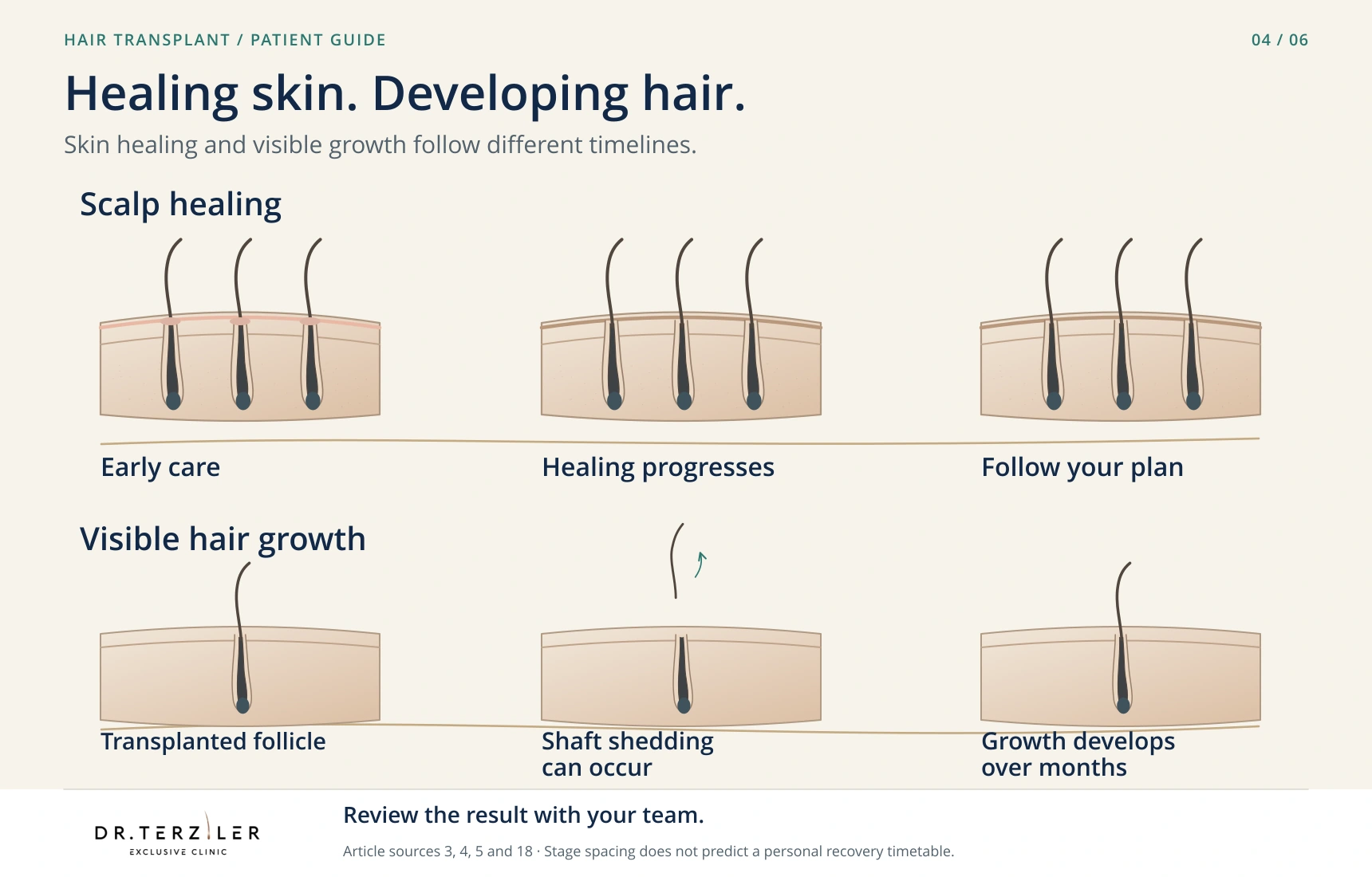
Hair transplant recovery has two overlapping timelines: the scalp heals after surgery, while the transplanted follicles cycle toward visible growth. Looking comfortable enough to return to work is different from seeing a mature result. Early shedding is also different from physically losing a graft. [3, 17, 18]
The periods below describe broad expectations from clinical patient guidance. They are not clearance to wash, exercise, fly or change medication on a particular day; your operation and healing may require different instructions. [4, 18]
Scroll the table sideways to read every column.
| Period | What may happen | What the observation means |
|---|---|---|
| First days | Tenderness, redness, swelling and small crusts | Early healing; worsening symptoms need review |
| First one to two weeks | Crusts and visible healing signs often improve | Social recovery varies with the procedure and hairstyle |
| Following weeks | Transplanted shafts and sometimes native hair may shed | Visible shedding alone does not measure graft survival |
| Around two months | Coverage can still look sparse or uneven | This stage is generally too early to judge the final result |
| Around three to four months onward | Early new growth may become noticeable | Onset and distribution vary |
| Around six to nine months | Many patients see a clearer change | Density and hair characteristics may still be developing |
| Around twelve months and sometimes longer | The result becomes more suitable for a fuller review | Some guidance describes maturation extending toward eighteen months |
Take a complete baseline before surgery and use the same views during follow-up. Changes at the hairline, mid-scalp, crown and donor should be recorded separately rather than represented by one flattering angle.
What are the worst days, and when will I look normal?
There is no universal “worst day.” Early swelling, tenderness, crusting, sleeping adjustments or worry about the appearance may bother different people at different times. Later, temporary shedding can be frustrating even when the scalp has healed. Your team should explain what is expected and how to contact them if the course changes. [18, 36]
“Normal” can mean no visible crusts, a comfortable return to work, an acceptable haircut or mature growth. Those milestones occur at different times. Plan time away from public-facing work around your procedure and the team’s advice, rather than treating a growth photo at six months as a recovery estimate.
Do transplanted hairs fall out, and does that mean the graft failed?
Transplanted hair shafts often shed before new growth appears. Losing a shaft is not the same as dislodging the follicular tissue placed in the scalp. The AAD describes shedding within two to eight weeks, but timing alone cannot confirm that every follicle is healthy. [3]
What the anchoring study measured
A 42-patient graft-anchoring study examined mechanical dislodgement in the early postoperative period. Hair pulling no longer dislodged grafts by day six, while adherent crusts behaved differently earlier in recovery; by day nine, grafts were not dislodged under that study’s conditions. This was an anchoring experiment, not permission to test your grafts, pick crusts or resume every activity on a fixed day. [17]
The explanation of shock loss after a hair transplant should also distinguish shedding of existing native hair from transplanted shafts. Persistent or unexpected changes need examination rather than a diagnosis from a shed strand.
What happens at two months, and when does the result start to look good?
At two months, a sparse appearance does not by itself establish failure. Visible improvement develops over subsequent months, and the timing varies across patients and scalp areas. A proper review uses the baseline, surgical record and the stage of growth rather than judging a final result from one early photograph. [3, 5]
Ask the team when they will assess early growth, later coverage and any concern about a specific area. The guide to final hair transplant results is most useful when its timeline is interpreted alongside those planned reviews.
What should I avoid while the scalp heals?
Protect the operated areas from rubbing, picking and unapproved products, and follow the instructions issued for your procedure. Washing, activity and sleeping recommendations can differ between techniques and teams. If two sets of instructions conflict, ask the operating team to resolve the difference rather than combining them yourself. [9, 18]
Keep the written plan accessible. It should name the contact for a concern, describe medication use and explain when you can change each part of your routine. The postoperative patient guide can support that plan, including when you are recovering away from the clinic.
When can I wash my hair and remove scabs?
Washing should follow your team’s method and start date. Do not use force to remove adherent crusts or pull at hairs to test whether they are secure. The graft-anchoring research explains why manipulating an attached crust is different from seeing a loose shaft fall out. [17, 18]
The hair-washing instructions after transplantation should match the operation you had. Ask before adding a scalp scrub, dye, minoxidil, a microneedling device or another active product to healing skin.
When can I sleep normally or wear a hat?
Your team’s instructions should specify how to protect the recipient and donor areas during sleep and whether any head covering is suitable. Comfort alone is not a complete test of whether pressure or friction is appropriate. Ask for guidance that accounts for the location of the grafts, the donor procedure and your usual sleeping position. [9]
The advice on sleeping positions after a hair transplant should include a clear point for reassessment. If pain, swelling or drainage is increasing, contact the team instead of simply changing pillows or tightening a hat.
When can I exercise, have sex or masturbate?
These activities need to be discussed as part of postoperative care because exertion, sweating, pressure and accidental contact may affect early recovery. There is no well-established masturbation-specific day that applies to every transplant. Sexual activity should follow the same individualized advice about physical exertion and protecting the scalp. [18]
As an example of published professional guidance, ASPS notes that some doctors advise avoiding sex for at least ten days and restricting vigorous activity for longer. This is not automatic clearance on day eleven. The return to exercise after a hair transplant should consider your healing, donor technique and the activity itself. [18]
Should I change smoking, alcohol, supplements or my haircut routine?
Tell the surgical team about nicotine use, alcohol, medicines and supplements before the procedure so they can provide a specific plan. Do not assume a product sold for “hair growth” is harmless around surgery. Unnecessary supplements do not replace treatment of a diagnosed problem, and medicines should not be stopped without the relevant prescriber’s advice. [9, 24, 42]
Haircuts, clippers, chemical treatments and sun exposure also involve different levels of contact with healing skin. Ask when each is appropriate rather than treating them as one general return-to-normal date.
What are the risks, side effects and possible disadvantages?
A hair transplant is surgery and is not 100% safe or 100% successful. Possible problems include bleeding, infection, scarring, folliculitis, altered sensation, prolonged redness, unexpected shedding, poor growth, an unnatural design and donor depletion. The pattern and frequency depend on the procedure, patient, definitions and follow-up. [19, 20, 21]
Some disadvantages are planning problems rather than an acute medical complication. Hair may grow but provide less coverage than expected; a technically healed donor may look too thin; a successful frontal result may become isolated as native hair recedes. Consent should address those outcomes alongside wound-related risks.
What does a hair transplant success rate actually measure?
A success percentage needs a named outcome, a denominator and a follow-up time. Graft retention, hairs counted in a target area, visible coverage and patient satisfaction measure different things. A figure without a method cannot tell you the chance that your own operation will meet your goals.
Scroll the table sideways to read every column.
| Claim | What you need to know |
|---|---|
| “High graft survival” | How placed grafts and later growth were counted, where and when |
| “More density” | Whether this is measured hair density, a photograph rating or a visual impression |
| “Satisfied patients” | Who responded, how satisfaction was assessed and whether missing follow-up was reported |
| “Low complication rate” | Which events counted, which patients were followed and for how long |
| “Permanent result” | Whether the claim concerns transplanted follicles, native hair or the whole appearance |
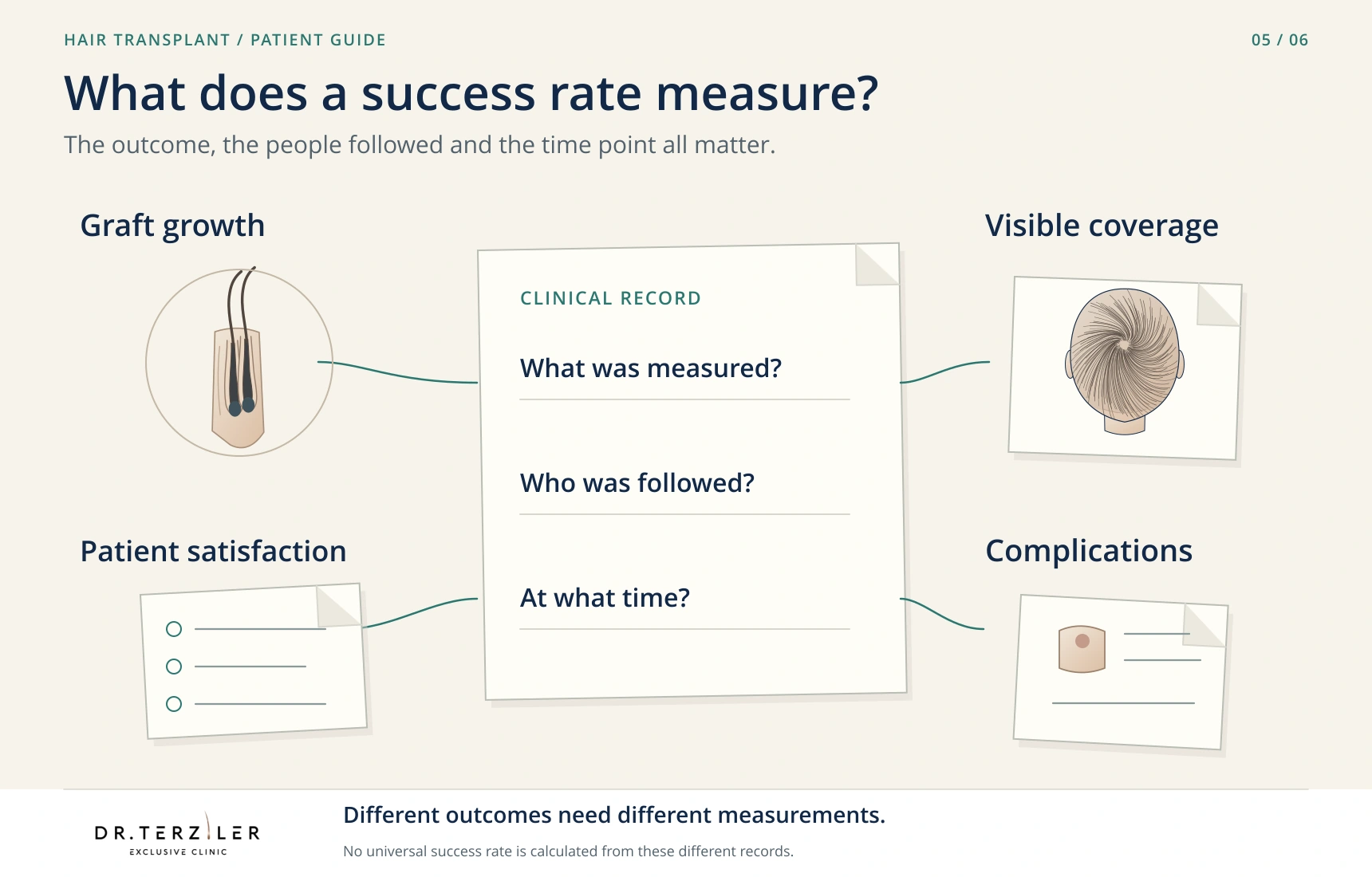
A 2025 complications meta-analysis included 45 articles: 24 case reports and 21 observational studies. The observational studies contained 2,353 participants. Those study populations and selected case reports cannot be turned into a universal percentage of transplants that “go wrong.” A 2026 review also found substantial variation in safety evidence. [19, 20]
The same caution applies to repair statistics. The ISHRS practice census describes activity reported by responding practices; it does not provide the failure probability for every person having surgery. A clinic should explain its own outcomes and record quality rather than borrowing an unrelated statistic. [40]
Are FUE scars invisible, and can the donor be overharvested?
FUE is not scarless. Small extraction scars can become visible depending on their number, distribution, healing, skin characteristics and haircut. FUT leaves a linear scar whose visibility also varies. “No linear scar” should not be interpreted as “no scar.” [12]
Overharvesting can leave patchy or reduced donor coverage and limit repair options. A second extraction cannot recreate the removed donor follicles. If you are seeking repair, the consultation should examine the donor, design, growth and remaining supply before promising another large session. [21, 41]
Which symptoms need prompt medical assessment?
Contact your care team promptly
Contact the surgical team promptly for worsening pain, spreading redness, pus, fever, excessive or persistent bleeding, or other changes outside the expected course. Severe symptoms or a rapidly deteriorating condition may require urgent local care rather than waiting for a remote clinic reply. A photograph can help communication but does not replace examination. [36]
If you are concerned about healing or a result, contact the clinic to arrange a review. Include the procedure date and a brief description. Use local emergency services for an emergency.
How long does a hair transplant last, including after ten or twenty years?
Transplanted follicles can provide long-lasting growth when they are selected from an appropriate donor region and survive surgery. However, “permanent” does not mean that the whole scalp will retain the same density or appearance for life. Native hair may continue to thin, donor characteristics may change and scalp disease can affect the result. [5, 22]
At ten or twenty years, the important question is whether the original design still fits the remaining hair and available donor supply. There is no reliable universal expiry date, and there is no guarantee that one procedure will meet every future need. A long-term plan should anticipate change rather than promise a frozen appearance.
How permanent is a hair transplant?
Can you still go bald after a hair transplant?
Yes. A transplant does not stop pattern hair loss in the non-transplanted hair. A person can retain transplanted hair while losing surrounding coverage, making the original work look isolated or less dense overall. This is one reason to discuss preservation and future loss before setting the hairline. [3, 16]
The explanation of whether transplanted grafts are permanent should separate donor resistance from the future of the rest of the scalp. A stable photograph today does not establish the appearance decades later.
Is hair loss two or three years later normal, or has the transplant failed?
New thinning after two or three years deserves assessment. Possibilities include native-hair progression, another shedding event, a scalp disorder or a change involving transplanted hair. The timing alone cannot identify which is happening. Compare the original graft map, baseline and follow-up views, and examine the scalp rather than treating every later loss as either inevitable or proof of surgical failure. [6, 22, 42]
A longer-term study, with limits
A four-year FUT study followed photographs from 112 patients and reported changes in apparent density compared with the one-year result. Its retrospective design, photographic assessment and lack of an untreated comparison limit the conclusions. It does not tell us the survival of every graft or establish that all modern transplants decline at the same rate. It does support caution about promising identical lifelong coverage. [22]
Can I have a second transplant later?
Sometimes, provided reassessment shows sufficient donor supply and a suitable scalp. The second procedure may address progression, a different area or a repair, but its possibilities are constrained by previous harvesting and scars. The decision should start with why the appearance changed and what remains available. [7, 8]
Planning the first surgery conservatively can preserve choices. Ask what the team would prioritize if future loss expands, and whether the current proposal depends on a second procedure that has not yet been discussed or priced.
Do I need finasteride, minoxidil or other treatment with a transplant?
Additional treatment may help manage ongoing hair loss, but it is not an automatic requirement for every surgical patient. The choice depends on diagnosis, likely benefit, contraindications, preferences and the risks of the particular medicine. Ask separately what is intended to preserve native hair, support a diagnosed condition or address postoperative care. [9, 16, 42]
Coverage outcomes, not graft-survival rates
In a randomized trial of 79 men undergoing transplantation, finasteride was compared with placebo from four weeks before surgery through 48 weeks afterward. Visible increases in superior or frontal scalp hair were reported in 94% of the finasteride group and 67% of the placebo group. Those are photographic coverage outcomes in that study, not graft-survival percentages and not proof that everyone should take the medicine. [16]
Can I have a hair transplant without finasteride?
It may be possible after a discussion of progression and realistic coverage. Declining or being unsuitable for finasteride does not automatically prevent surgery, but it can affect the long-term plan for vulnerable native hair. A clinician should explain alternatives and the uncertainty if loss continues. [9, 16]
Finasteride has potential sexual and psychiatric adverse effects, and reproductive precautions also matter. Treatment decisions need an individual benefit-risk discussion, including relevant medical history and other medicines. Minoxidil and other treatments have their own instructions and adverse effects; none should be started on healing scalp simply because it appears in a general transplant article. [23, 24, 42]
The clinic’s hair-treatment options can be considered within that diagnosis-based discussion. Surgery and medical care should have distinct goals and review criteria.
What are the alternatives, and do newer add-ons improve the result?
Alternatives include treating the underlying cause, appropriate medical therapy, observation, changes to damaging hair practices, cosmetic camouflage and hair systems. The right option depends on whether the problem is shedding, progressive miniaturization, breakage, inflammation or an established area of loss. Treatment can be worthwhile even when surgery is unsuitable. [42]
Some people prefer to avoid an operation; others use medical care to manage native hair before deciding on surgery. Neither approach should be presented as a failure to act. Ask what outcome will be reviewed and what would justify changing course.
Is PRP necessary after a hair transplant?
PRP is an optional intervention to discuss, not a universally proven requirement. A 2025 systematic review of PRP as a transplant adjunct included three controlled prospective studies with 217 participants. Differences in preparation and assessment limited the ability to generalize a single effect to every protocol. Encouraging results do not establish that every patient needs PRP or that a named package guarantees growth. [25]
If PRP treatment is proposed, ask whether the goal concerns existing hair, healing or transplant outcomes, and what evidence supports that specific use. The planned outcome and extra cost should be stated separately from the transplant itself.
Can light therapy, exosomes or stem-cell treatments replace surgery?
These terms refer to different interventions and evidence bases. Light-therapy research in alopecia cannot be treated as proof that any device guarantees transplanted-graft survival. An evaluation of low-level laser hair treatment should identify the device, diagnosis and intended outcome rather than treat all light exposure as equivalent. [26]
For regenerative products, preparation, processing, route and regulation matter. The FDA’s public safety information states that there are no FDA-approved exosome products. A study of one laboratory preparation does not establish the effectiveness or safety of every commercial product, and a US regulatory statement does not describe authorization in every other country. [32]
If a clinic discusses exosome-based hair treatment, ask for the exact product, route, evidence and local regulatory status. Similar questions apply to interventions described as stem-cell treatment: the label alone does not show that they create an unlimited supply of transplantable hair.
What is the newest hair transplant method, and is hair cloning available?
New instruments and delivery approaches are different from creating new donor follicles. Tissue engineering and follicle multiplication are research areas, but they should not be used to promise that today’s donor limits no longer matter. Ask whether the proposed intervention is routine surgery, an adjunct or participation in a properly regulated research study. [34]
Hair banking also needs a precise explanation of what is stored, under what conditions and what established clinical use is available. Storage does not itself guarantee future cloning or successful restoration. An offer involving new technology should be assessed through evidence and consent rather than novelty alone.
Are artificial hair implants or country-specific “secrets” equivalent alternatives?
Synthetic fiber implantation is different from moving your own follicles. In the United States, prosthetic hair fibers are banned medical devices; that rule should not be confused with ordinary wigs or autologous transplantation. Check the exact procedure and jurisdiction when comparing offers. [33]
There is also no single national “secret” treatment. Japanese dermatology guidance has evaluated established medical and surgical options for pattern hair loss. Its 2017 guideline, published in 2018, is clinical guidance from a particular period, not evidence that a nationality-based remedy or one new product is best for everyone. [35]
How should I interpret hair transplant before-and-after photographs?
Before-and-after photographs show appearance under recorded conditions. They are more informative when lighting, camera angle, distance, head position, parting, hair length, wetness and concealing products are comparable. A photograph alone cannot establish graft survival or isolate the effect of one intervention. Standardized hair photography has long been recognized as necessary for more consistent comparison. [27, 28]
When viewing hair transplant before-and-after results, look for the same patient, a stated interval, relevant donor views and information about the treated areas. Ask whether medicines or additional procedures contributed to the result.
Clinic-provided photographs
Which hair transplant before-and-after examples can I compare?
Six cases, seven photographs. Compare the view, the labelled follow-up interval and the treatment record before judging the appearance.
Check which side is before. Several composites place the preoperative view on the right. Counts and intervals come from the image labels. Lighting and styling vary; photographs do not measure graft survival or predict your result.
Showing all 6 cases.
Frontal hairline · two views
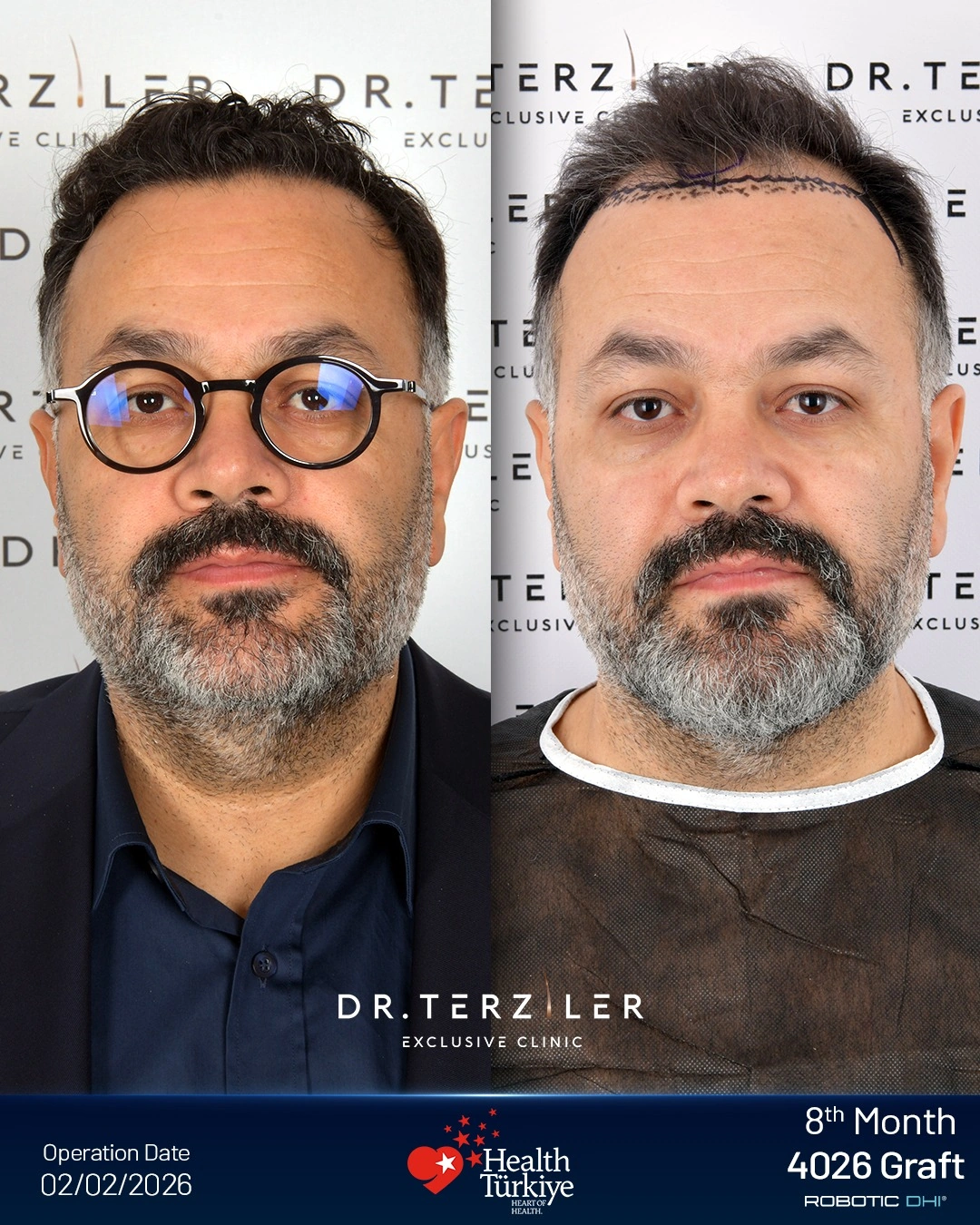
How does this case look from above?
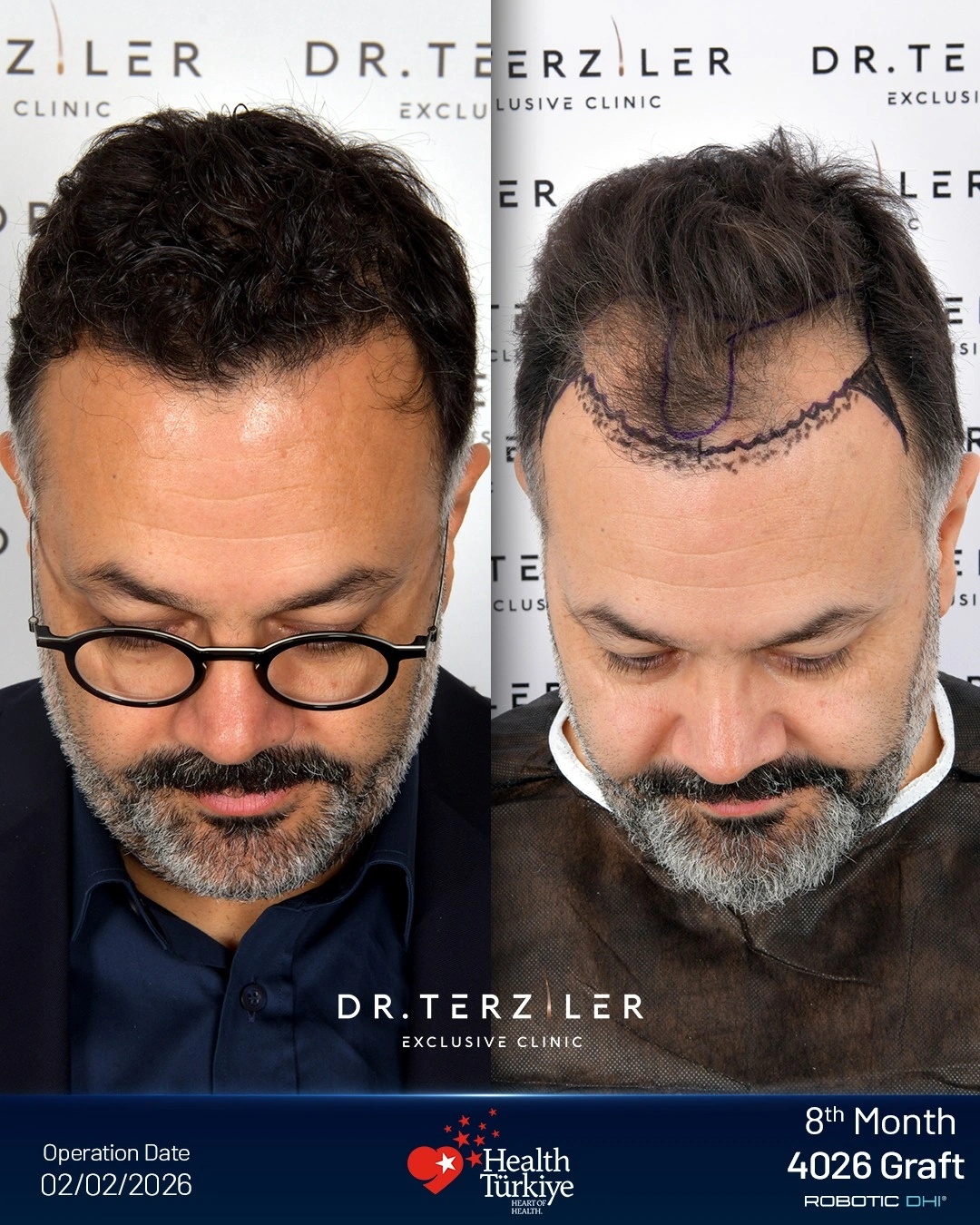
The frontal and top-front photographs show the same case, not two separate patients.
Female hair transplant · top-front
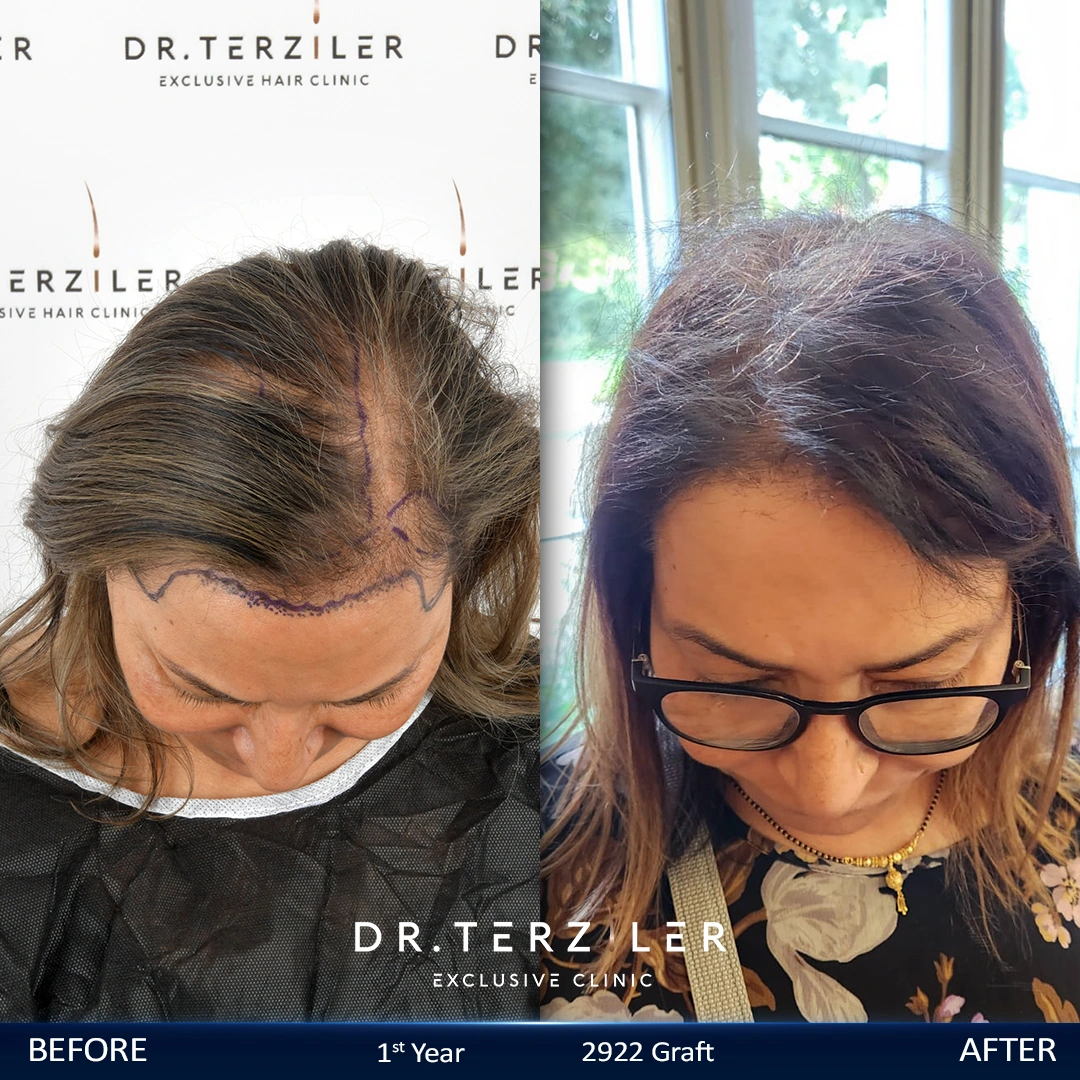
The central part and frontal area can be viewed together. Lighting and styling differ between the photographs.
Afro hair transplant · frontal
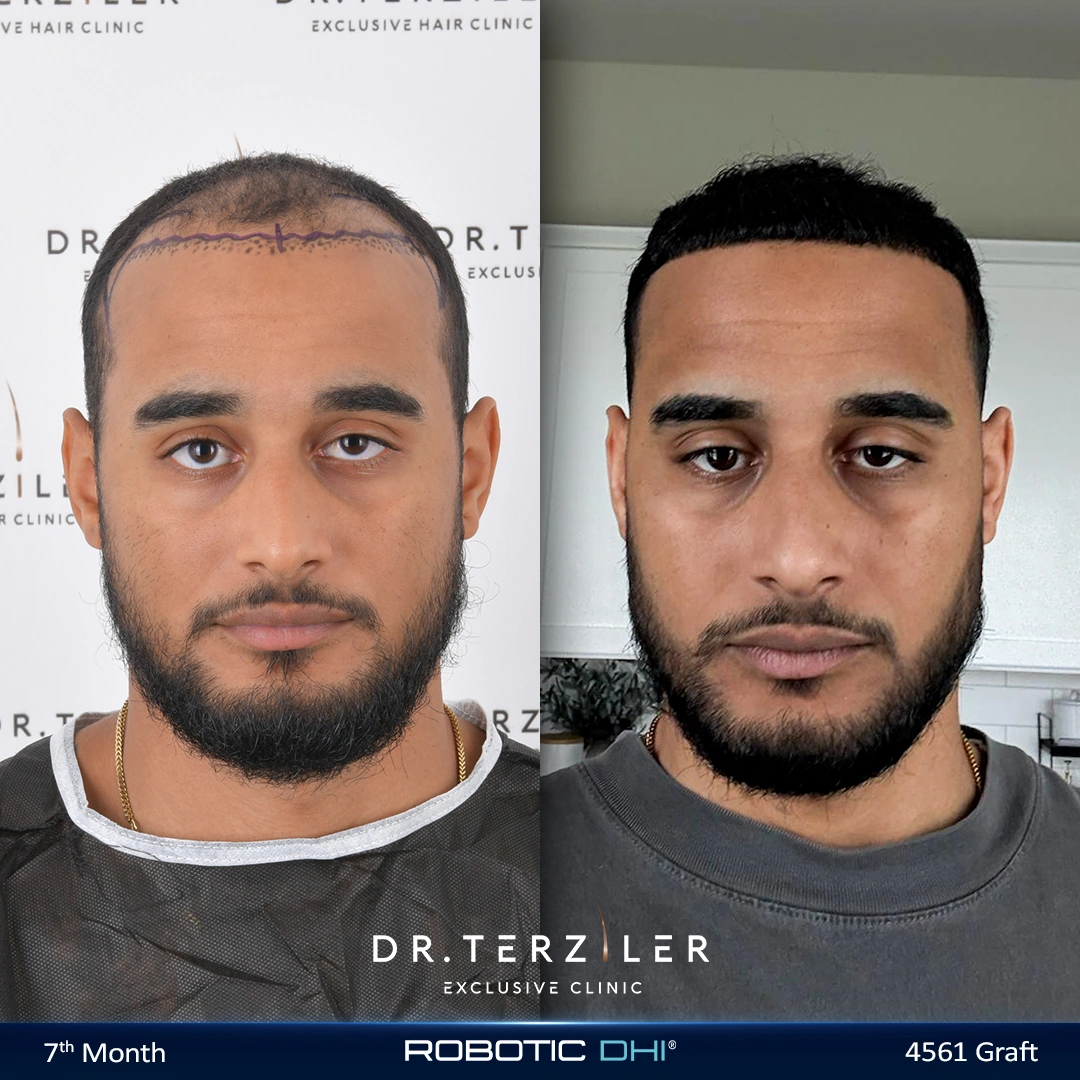
The frontal view includes the preoperative hairline drawing. This example does not establish another person’s graft requirement.
Crown hair transplant · top view
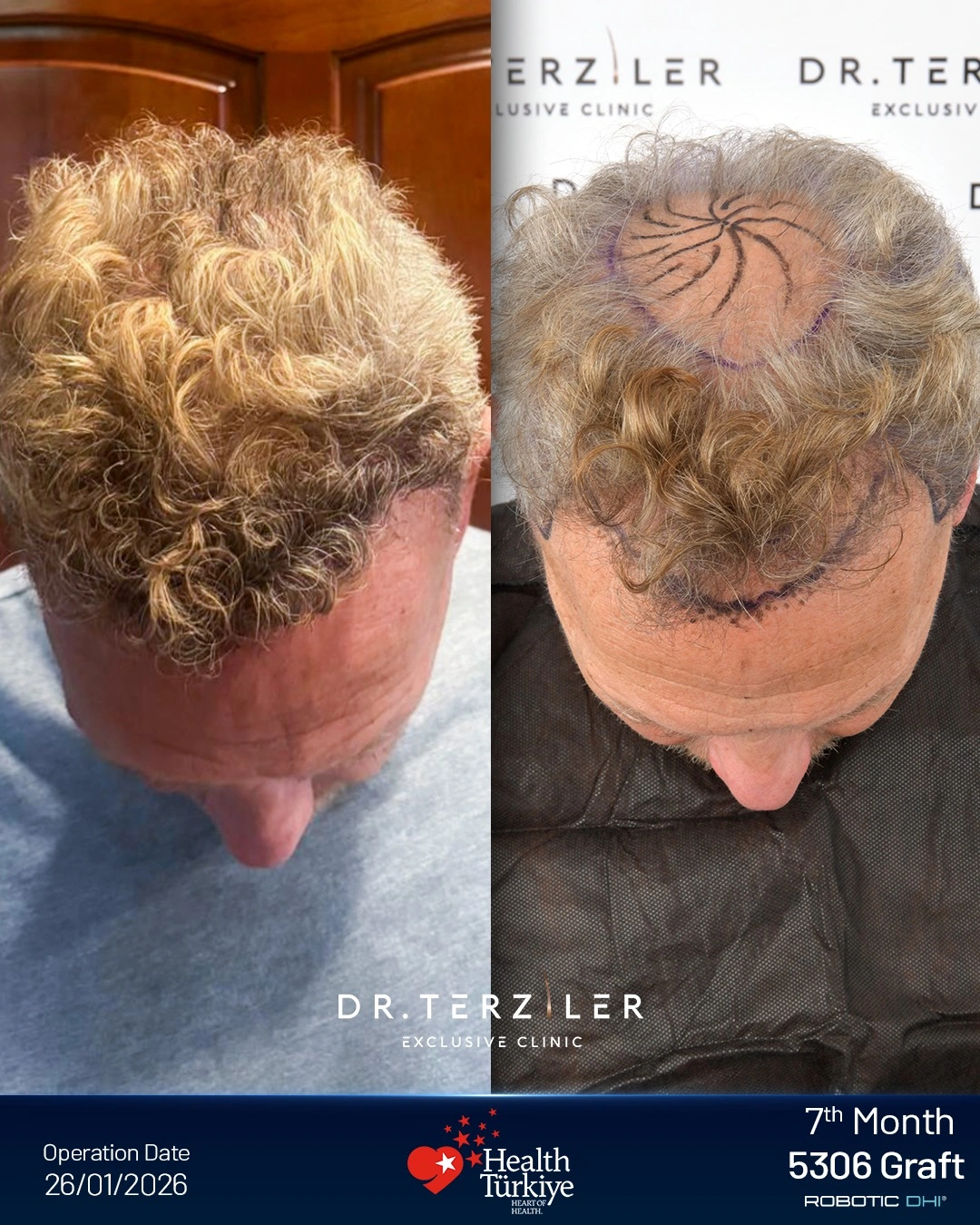
The overhead angle shows the crown and frontal area. The supplied graft count does not identify the allocation to each zone.
Frontal hairline · ten months
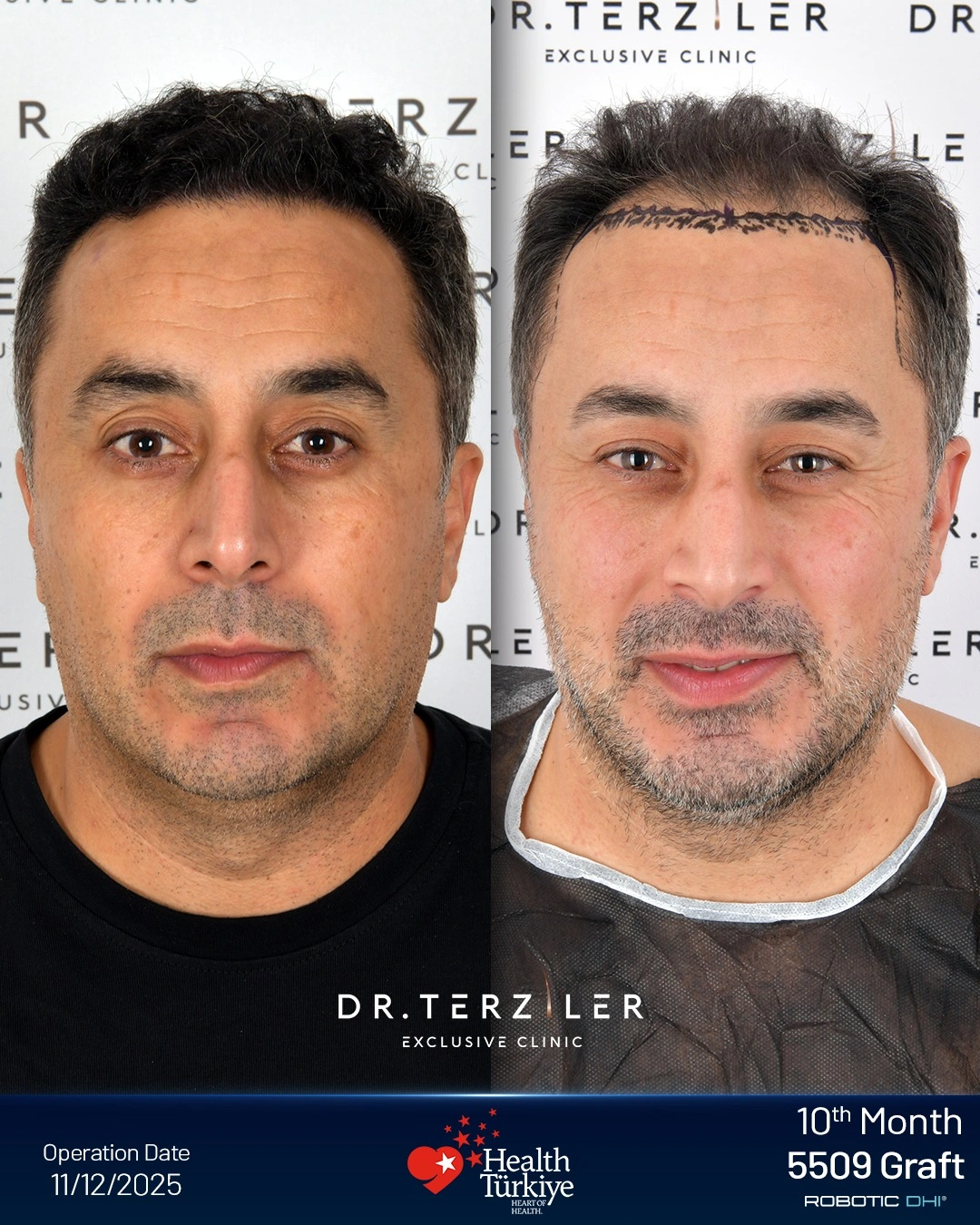
Use the stated interval when interpreting the photograph. A frontal image does not show the donor or quantify graft growth.
Frontal hairline · twelve months
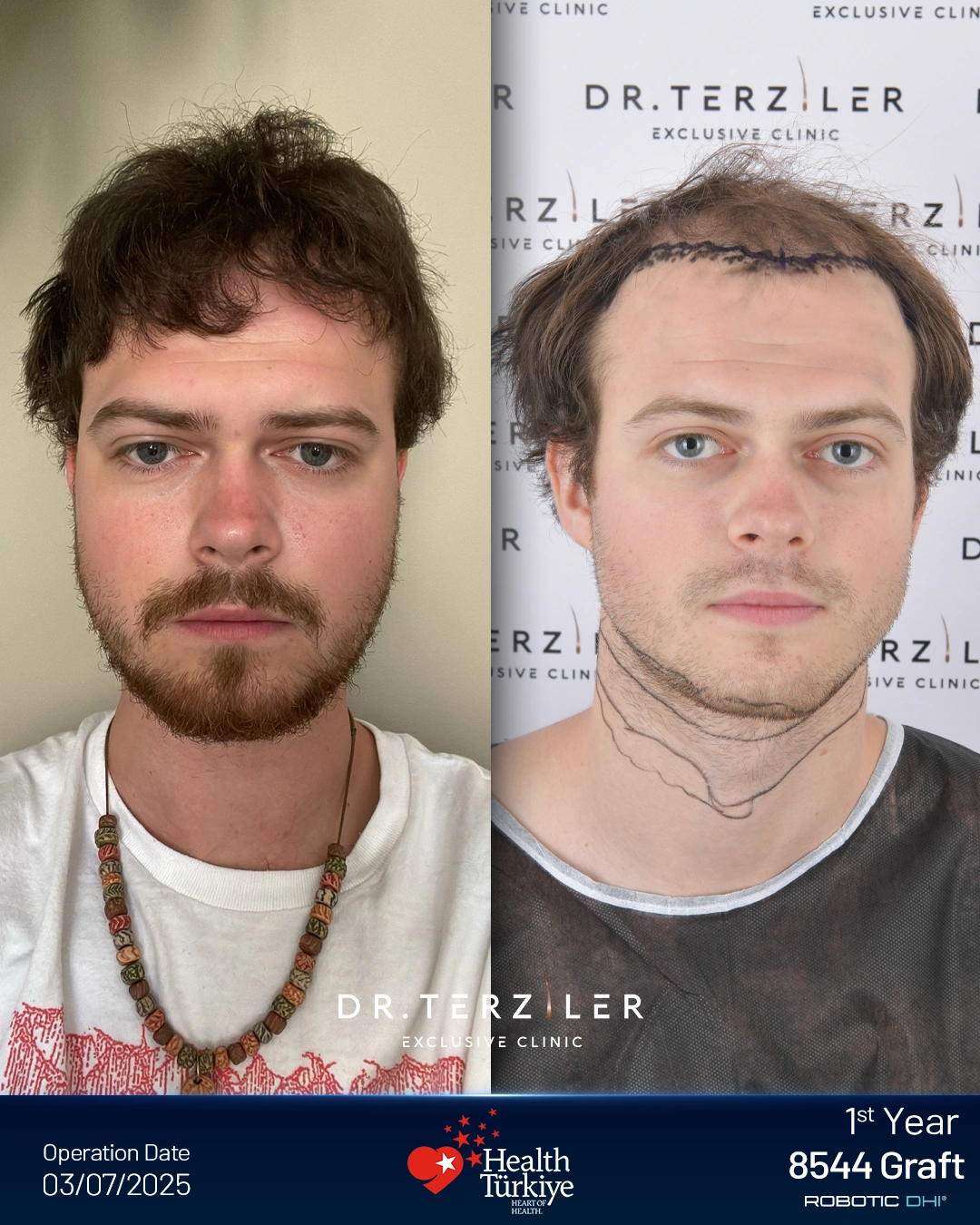
The labelled count records this example. It is not a recommended session size or a target for another patient.
What can I fairly compare at my next review?
Choose what you want to discuss, then record the photograph conditions. No photograph is uploaded or scored, and this tool does not measure graft survival or count hairs.
Compare the same scalp areas using dated views with similar lighting, angle, head position, parting, hair length and hair condition. Discuss new or worsening symptoms with your care team rather than waiting for routine photographs.
Your review record
Comparable photographs support a discussion. They do not establish a diagnosis, a measured hair count or a treatment success rate.
Do hair transplants look natural, and can other people tell?
A transplant can look natural when design, direction, graft selection and coverage fit the person. Naturalness is not established by a high count or by hiding the donor. The frontal edge, temple transition, crown direction and appearance with different hair lengths all matter. [5, 38]
At a consultation, ask to see results relevant to your starting pattern, hair characteristics and coverage goals. A very different patient’s transformation may demonstrate a possibility without showing what your donor can support. A scar, an overly regular hairline or a density mismatch can remain noticeable even when hair has grown.
What should a useful case study disclose?
A useful record identifies the starting pattern, procedure date, treated zones, graft count and unit, follow-up dates, other treatments and how the outcome was assessed. It should explain limitations and missing information. A collection of attractive photographs without those details is not equivalent to a clinical outcome study.
The clinic’s hair transplant case studies should be interpreted through that record. You can also ask which examples show donor healing and how the clinic documents patients who do not return for follow-up.
How should I choose a clinic, surgeon or country?
Choose a clinical plan and accountable professionals before choosing a destination. Verify the responsible clinician’s registration, relevant experience, the facility, the people performing surgical steps, infection-control arrangements and the plan for complications. Professional membership, a device brand or a travel package does not answer all of those questions. [11, 30, 37]
The clinic-selection checklist should help you obtain evidence: a named clinician, an examination, informed consent, a surgical record and an accessible follow-up route. Ask how many patients the responsible professional oversees that day and how unexpected findings are handled.
Is it safe to travel to Turkey, and which country is best?
No country label guarantees an individual clinic’s safety or result. Turkey, the US, the UK and Canada contain different providers, costs and regulatory arrangements. The decision should compare the actual professionals and care plan, including what happens after you leave. The CDC emphasizes advance planning, medical records and arrangements for complications when seeking care abroad. [30]
When comparing hair transplantation in Turkey and the USA, include the full cost of travel and follow-up rather than only the surgical fee. Patients traveling from Canada should also review official advice about care outside the country, insurance exclusions and records they may need on return. [31]
For local verification, use the relevant licensing regulator: state medical boards in the US, professional and facility regulators applicable to the UK jurisdiction, and provincial or territorial medical regulators in Canada. A credential should be checked with its issuing body, not inferred from a website badge.
When is it safe to fly after a hair transplant?
There is no universal flight-clearance time that fits every operation, health history and journey. Arrange the first postoperative check, discuss the itinerary with the operating clinician and leave room for problems that could delay travel. Flight length, mobility, medical risk and access to help may affect the advice. Generic waiting periods for major chest or abdominal surgery should not be copied into a hair-transplant timetable. [30, 31]
Ask who will help if symptoms develop in transit or at home. Carry the procedure summary and medication information, and know how to obtain local assessment. A transfer to the airport is a transport service; the follow-up plan is a separate clinical requirement.
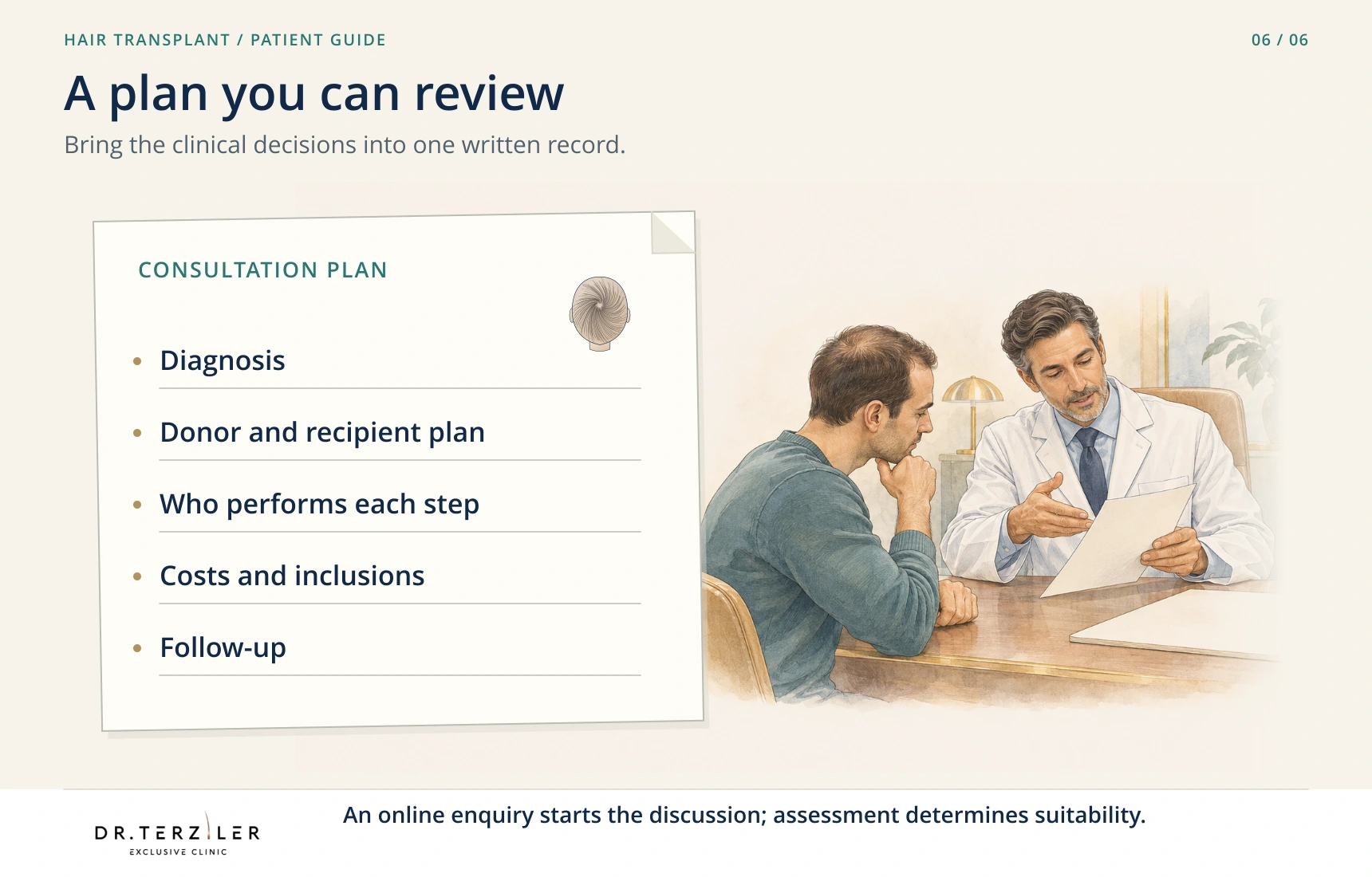
What should I bring to a hair transplant consultation?
Bring a timeline of hair loss, older photographs, previous procedure records, current and past treatments, a medication and supplement list, relevant health history and your main goal. State whether you are most concerned about the frontal frame, crown, diffuse thinning, a scar or a previous result. Uncertainty is useful information; you do not need to arrive with a self-diagnosis. [9, 24]
Use the consultation to produce a decision you can review later. If the clinician recommends waiting, treatment or further investigation, ask what will be assessed and when the decision will be revisited.
Which questions should the written plan answer?
- What diagnosis explains my current hair loss, and is it stable enough for surgery?
- What does the donor examination show, including miniaturization and previous depletion?
- Which areas will be treated, and what improvement is realistic with the available supply?
- How will grafts be obtained and placed, and who performs each surgical step?
- Does the quoted number mean grafts or hairs, and what final record will I receive?
- What are the alternatives, material risks and likely compromises?
- How could further hair loss change the design, and what options would remain?
- What care, reviews, additional charges and contact routes apply after surgery?
A useful plan should make the tradeoffs understandable without requiring you to become a surgeon. If the answers depend on an in-person examination, that limitation should be stated clearly rather than hidden inside a confident online graft estimate.
What should I bring to my consultation?
Prepare an editable note in your own words. Every field is optional, and approximate dates or “Not sure” are useful. The note records observations, not a diagnosis.
Bring your hair-loss history, goals, treatments, previous procedure records and relevant photographs. You can book a consultation with the team or start a WhatsApp enquiry.
For example: frontal hairline, crown, donor area or a previous result
An approximate date or “Not sure” is fine
Procedure, approximate date and records, if known
Include names if known; do not change prescribed treatment on your own
Optional: scalp symptoms, medicines or other history you want assessed
For example: dated photos, a quote, graft record or aftercare instructions
Describe the change you would like to discuss
You have edited your note. Replace it with a newly generated note from the fields above?
This is optional and starts off. Opening WhatsApp prepares a message; you choose whether to send it. For a medical emergency, use local emergency services.
Your note is not automatically sent to the clinic, stored between visits or included in this component’s analytics events. The form opens separately and does not receive your note automatically.
Which sources support this guide?
Evidence checked on 9 November 2026. Professional patient guidance explains usual practice; individual studies answer narrower questions. The evidence summaries above identify important limitations rather than treating every publication as proof of the same outcome.
- MedlinePlus Medical Encyclopedia. Hair transplant.
- International Society of Hair Restoration Surgery. Surgical treatments for hair loss.
- American Academy of Dermatology. A hair transplant can give you permanent, natural-looking results.
- NHS. Hair transplant.
- British Association of Aesthetic Plastic Surgeons. Hair transplant surgery.
- StatPearls. Hair transplantation.
- ISHRS FUE Clinical Practice Guidelines, 2019.
- ISHRS FUT task force. Follicular Unit Transplantation guidelines, 2024.
- An international expert consensus statement focusing on pre and post hair transplantation care, 2023. PubMed 37477225.
- ISHRS. Follicular Unit Excision terminology, 2019.
- ISHRS. Position statement on qualifications for scalp surgery, revised 2024.
- ISHRS. Is FUE scarless?
- Umar S. Body Hair Transplant by Follicular Unit Extraction: My Experience With 122 Patients, 2016.
- Advances and challenges in hair restoration of curly Afrocentric hair, 2014. PubMed 24680003.
- ISHRS. Hair loss in women: assessing the loss and developing a treatment plan.
- Effects of finasteride (1 mg) on hair transplant, 2005. PubMed 16188178.
- Graft anchoring in hair transplantation, 2006. PubMed 16442039.
- American Society of Plastic Surgeons. Hair transplant recovery.
- Khatib et al. Complications Following Hair Transplantation: A Systematic Literature Review and Meta-Analysis, 2025. PubMed 40913181.
- Safety Considerations in Hair Restoration Procedures: A Comprehensive Review, 2026. PubMed 42594307.
- FUE complications review. Frontiers in Medicine, 2026; article 1750989.
- Longevity of Hair Follicles after Follicular Unit Transplant Surgery, 2021.
- NHS. Finasteride, including safety information.
- MedlinePlus. Finasteride drug information.
- Efficacy of Platelet-Rich Plasma as an Adjunct to Hair Transplantation: A Systematic Review, 2025. PubMed 41069573.
- Low-Level Laser and LED Therapy in Alopecia: A Systematic Review and Meta-Analysis, 2024. PubMed 39404126.
- Standardized hair photography, 1997. PubMed 9063510.
- American Board of Hair Restoration Surgery. Certification requirements and standardized photographs.
- Psychological Dimensions of Hair Transplantation: A Narrative Review of Current Evidence, 2025. PubMed 40990054.
- CDC Yellow Book. Medical tourism.
- Government of Canada. Receiving medical care outside Canada.
- US Food and Drug Administration. Public safety notification on exosome products.
- US Food and Drug Administration. Medical device bans, including prosthetic hair fibers.
- ISHRS. Tissue engineering and hair follicle cloning.
- Manabe et al. Guidelines for the diagnosis and treatment of male-pattern and female-pattern hair loss, 2017 version. J Dermatol, 2018.
- Cleveland Clinic. Hair transplant.
- ISHRS Fight the Fight. Before you choose a surgeon.
- American Society of Plastic Surgeons. Hair transplantation and restoration.
- Johns Hopkins Medicine. Hair transplant.
- ISHRS. 2025 practice census results.
- ISHRS. FUE: What is it?
- American Academy of Dermatology. Hair loss: diagnosis and treatment.