
Medically reviewed by Dr. Servet Terziler, founder of Dr. Terziler Exclusive Clinic, AACI-accredited surgeon and inventor of Robotic DHI. Trained in ISHRS education workshops. Updated 10 November 2026.
A New York clinic quotes $24,000 for 4,000 grafts, and your first thought is probably not “graft survival”. It is “how much of my down payment is that?” This page puts both countries on the same calculator, then tells you where the cheaper option stops being cheaper.
Quick answer: Hair transplant Turkey typically costs 75 to 85 percent less than in the US for sessions of 4,000 grafts or more, even after flights. US clinics charge $5 to $10 per graft, so 4,000 grafts cost $20,000 to $40,000 for the procedure alone. An all-inclusive Istanbul package for the same session costs $3,500 to $8,000, plus about $500 to $1,200 for a nonstop flight. The result depends on the surgeon, not the country.
- U.S. procedure example$20k–$40k4,000 grafts
- Istanbul trip range in the article$4.5k–$9.8kSee the full cost assumptions
- New York to IstanbulAbout 10 hoursCheck your nonstop itinerary
At a glance: 4,000 grafts in the US: $20,000 to $40,000. Same session in Istanbul with flights: about $4,500 to $9,800. JFK to Istanbul: about 10 hours nonstop.
What Are the Differences Between Hair Transplant Procedures in Turkey and the US?
Hair transplant procedures in Turkey are 75 to 85 percent cheaper than in the US for large sessions, use the same FUE and DHI techniques, and are sold as all-inclusive packages instead of per-graft bills. The real quality gap is between clinics, not countries: who performs the surgery, how grafts are handled, and who follows you up after you fly home.
| Factor | Turkey (accredited clinic) | USA (typical private clinic) |
|---|---|---|
| Cost, 4,000 grafts | $3,500 to $8,000 all-inclusive | $20,000 to $40,000, procedure only |
| Pricing model | Fixed package | $5 to $10 per graft |
| Techniques | FUE, Sapphire FUE, DHI, unshaven DHI; Robotic DHI at Dr. Terziler | FUE, FUT (strip), robotic-assisted FUE, DHI in some clinics |
| Who performs key steps | Varies by clinic. Ask who makes incisions and extracts grafts. | Varies by clinic. Ask the same question. |
| Graft survival | Published FUE series report about 90 to 93%; Dr. Terziler clinic audit: 98.1% (clinic-reported) | Similar published range for experienced FUE teams |
| Included | Hotel, VIP transfers, medication, aftercare, remote follow-up | Procedure; extras billed separately |
| Waiting time | Usually 1 to 4 weeks | Often several weeks to months for top surgeons |
| Follow-up | Remote video check-ups plus WhatsApp; in person needs travel | In person, local |
| Insurance / HSA / FSA | Not covered | Not covered; IRS Publication 502 lists hair transplants as non-deductible |
| Travel | About 10 hours nonstop from JFK | None |
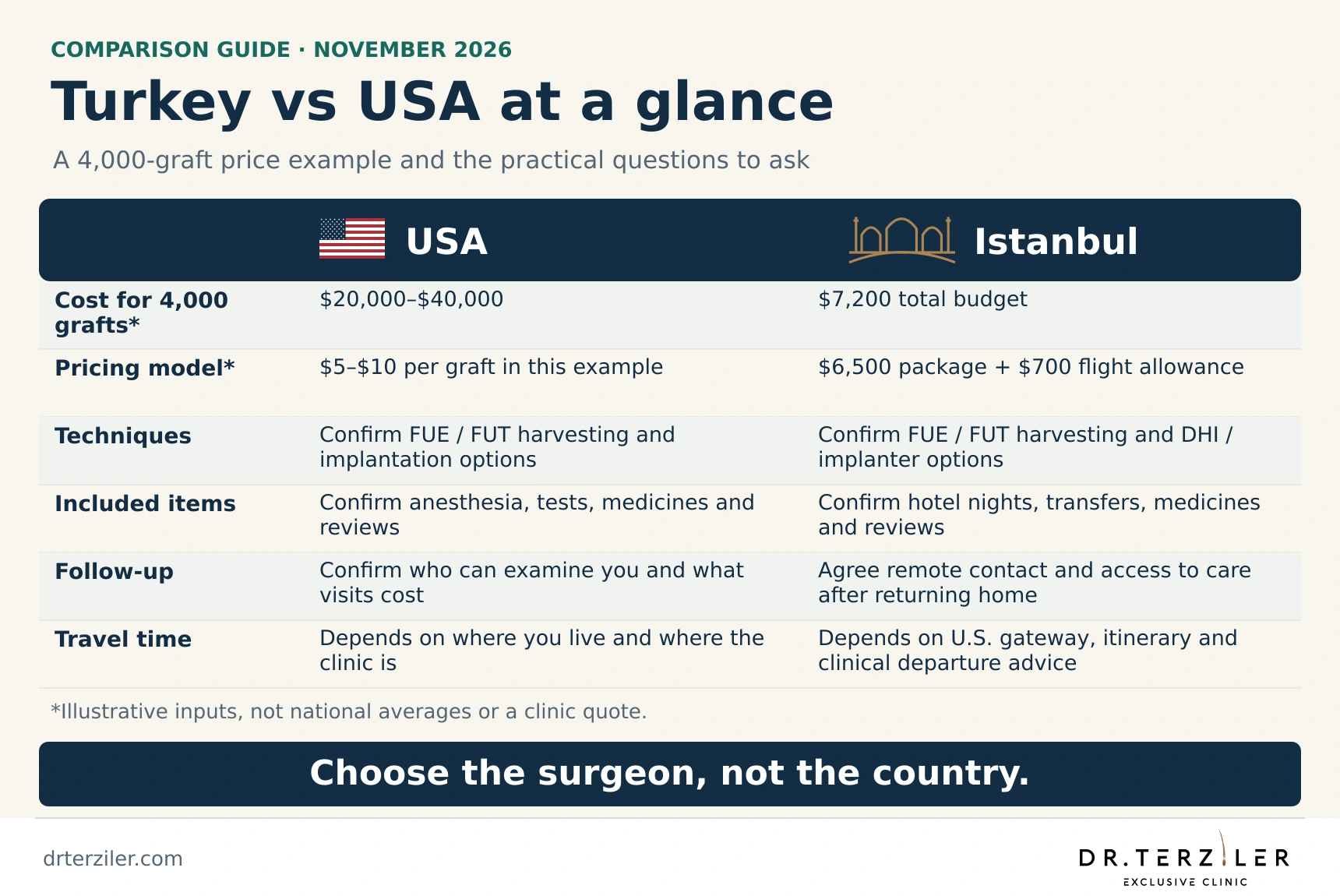
Read the graphic’s context
The graphic uses a $5–$10 U.S. per-graft example and an assumed $6,500 Istanbul package plus a $700 flight allowance. These are explanatory inputs, not verified national averages or a current clinic quote.
How Much Cheaper Is a Hair Transplant in Turkey Compared to the US?
How much is a hair transplant in Turkey vs the United States?
A hair transplant in Turkey costs $3,500 to $8,000 all-inclusive at an accredited Istanbul clinic. The same procedure in the United States costs $5 to $10 per graft: about $10,000 to $20,000 for 2,000 grafts and $20,000 to $40,000 for 4,000 grafts. The Istanbul price includes hotel, transfers and medication; the US price covers the surgery only.
A hair transplant in Turkey is about 75 to 85 percent cheaper than in the US once a session reaches 4,000 grafts. The gap comes from the pricing model. US clinics bill each graft, so the bill rises with every graft. Most Turkish clinics, including Dr. Terziler Exclusive Clinic, sell a fixed package, so a large session costs about the same as a medium one.
What does the full trip cost an American patient?
The fair comparison adds the flight, a few days off work and small extras to the Istanbul side. We did that maths below. Hotel, transfers and medication are inside the package.
| Grafts | USA, procedure only ($5 to $10/graft) | Istanbul total (package + flight + extras) | You save | Saving at midpoint |
|---|---|---|---|---|
| 3,000 | $15,000 to $30,000 | $4,500 to $9,800 | $5,200 to $25,500 | about 68% |
| 4,000 | $20,000 to $40,000 | $4,500 to $9,800 | $10,200 to $35,500 | about 76% |
| 5,000 | $25,000 to $50,000 | $4,500 to $9,800 | $15,200 to $45,500 | about 81% |
How we calculated it: Istanbul package $3,500 to $8,000 + nonstop economy flight $500 to $1,200 + meals and extras $500 to $600 = $4,500 to $9,800. Flight prices change by season, so check your own route on a fare tracker before you decide.
The bigger the session, the bigger the saving. At midpoint prices, Istanbul is about 68 percent cheaper at 3,000 grafts, 76 percent cheaper at 4,000 grafts and 81 percent cheaper at 5,000 grafts, flights included.
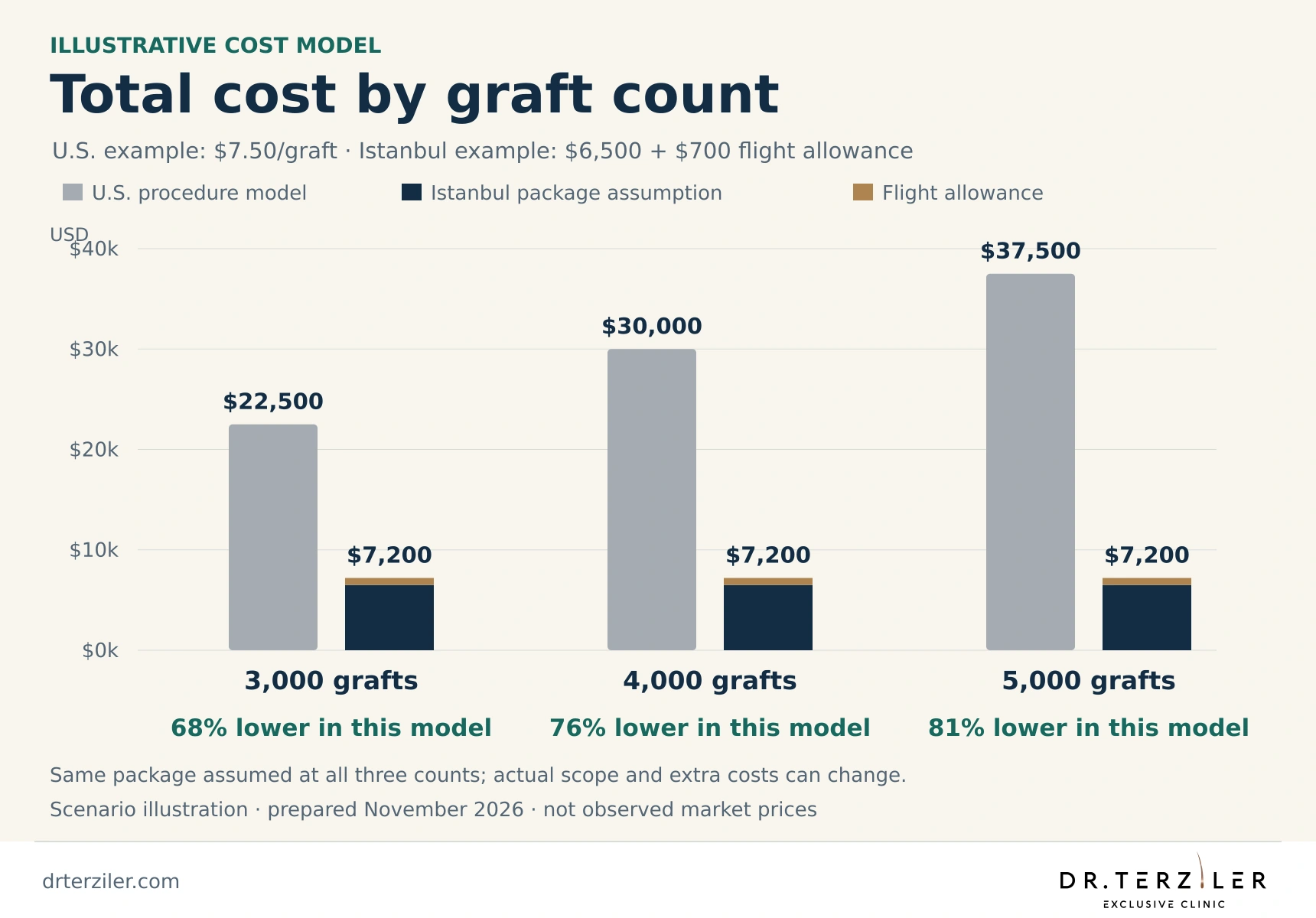
Read the graphic’s context
The graphic’s fixed $7,200 scenario differs from the $4,500–$9,800 range in the article table. It is not a price survey or a promise that the same package is available at every graft count. Add any excluded costs from your actual quotes.
When is Turkey not cheaper? The break-even graft count
Small sessions change the picture. At $5 per graft, a US clinic charges $5,000 for 1,000 grafts. A budget Istanbul trip costs about $4,500 all in. The saving is close to zero. For a premium Istanbul package with a $8,000 price and $1,500 in travel, the break-even point sits near 1,900 grafts at US prices of $5 per graft, and near 950 grafts at $10 per graft.
Below roughly 1,000 to 1,900 grafts, a hair transplant in Turkey saves little or nothing compared with the US once flights and time off are counted. Above 3,000 grafts, the saving is usually $10,000 or more.
If you need a small hairline touch-up, a good local surgeon may be the smarter choice. We tell patients that on consultation calls too. It saves everyone a 10-hour flight.
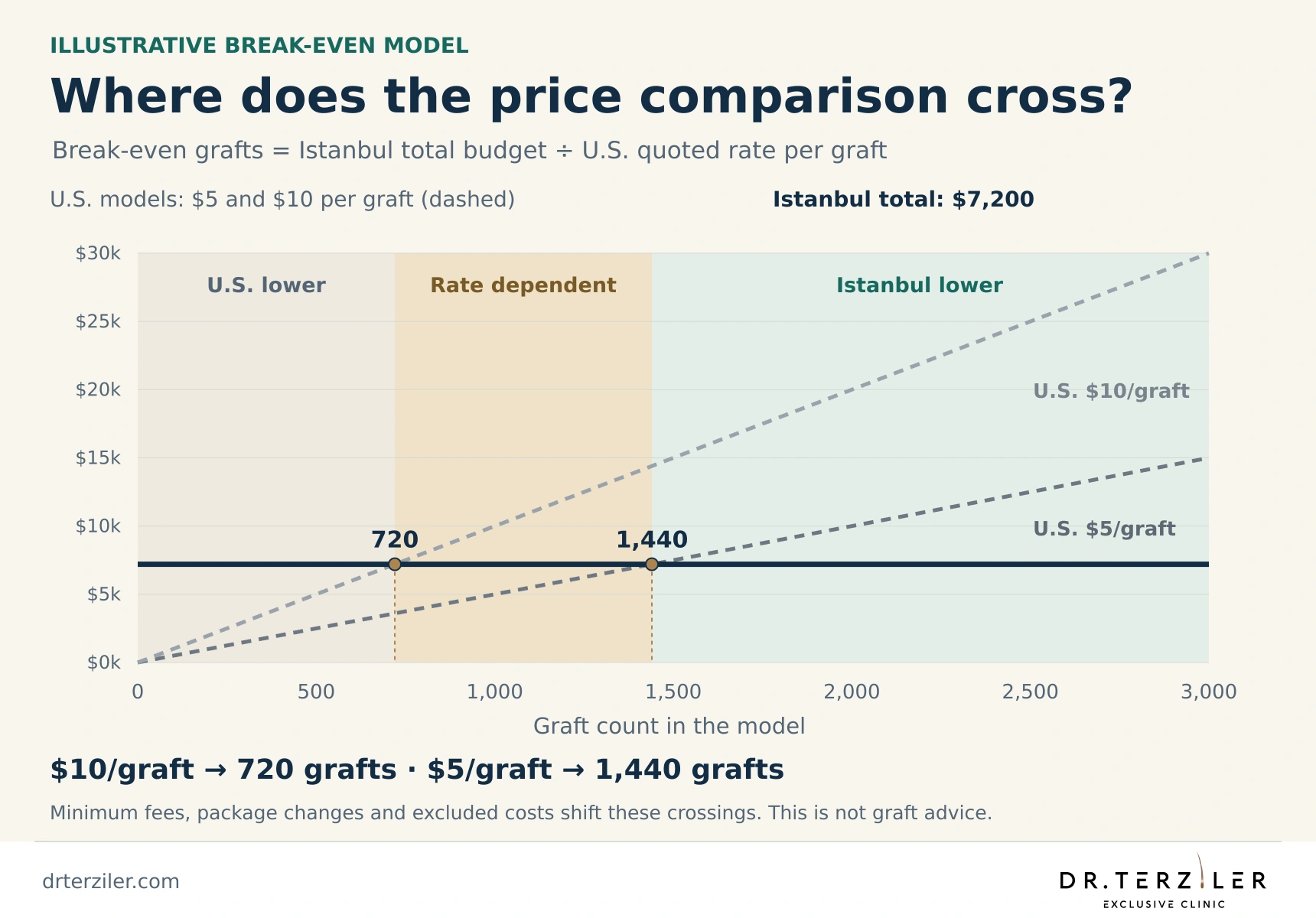
Read the graphic’s context
Break-even grafts = total Istanbul budget ÷ U.S. effective price per graft. Changing the budget, minimum fee, package scope or unlisted expenses changes the crossing. This is a price model, not a recommended graft count.
Is a hair transplant in Turkey worth it?
A hair transplant in Turkey is worth it for most Americans who need 3,000 grafts or more and choose an accredited, doctor-led clinic. The saving is usually $10,000 to $35,000 after flights. It is not worth it for small sessions under about 1,500 grafts, or at any clinic that cannot name the surgeon who will operate.
Worth it has three parts: the money saved, the result after 12 months and the cost of fixing a bad result. The first part is easy maths. The second and third depend on the clinic, which is why the next sections focus on who performs the surgery and how to check them.
Compare the total cost of both plans
Replace the illustrative inputs with your own quotes. The airport selection records your departure; it does not look up airfares or estimate your graft requirement.
How much does 3,000 grafts cost in Turkey compared to the USA?
3,000 grafts cost $3,500 to $8,000 all-inclusive in Turkey and $15,000 to $30,000 in the USA at $5 to $10 per graft. With flights, an American patient saves about $5,200 to $25,500. Three thousand grafts usually cover a Norwood 3 hairline and frontal zone. See what a full 3,000 grafts hair transplant covers, with photos.
How much does a 4,000-graft hair transplant cost in the US and Turkey?
In the US, 4,000 grafts cost $20,000 to $40,000 for the procedure alone. In Istanbul, the same session costs $3,500 to $8,000 all-inclusive. Four thousand grafts usually cover Norwood 4 to early Norwood 5, one of the most common profiles in hair restoration. More on a 4,000 grafts hair transplant.
How much do 5,000 grafts cost in Turkey vs the USA?
5,000 grafts usually cost the same package price as 4,000 grafts in Turkey, about $3,500 to $8,000, while the USA charges $25,000 to $50,000. In the US, 5,000 grafts cost $25,000 to $50,000, and some surgeons split this into two sessions. In Istanbul, 5,000 grafts usually cost the same package price as 4,000. Five thousand grafts suit Norwood 5 to 6, but only if the donor area can supply them safely. A Tricho Test and donor density map decide that, not the price list.
| Norwood stage | Typical grafts | USA (procedure only) | Istanbul (all-inclusive) |
|---|---|---|---|
| Norwood 2 | 1,000 to 1,800 | $5,000 to $18,000 | $3,500 to $8,000 |
| Norwood 3 | 1,800 to 2,800 | $9,000 to $28,000 | $3,500 to $8,000 |
| Norwood 4 | 2,800 to 3,800 | $14,000 to $38,000 | $3,500 to $8,000 |
| Norwood 5 to 6 | 3,800 to 5,500 | $19,000 to $55,000 | $3,500 to $8,000 |
Not sure of your stage? Compare your photos with our Norwood scale guide, or read how many grafts you need.
Want the Turkey-only price list? See our full hair transplant cost in Turkey guide.
How Much Is a Hair Transplant in the USA?
A hair transplant in the USA usually costs $4,000 to $15,000 for 1,000 to 2,000 grafts and $15,000 to $50,000 for 3,000 to 5,000 grafts. Most US clinics charge $5 to $10 per graft. Prices are highest in New York, Los Angeles and Miami. Health insurance does not cover it, and HSA or FSA funds cannot be used.
US prices vary by city and by surgeon demand. Large national chains often price smaller sessions per graft and add fees for consultation, PRP or medication. Ask every US clinic for a written quote that lists the per-graft rate, the expected graft count, the surgeon’s name and what follow-up visits cost.
| US city | Typical session (2,000 to 3,000 grafts) |
|---|---|
| New York, Los Angeles | $12,000 to $25,000 |
| Chicago, Boston, Washington DC | $10,000 to $22,000 |
| Dallas, Houston, Miami, Atlanta | $8,000 to $18,000 |
Does US insurance, HSA or FSA cover a hair transplant in Turkey?
No. US health insurance does not cover a hair transplant in Turkey or in the US, because insurers classify it as cosmetic surgery. IRS Publication 502 lists hair transplants as a non-deductible medical expense, so HSA and FSA funds cannot pay for the surgery.
Two exceptions are worth asking about. Hair restoration after burns, trauma or cancer surgery is sometimes reconstructive, so ask your insurer in writing. Travel insurance with medical evacuation cover is a separate product, and the CDC recommends it for every medical traveler.
What Is the Difference Between All-Inclusive Hair Transplant Packages in Turkey and the US?
An all-inclusive package in Istanbul covers the surgery, hotel, VIP airport transfers, medication, the first wash and remote follow-up for one fixed price. US clinics price the procedure and bill the rest separately. Compare the total trip cost, not the surgery fee.
| Item | Istanbul package (Dr. Terziler) | Typical US clinic |
|---|---|---|
| Surgery (FUE, DHI or Robotic DHI) | Included | Billed per graft |
| Consultation, Tricho Test, hairline design | Included, same day as surgery | Often billed or credited |
| Hotel and VIP transfers | Included | Not needed or self-paid |
| Medication and aftercare kit | Included | Usually pharmacy cost |
| First wash and check-up | Included | Usually included |
| Remote follow-up (video + WhatsApp) | Included, 12 months | In-person visits |
| Graft count proof | On-screen counter, printed record, surgery video | Varies |
| Guarantee | Written 2-year guarantee | Varies |
See exactly what each tier includes on our hair transplant packages page.
Who Actually Performs Your Hair Transplant in Turkey vs the US?
The biggest quality risk in hair transplant tourism is not the country. It is who performs the surgery. The ISHRS position is that a licensed physician must make the recipient incisions and extract the grafts. A 2025 Mayo Clinic review of hair transplant tourism in Turkey reports that some high-volume clinics let unsupervised technicians do these steps.[1], [2]
Technician-led models exist in both countries. In Istanbul the problem is scale: some clinics run 10 or more patients a day with one doctor. That is a math problem no one can solve with talent. Ask these five questions before you pay anything:
Who holds the punch?
Mark questions for which you have an answer. The checklist records what still needs discussion; it does not rate or approve a clinic.
The five questions remain readable. Discuss them with the clinic.
At Dr. Terziler Exclusive Clinic, the answers are written into the booking. The clinic treats a maximum of 4 patients a day. A real-time on-screen counter shows every graft. You leave with a printed record of your name, doctor, date and exact graft count, plus a video of your surgery. Meet the medical team.
Why handling matters (evidence)
A Dermatologic Surgery study (Kwack et al., 2021) transplanted intact and injured human FUE grafts in a laboratory mouse model. 71% of intact grafts grew, while only 13% of fractured grafts survived. Careful extraction is not a luxury detail. It decides how many grafts grow.[4]
Is the Quality of Hair Transplants in Turkey the Same as in the US?
Yes, at accredited clinics where a doctor performs the surgical steps, the quality is comparable. Both countries use the same FUE punches, sapphire blades and DHI implanter pens. Published FUE results report graft survival of about 90 to 93 percent: a 2024 study of 248 patients found 93.1 percent survival at 9 months (Jin et al., Journal of Cosmetic Dermatology). Dr. Terziler Exclusive Clinic reports 98.1 percent graft survival in an internal 12-month audit of 120 patients. This is a clinic-reported figure, not a peer-reviewed one. Read more on the success rate of a hair transplant.[3]
Surgical volume matters, but not in the way ads suggest. ISHRS members worldwide average about 15 surgeries a month and spend about three quarters of their practice on hair restoration. Experience exists in both countries. What differs is how many patients one surgeon is responsible for on a single day.[1]
One technique is specific to our clinic. Robotic DHI is a system Dr. Servet Terziler invented. It automates extraction and implantation with depth control of plus or minus 0.1 mm and angle control of plus or minus 5 degrees. Robotic-assisted FUE systems used in some US clinics automate extraction and site making, while implantation stays manual. Picasso Robotic DHI adds Dr. Terziler’s hand-drawn hairline design to the same system.
What Is the Difference Between Hair Transplant Regulations in Turkey and the US?
In Turkey, the Ministry of Health licenses every hair transplant facility and requires that surgery be performed by licensed physicians. In the US, any licensed physician may perform hair transplants, and state medical boards regulate practice. Board certification in hair restoration (ABHRS) is voluntary and exam-based. Accreditation is a second layer in both countries.
| Layer | Turkey | USA |
|---|---|---|
| Who may operate | Licensed physician in a Ministry-licensed facility | Any licensed physician |
| Practice oversight | Ministry of Health inspections | State medical boards |
| Specialty credential | ISHRS training, international accreditation | ABHRS board certification (voluntary, exam-based), ISHRS membership |
| Facility accreditation | International bodies such as AACI or JCI | AAAASF, AAAHC, Joint Commission |
Dr. Terziler Exclusive Clinic holds AACI accreditation for both the surgeon and the facility. You can verify it on the AACI registry.
A 2025 Mayo Clinic review called the Turkish hair transplant market a “data black hole” because clinics rarely publish outcomes. That is why we publish our graft survival audit and give every patient a printed graft record. Ask any clinic, anywhere, for the same.[2]
Which Hair Transplant Techniques Do Turkish Clinics Offer Compared to US Clinics?
Accredited Istanbul clinics offer every mainstream technique available in the US, plus DHI and unshaven methods at a much larger scale. Robotic DHI, invented by Dr. Servet Terziler, is not a US clinic option.
| Technique | USA | Istanbul |
|---|---|---|
| FUE | Yes | Yes |
| FUT (strip) | Yes | Less common |
| DHI (implanter pen) | Some clinics | Widely; DHI with a 0.70 mm implanter at Dr. Terziler |
| Sapphire FUE | Limited | Yes |
| Robotic-assisted FUE | Yes (extraction and site making) | Limited |
| Robotic DHI | No | Yes, at Dr. Terziler Exclusive Clinic |
| Unshaven / no-shave | Yes, often premium priced | Yes, unshaven hair transplant |
| PRP, exosomes, growth factors | Yes, extra cost | Often in the package; see Hair PRP and exosome therapy |
Not sure which method fits you? Compare FUE vs DHI or read which hair transplant type is good for me. Women and Afro-textured hair need different planning: see female hair transplant and Afro hair transplant.
An implanter pen study of 191 patients (Zhao et al., Aesthetic Plastic Surgery, 2025) found that the stick-and-place method reached higher graft density and patient satisfaction than premade incisions, with similar survival. That is the method DHI uses.[5]
For large sessions over 2,500 grafts, Dr. Terziler stores grafts in a chilled HypoThermosol solution with ATP to protect them during the hours outside the body.
Why Do People Go to Turkey for Hair Transplants Instead of the US?
People go to Turkey for hair transplants because the total cost is 75 to 85 percent lower for large sessions, packages include hotel and transfers, waiting times are short, and Istanbul has decades of high-volume experience. Turkey hosted about 1.4 million health tourists in 2023, and hair transplant is the most requested procedure.
Why is a hair transplant so cheap in Turkey?
A hair transplant is cheap in Turkey because the costs behind it are low, not because the surgery is simpler. Five structural factors explain the price, none of them about skill:
- Lower costs. Salaries, rent and clinic overheads in Istanbul are a fraction of Manhattan prices.
- Package economics. High volume lets clinics bundle hotel, transfers and medication into one price.
- Specialization. Many Istanbul surgeons do hair restoration only, every working day.
- Infrastructure. Istanbul Airport is a global hub with nonstop flights to 14 US cities.
- Government support. Turkey promotes health tourism through licensing and its official health tourism agency.
A 2025 review from Mayo Clinic estimated that Istanbul’s hair transplant industry generates about US$1 billion a year. Low prices attract quality clinics and shortcut clinics alike, which is why the next section matters.[2]
Is a Hair Transplant in Turkey Safe? Can It Be Trusted?
Yes, a hair transplant in Turkey is safe at a licensed, accredited clinic where a named doctor performs the surgery. The risk sits with clinic choice. The ISHRS 2025 Practice Census reports that 59 percent of members know of black-market hair transplant clinics in their own cities, up from 51 percent in 2021. Those clinics exist in Istanbul, London, Houston and Bangkok alike.
Is a hair transplant in Turkey risky?
A hair transplant in Turkey carries the same medical risks as in the US: infection, poor graft growth, visible scarring, an unnatural hairline and an over-harvested donor area. The extra risk in Turkey comes from technician-led, high-volume clinics and from distance, because a problem after you fly home needs remote follow-up or a second trip.
| Risk | How often / why | How to lower it |
|---|---|---|
| Infection, folliculitis | Uncommon; usually mild and treatable with antibiotics | Sterile clinic, aftercare kit, clear wash protocol |
| Poor graft growth | Linked to graft handling and time outside the body | Doctor-performed extraction, graft storage protocol, written graft record |
| Unnatural or low hairline | Linked to rushed design | Doctor-drawn hairline planned for your age at 45 |
| Over-harvested donor | Linked to very large sessions and unlimited-graft offers | Donor density map before quoting a graft number |
| Distance | Follow-up is remote | 12-month video protocol, WhatsApp access, written guarantee |
Read our guide on how to choose the right hair transplant clinic for the full checklist.
Istanbul is a safe city for medical travel. The US State Department rates Türkiye at Level 2, “Exercise increased caution”. Its higher-risk zones are in the southeast and along the Syrian and Iraqi borders, hundreds of kilometres from Istanbul.[7]
| Check | Green flag | Red flag |
|---|---|---|
| Surgeon name | Named surgeon, verifiable CV | “Our expert team”, no name |
| Who operates | Doctor makes incisions and extracts | Doctor “supervises” only |
| Patients per day | 4 or fewer per surgeon | 6 to 10 or more |
| Accreditation | Number you can check on the registry | Badge image, no number |
| Graft proof | Live counter, printed record, video | “Trust us” count |
| Before and after | Dated, consented, same lighting | Stock or watermarked photos |
| Written quote | Surgery, hotel, transfers, medication, follow-up listed | Price changes after arrival |
| Price floor | Realistic for doctor-performed surgery | Under about $2,000 for a large session |
Do Americans Go to Turkey for Hair Transplants?
Yes. Americans travel to Turkey for hair transplants mainly to save $10,000 or more on large sessions. Turkey hosted about 1.4 million health tourists in 2023, and hair transplant is its most requested procedure. Nonstop flights from 14 US airports bring Istanbul within 10 to 13 hours of most American cities.
Watch an American guest’s visit to our clinic in Istanbul, from arrival to the operating room.

A US guest tours the clinic and meets Dr. Servet Terziler. Ask us about your own trip on WhatsApp.
How do Americans travel to Istanbul for a hair transplant?
Americans fly nonstop to Istanbul from 14 US airports on Turkish Airlines, stay 3 to 4 nights and fly home after their check-up. US citizens need an e-Visa from the official evisa.gov.tr site before travel.
| US airport | Nonstop to Istanbul? | Approx. flight time |
|---|---|---|
| New York JFK, Newark | Yes | about 10 hours |
| Boston, Washington Dulles | Yes | about 9.5 to 10 hours |
| Chicago O’Hare, Detroit | Yes | about 10.5 hours |
| Atlanta, Miami | Yes | about 11 hours |
| Houston, Dallas | Yes | about 11.5 to 12 hours |
| Denver | Yes | about 11 to 12 hours |
| Seattle | Yes | about 11 hours |
| Los Angeles, San Francisco | Yes | about 12.5 to 13.5 hours |
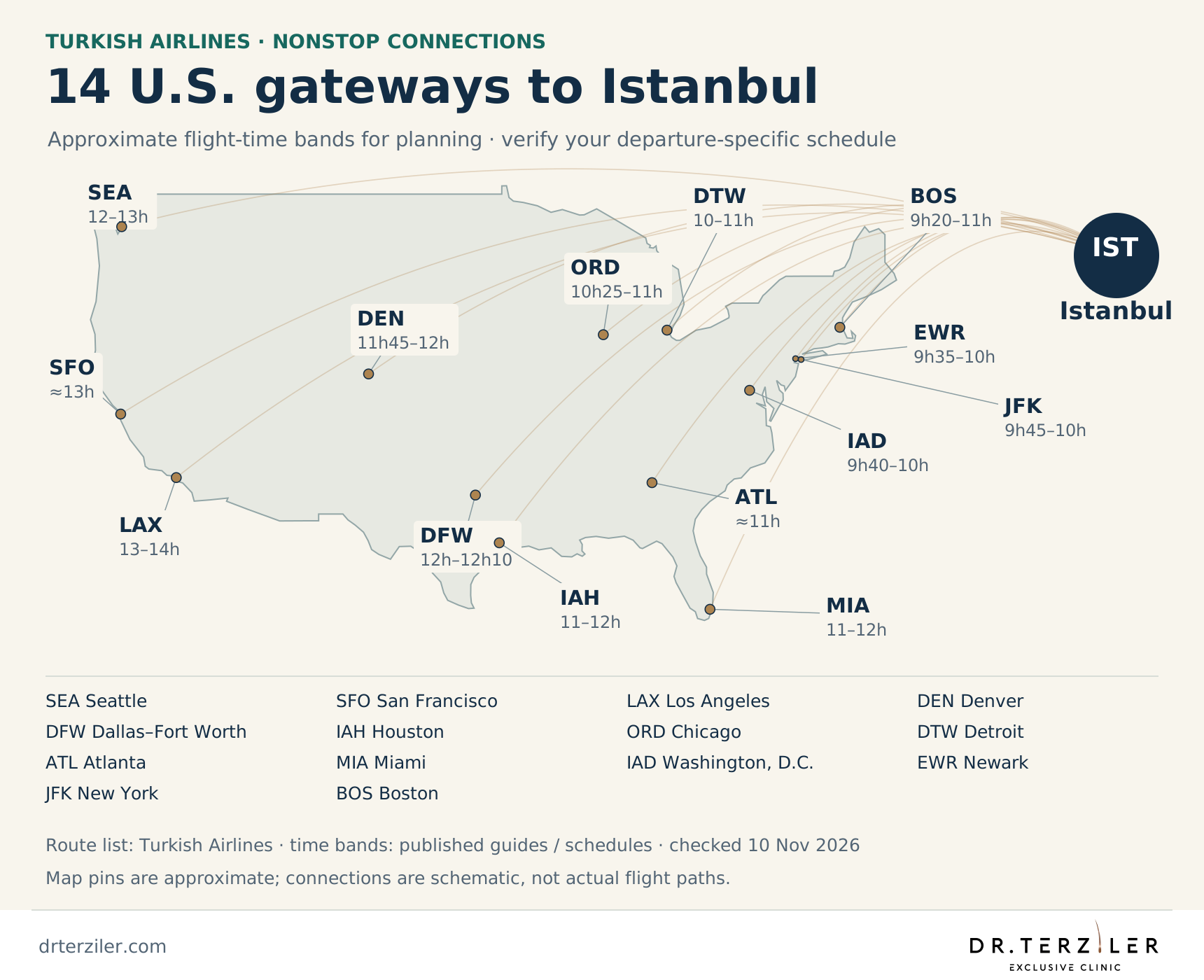
Read the graphic’s context
Verify the exact airport, date, direction and itinerary before booking. Map pins are approximate and connections are schematic, not actual flown paths. Route guides and selected schedule references were used for the time bands.
What does the Istanbul trip look like day by day?
| Day | What happens |
|---|---|
| Day 1 | Arrive at IST. VIP transfer to the hotel. Rest. |
| Day 2 | Morning: Tricho Test, donor mapping and hairline design with the doctor. Afternoon: surgery under local anesthesia plus IV sedation. Most patients rate the pain as low; see does a hair transplant hurt and painless hair transplant with sedation. |
| Day 3 | Check-up and dressing change. |
| Day 4 | First wash, aftercare training, flight clearance, VIP transfer to the airport. |
| Months 1 to 12 | Video check-ups at 1, 3, 6 and 12 months, photo reviews, WhatsApp access. |
Prepare with our pre-op hair transplant guide and the before my surgery checklist.
Time zone tip: Istanbul uses UTC+3 all year. It is 8 hours ahead of New York in winter and 7 hours ahead in summer. Book your video check-ups in your morning; it is afternoon in Istanbul.
Can You Fly Home Right After a Hair Transplant?
Most hair transplant patients can fly home 2 to 3 days after surgery. The often-quoted 10 to 14 day wait comes from CDC travel advice for major surgery, especially chest surgery. A hair transplant is outpatient surgery under local anesthesia. The real risk on a long flight is a blood clot, so walk every 1 to 2 hours, drink water and wear compression socks.
The CDC medical tourism guidance warns that flying after surgery raises the risk of deep vein thrombosis and suggests waiting 10 to 14 days after major procedures. That rule does not translate to a scalp procedure without general anesthesia. Your surgeon should still clear you before you fly. Pack a neck pillow, a loose cap, saline spray and your printed graft record. Do not let the cabin crew stow anything over your head.
Before you book the return flight, read the first 10 days after a hair transplant and the after my surgery guide. Plan the gym and the bedroom too: see when to resume exercise and sexual activity after a hair transplant.
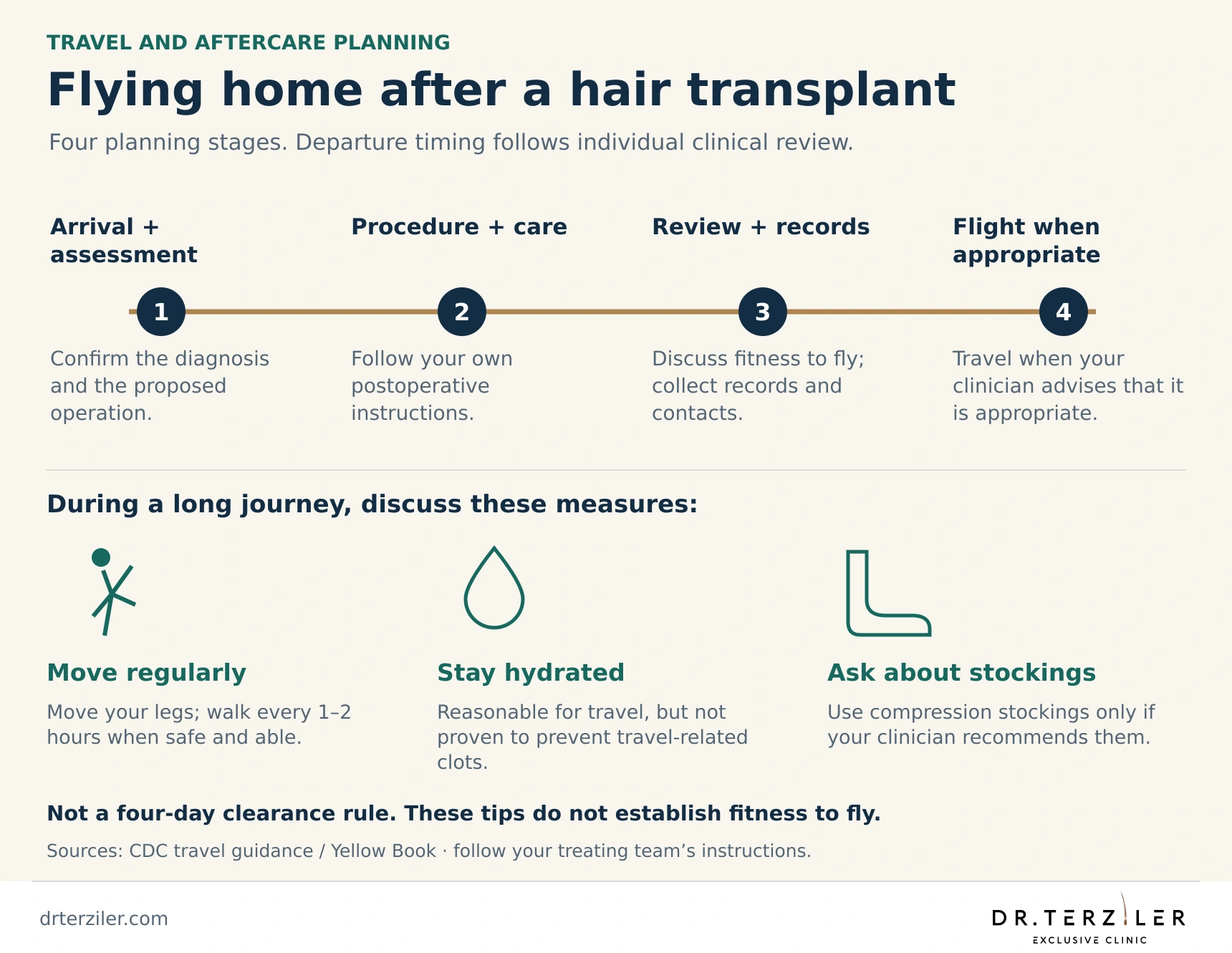
Read the graphic’s context
Move your legs and walk periodically when safe and able. Hydration is reasonable for travel but has not been established as prevention of travel-associated blood clots. Use compression stockings only if your clinician recommends them.
What Happens If Something Goes Wrong After You Return to the US?
Most post-op worries are normal healing, not complications. Shock loss between weeks 2 and 8 is the classic one: transplanted hairs shed while the follicles rest. Dr. Terziler gives every patient a written month-by-month growth timeline so this phase does not cause panic.
| Problem | Who can treat it in the US | Need the surgeon? |
|---|---|---|
| Mild swelling, itching, scabs | Self-care with aftercare kit | No, report on WhatsApp |
| Folliculitis (small pimples) | Primary care or urgent care, topical or oral antibiotics | Usually no |
| Fever over 38.5°C / 101.3°F, spreading redness, pus | Urgent care or ER the same day | Yes, inform the clinic |
| Persistent numbness beyond 3 months | Dermatologist | Yes, video review |
| Poor growth at 12 months | Not a local issue | Yes, guarantee review |
Growth follows a slow calendar: most patients see the final result at 12 to 18 months. See when you see final hair transplant results.
Bring your surgical summary, medication list and graft record home. The CDC advises every medical traveler to carry these, so any US doctor can help quickly.[6]
The hidden cost: what a cheap transplant can cost later
Cheap hair transplants can cost more in the end. ISHRS reports that repairs of black-market hair transplants made up 10 percent of its members’ cases in 2024, up from 6 percent in 2021. A repair in the US often costs more than the original surgery, and burned donor hair cannot be replaced.[1]
If you already had a transplant that did not grow, read hair transplant gone wrong and our guide to revision hair transplant.
So the right question is not “Turkey or USA?”. It is “What is the chance this clinic gets it right the first time, and what happens if it does not?” A written guarantee, a named surgeon and a graft record are your insurance.
How Long Do Turkish Hair Transplants Last?
Turkish hair transplants last as long as one from the US, because the result depends on the donor follicles, not the country. Follicles taken from the back of the scalp resist the hormone DHT, so transplanted hair usually lasts for life. Your native hair can keep thinning, which is why a 10-year plan matters more than a dense first session.
Hairline age rule: a 25-year-old should not get a 19-year-old hairline. We design for how you will look at 45. See hairline design 101 and the best age for a hair transplant.
Donor budget: we record how many grafts remain for a possible second session.
Medical therapy: finasteride and minoxidil can protect native hair. Discuss them with your doctor at home. Our hair loss guide explains the options.
Are transplanted grafts permanent? Read do transplanted grafts ever fall out.
Ten years after a well-planned transplant, most patients keep their transplanted hair. Problems appear when the hairline was set too low or the donor was over-harvested, which is common in rushed, technician-led surgery.
What Do Reddit Users Say About Turkey vs USA Hair Transplants?
Reddit users in r/HairTransplants and r/tressless mostly agree on three points: Turkey wins clearly on price, results depend on who performs the surgery rather than the country, and most bad outcomes they share come from high-volume clinics where technicians do the surgical steps. US surgeons get credit for conservative hairlines and local follow-up.
| What Reddit users repeat | What the evidence says | Where we answer it |
|---|---|---|
| “Turkey is a third of the price.” | True for large sessions; small sessions save little. |
|
| “Clinics do 6 to 10 patients a day with techs.” | Reported by a 2025 Mayo Clinic review for part of the market. |
|
| “If money is no object, go US.” | Choose by surgeon and follow-up, not flag. |
|
| “Who fixes it if it fails?” | ISHRS: 10% of members’ cases are black-market repairs. |
|
| “Turkish hairlines are too low.” | A design choice, not a country trait. |
|
What Do Our US Patients Report?
According to Dr. Terziler Exclusive Clinic data from 142 US patients treated between January 2025 and October 2026, the average US quote patients brought with them was $24,600 for 3,400 grafts. The same patients paid an average of $6,900 in Istanbul including flights, a saving of 72 percent. 91 percent flew home within 4 days.
| US patient metric | Result | Source |
|---|---|---|
| US patients treated (period) | 142 (Jan 2025 to Oct 2026) | CRM |
| Top departure states / cities | New York, California, Texas, Florida | CRM |
| Average graft count | 3,600 | Graft records |
| Average written US quote brought to consultation | $24,600 for 3,400 grafts | Quote Audit uploads |
| Average total paid incl. flight | $6,900 | CRM + patient survey |
| Average nights in Istanbul | 3.4 | Hotel bookings |
| Completed 12-month follow-up | 78% | Follow-up log |
| Graft survival at 12 months (US subgroup) | 97.6% | Follow-up photos, same audit method as the 98.1% audit |
| Would choose Istanbul again | 131 of 142 | Patient survey |
| Biggest worry before the trip | Who performs the surgery (44%); flying home (21%); follow-up after returning (18%) | Patient survey |
Figures are clinic-reported and not peer-reviewed.
Is It Better to Get a Hair Transplant in America or Turkey?
Turkey is better for most healthy adults who need 3,000 or more grafts and can travel for 4 days. The USA is better for small sessions, complex repair cases, or anyone who needs in-person follow-up close to home.
| Choose Turkey if… | Choose the USA if… |
|---|---|
| You need 3,000 or more grafts | You need fewer than about 1,500 grafts |
| Your US quote is above $10,000 | Cost is not the deciding factor |
| You want Robotic DHI or unshaven DHI | You need FUT strip surgery |
| You can take 4 days for the trip | You cannot travel abroad |
| You are healthy with standard pattern hair loss | You have a complex repair or conditions needing in-person monitoring |
| You get a named surgeon, graft proof and a written guarantee | You prefer every follow-up in person |
“Patients ask me Turkey or America. I ask them who will hold the punch, how many patients that surgeon has today, and who answers the phone at month 4. Answer those three and the country picks itself.” Dr. Servet Terziler
Why Do American Patients Choose Dr. Terziler Exclusive Clinic?
| What you get | Detail |
|---|---|
| The inventor of Robotic DHI | Dr. Servet Terziler designed the system and operates with it in Istanbul. |
| A doctor-led boutique model | Maximum 4 patients a day. Doctors: Dr. Servet Terziler, Dr. Kürşat Yalvaç (hair transplant surgeon), Dr. Semra Uludemir (anesthesia). |
| Proof of every graft | Real-time graft counter, printed graft record, surgery video. |
| Measured outcomes | 98.1% graft survival in a 12-month internal audit of 120 patients (clinic-reported); density up to 60 grafts/cm². |
| Safety | AACI accreditation for surgeon and clinic. UV and ozone sterilization. Local anesthesia plus IV sedation. |
| Long-term care | Lifetime donor preservation plan, 12-month remote follow-up, written 2-year guarantee. |
See real results in our before and after gallery and patient case studies, and read about Dr. Servet Terziler.
In the US press: Dr. Terziler’s work has appeared in the Los Angeles Times and the Detroit Free Press. See all press coverage.
Frequently Asked Questions: Hair Transplant Turkey vs USA
Short answers for a quick check. Each one links to the section with the full explanation.
How much is a hair transplant in Turkey vs the United States?
A 4,000-graft hair transplant costs $3,500 to $8,000 all-inclusive in Istanbul and $20,000 to $40,000 in the US for the procedure alone. With a nonstop flight, the Istanbul total is about $4,500 to $9,800. Read more: full cost comparison.
Is it better to get a hair transplant in America or Turkey?
Turkey is better value for sessions above about 3,000 grafts. The US makes sense for small sessions, repairs or patients who need in-person follow-up. In both countries, the surgeon matters more than the location. Read more: the decision table.
Why is a hair transplant so cheap in Turkey?
Lower salaries and rent, package pricing, high volume and government support for health tourism keep prices low. Very low prices can also mean technicians do the surgery, so check who operates. Read more: why Turkey costs less.
How much does 3,000 grafts cost in Turkey compared to the USA?
3,000 grafts cost $3,500 to $8,000 all-inclusive at an accredited Istanbul clinic, compared with $15,000 to $30,000 in the US. Read more: 3,000 grafts breakdown.
How much do 5,000 grafts cost in Turkey vs the USA?
Most Istanbul clinics charge the same package price for 5,000 grafts as for 4,000: about $3,500 to $8,000. In the US, 5,000 grafts cost $25,000 to $50,000. Only a donor assessment can confirm that 5,000 grafts are safe for you. Read more: 5,000 grafts breakdown.
Is a hair transplant in Turkey worth it?
Yes for most patients needing 3,000 or more grafts at an accredited, doctor-led clinic. The saving is usually $10,000 or more. Below about 1,500 grafts the saving is small. Read more: the break-even graft count.
Is a hair transplant in Turkey risky?
The risk depends on the clinic. ISHRS reports black-market clinics in many cities worldwide. Choose a named surgeon, check accreditation, ask for a graft record and avoid prices that look too good. Read more: risks and how to lower them.
How long do Turkish hair transplants last?
Transplanted follicles from the donor zone resist DHT, so results are usually permanent. Native hair can still thin, so plan medical therapy and keep a donor reserve. Read more: long-term planning.
How soon can I fly back to the US after a hair transplant?
Most patients fly home 2 to 3 days after surgery once the surgeon clears them. Walk often, drink water and wear compression socks to lower the blood clot risk. Read more: flying home safely.
Does US insurance, HSA or FSA cover a hair transplant in Turkey?
No. Insurers treat hair transplants as cosmetic, and IRS Publication 502 lists them as non-deductible, so HSA and FSA funds do not apply. Read more: US cost and insurance.
Do Americans go to Turkey for hair transplants?
Yes. Turkey hosted about 1.4 million health tourists in 2023, and hair transplant is its most requested procedure. Nonstop flights from 14 US airports make the trip simple. Read more: flights and the day-by-day trip.
What is Robotic DHI?
Robotic DHI is a hair transplant system invented by Dr. Servet Terziler that automates graft extraction and implantation with controlled depth and angle. It is performed at Dr. Terziler Exclusive Clinic in Istanbul. Read more: Robotic DHI.
What do Reddit users say about Turkey vs USA hair transplants?
Reddit threads usually agree on two points: Turkey wins on price, and results depend on who does the surgery. Most bad stories involve technician-led, high-volume clinics. Read more: the Reddit summary.
What is the ideal age for a hair transplant?
Most surgeons prefer patients over 25 with a stable hair loss pattern. Younger patients can qualify with a conservative hairline and a long-term plan. Read more: the best age for a hair transplant.
Does a hair transplant in Turkey hurt?
The local anesthetic injections sting for a few minutes; after that the surgery is usually painless. Dr. Terziler Exclusive Clinic adds IV sedation. Most patients need only mild painkillers for 2 to 3 days. Read more: does a hair transplant hurt.
Sources
- ISHRS. 2025 Practice Census Results. ishrs.org/2025-practice-census-results/
- Haider SA, et al. The Allures and the Alarms of the Hair Transplant Tourism Industry. Aesthetic Plastic Surgery. 2025;49(17):4745-4753. doi:10.1007/s00266-025-05018-0
- Jin M, et al. Long-hair follicular unit excision enhances the cosmetic results of hairline restoration. Journal of Cosmetic Dermatology. 2024;23(4):1344-1350. doi:10.1111/jocd.16136
- Kwack MH, et al. Comparative Graft Survival Study of Follicular Unit Excision Grafts With or Without Minor Injury. Dermatologic Surgery. 2021;47(5):e191-e194. doi:10.1097/DSS.0000000000002878
- Zhao Y, et al. Premade Incisions vs. Stick and Place. Aesthetic Plastic Surgery. 2025;49(13):3597-3604. doi:10.1007/s00266-025-04871-3
- CDC. Medical Tourism: Travel to Another Country for Medical Care. wwwnc.cdc.gov/travel/page/medical-tourism
- US Department of State. Türkiye Travel Advisory, 28 April 2026. travel.state.gov
- IRS. Publication 502, Medical and Dental Expenses. irs.gov
- Hürriyet Daily News. Health tourism revenues reach $2.3 billion (official 2023 figures), 9 April 2024.
- Turkish Airlines / Detroit Metro Airport. Turkish Airlines launches 13th US gateway, 6 November 2023.
- Republic of Türkiye e-Visa. evisa.gov.tr
- CDC Yellow Book. Deep Vein Thrombosis and Pulmonary Embolism. Travel-risk assessment and preventive measures.
- Republic of Türkiye Ministry of Foreign Affairs. Visa Information for Foreigners. Check passport category and purpose of travel.
- Turkish Airlines. Flights from the United States: nonstop U.S. gateways to Istanbul. Route list checked 10 November 2026.
Get a doctor-reviewed quote in 24 hours
Send 4 photos and, if you have one, your US quote. You get a graft range, technique, package price and the US price for the same session.
Request a review using the clinic’s appointment form. The team can confirm how to share your quote and photographs.
You can also use the appointment form or ask on WhatsApp.
Turkey vs USA Quote Checklist
Keep the five surgeon-role questions, clinic-verification checklist and a blank quote-comparison grid for your consultation.
Ask the team for the consultation checklist.
Compare the written plan
Get the Turkey vs USA Quote Checklist before choosing a clinic.